Rss Feed
Tweeter button
Facebook button

BHS Landscaping Class Gives some TLC to Margie Michael Learning Garden

Brownwood High School’s landscaping class recently worked on the Margie Michael Learning Garden at Woodland Heights Elementary.  The class is led by Mitzi Cockerham, Mrs. Michael’s daughter.

The garden was dedicated to honor the memory of Woodland Heights Elementary teacher Margie Michael on May 12, 2011.

Michael taught for 37 years, 7 of them at Woodland, and was a big part of the original learning gardens at the school.  Upon her sudden passing, coworkers Christy Wilson and Woodland Heights then principal Bob Turner came up with the idea of a memorial garden in her name.  Turner was instrumental in securing a $10,000 grant from the Goodies Corporation that, according to Roberts, made the idea turn into something so much bigger and better.

Pictured above is the Brownwood High School Landscaping class at the garden.  Pictured below, Mitzi Cockerham’s landscaping class works on the Margie Michael Learning Garden at Woodland Heights Elementary.  Photos contributed.

The Art of Gardening without really trying: The “Lazy Gardener’s” oasis still …

The Art of Gardening without really trying: The “Lazy Gardener’s” oasis still growing for the upcoming Highline Garden Tour on June 8th

Garden Tour is June 8

By Rebekah LaSala
Special to the Highline Times

Stephen Lamphear is much more than a lazy gardener, referring to his “Lazy Gardener” column from 1999 to 2007 that he had with the Highline Times. Lamphear was a former Burien City Council member from 1998 to 2000. Lamphear is a spirited combination of a sage zenmaster truly connected to his garden and a man who can turn a black gardening thumb green. Lamphear’s zen-like wisdom and passionate advice can take the fear factor out of gardening for many.

Lamphear’s garden will be featured in the upcoming Highline Garden Tour on June 8th, 2013 from 10 a.m. to 5 p.m. The Tour features private gardens in Burien, Normandy Park, and SeaTac designed to inspire new ideas and the latest techniques. Ed Baldwin, General Manager for the Highline SeaTac Botanical Gardens Center states that at the Center (at 13735 24th Ave S, SeaTac), “We have a lot of irises and summer flowers in prolific bloom this year.”

Lamphear is the original founder of what was then called the Burien Garden Tour in 1996. He passed on the Garden Tour to the Burien Historical Society in 2003. Lamphear created the Highline Botanical Garden Foundation in 1997 to save Elda Behm’s reknowned garden. Through that, the Foundation became the Highline SeaTac Botanical Gardens. The main garden officially opened in 2003. Lamphear was also the first to create the Burien Senior Center Plaza Garden in 2003.

His work has been in numerous publications. He has been featured prominently in “Garden Retreats: Creating an Outdoor Sanctuary” by Barbara Blossom in 2000. Also, Lamphear won a trip for first place garden to London through the 1997 Pacific Gardens Contest, and was published in the 2000 Better Homes Gardens specialty publication, “Garden, Deck Landscaping.”

Lamphear’s gardens feel like a welcome home to an old friend’s house that you love dearly, or a place that you remember in your mind’s eye of what serenity might look like. On each turn, you will see friendly marks of the Buddha at every turn like the smiling cat Buddha, outdoor “rooms”, a Zen style pond and water garden, and other surprises. Take one walk through Lamphear’s backyard, and these gentle plants will pull you in. The Asian influence include Chinese and Japanese plants, but nothing is off limits for Lamphear. He welcomes all kinds of native plants and plants from other places. He says that the “lazy garden” term really comes from the intricate understanding that all plants want to grow. However, he says, they just need loving prodding to develop in their own unique way.

Rather than spend the same big amount of money the same kinds of plants every year, Lamphear says he has often divided his plants in half, used seeds and other ways to intricately build of the plants that were already there. The result is this “lazy” and truly brilliant garden. He says, “My preference is plants. I want them to provide texture, shape and form.” However, Lamphear loves flowers too, but wants them to be interwoven carefully in the soothing interplay of color that is the current theme in his garden, with varying shades of golden yellow. He also features Chinese, Japanese and Tibetan plants like the Chinese Fleece Flower, Japanese Painted Fern and Tibetan Clematis.

Lamphear’s garden includes: rufous hummingbirds, evening and black-headed grosbeaks, song sparrows, wrens, goldfinches, golden-mantled squirrel, merlins and other raptors, red fox, opossums, salamanders and too many raccoons.

Lamphear has deep roots to his gardening and says, “The first gardening I did was when I was about 10. I became a test gardener for a rose company and got FREE roses to track for performance. My first actual garden was in 1981 when I bought my first house in Ballard. It wasn’t much, but I had real dirt.”

Lamphear says, “It wasn’t until I bought this house in 1992 that I got truly bitten by the horticulture bug. I had an apron that read: ‘You can lead a Hor-ti-culture but you can’t make her think’. It was a scream. So, this place is the genesis of my obsession!”
Regarding gardening work ethics, he says, “Instead of watching ESPN, I am in the garden, sometimes several hours a day. It can feel like hours but it is just an hour. ” He explains that he just becomes one with what he is doing. It is a “zen” thing for him. Lamphear says, “Gardeners are the most optimistic people on the planet. Some irises take 20 years to bloom. Who else would wait 20 years for something like that?”

Among some of Lamphear’s richly diverse representation can just be told by their names: “Sky’s of Italy”, “Compton’s Variety”, “Painter’s Palette”, “Chilean Feather Bamboos”, “Jupiter’s Beard”, “Variegatas” and what may be some people’s favorite this summer: The Viagra Lily (Dracunculus Vulgaris). Humor is part of Lamphear’s gardening.

Lamphear knows his plants so intimately that he says he understands when they are getting along or “fighting” and says they are truly his children. He states proudly that he knows every plant’s history and name within his garden.

Lamphear feels gardening is for everyone and states, “Figure out how to focus it. Put the pots together. It’s okay to buy one plant if that’s all you can afford. A limited budget just means more planning.”

Lamphear feels gardening can be very personal and respects different gardening styles. He says, “You can learn a lot from garden tours: including what NOT to do.”

The tickets for the Highline Garden Tour are now on sale and are $15 in advance, with group rates of $12 per person if bought in groups of four or more. They are $18 on the day of the tour, and can be purchased at Wild Birds Unlimited, 15858 1st Avenue S, Burien Bark, 13258 1st Avenue S; and Sterling Bank, 224 SW 152nd – all in Burien. The tickets are also available at 206-241-5786. Some of this year’s sponsors are: Wild Birds Unlimited, The Bean, Rodda and Sons Landscaping, Burien Bark, Grand Central Bakery, and Rain City Sewer and Plumbing and are offering coupons and specials.

DeFranco Landscaping Inc. works to protect Lake George by limiting pollution … – Glens Falls Post

HAGUE — It was Lake George that drew Tony DeFranco back to this northern Warren County town to work for his family’s firm, which has a growing aim to plant landscaping features that protect the lake from pollutants.

DeFranco returned three years ago to work with his father at DeFranco Landscaping Inc. in Hague, the business David DeFranco started in 1984.

The younger DeFranco’s interest in coming back to the area was piqued in part by projects like the West Brook Environmental Initiative in Lake George.

“If something happened to this lake, we wouldn’t have this business,” DeFranco said. “Tourism is what we have here in the Adirondacks, in Lake George.”

The family-owned firm, which has counted all five of the DeFrancos (both parents and three children) as employees at one point or another, has found a niche in northern Warren County — combining landscaping with stormwater and erosion control and property management.

Tony DeFranco, a professional engineer, also does consulting work and has expanded the scope of the business. When his father retires one day, DeFranco will take over the nearly 30-year-old business.

Much of their business comes from owners of seasonal properties, where the DeFrancos put shoreline buffers and rain gardens on the properties that are meant to be another line of defense in filtering pollutants from runoff before it enters the lake.

In the past two years, the firm has put in about 20 rain gardens, mostly at shoreline properties, which are depressions meant to catch runoff from nearby roofs or driveways before it enters the lake in a pollutant-filled stream.

DeFranco crews wrap rocks in fabric and bury them in soil, and then plant native plants in the rain garden.

The gardens are designed to soak up a large amount of liquid. Some of the water is held in the voids between the rocks beneath the soil, and the native plants take on many of the pollutants and nutrients in the water.

Climate change is also starting to change how certain elements are designed and what the rain gardens can accommodate, as weather patterns shift toward more severe but less frequent rain events, DeFranco said.

The rain gardens essentially mimic wetlands, and are all unique based on the property where they’re located.

But the DeFrancos have a mix of clients, including commercial clients, in the area they serve in northern Warren and Essex counties.

The DeFrancos over the years have observed changes in the guidelines of regulatory agencies for site design that’s meant to have a minimal environmental impact, and may be seeking approval from three to five agencies on any given project depending on where it’s located. Those agencies can include the Lake George Park Commission, the Adirondack Park Agency, the state Department of Environmental Conservation, the Army Corps of Engineers, as well as town planning and zoning boards.

“As soon as you trigger one thing, you trigger another, then another,” David DeFranco said.

The layout of lakefront properties has changed in the past few decades, as many homes built in the 1960s and 1970s were as close to the water as possible for the view, and regulatory agencies and environmental groups have since begun emphasizing a larger setback from the water that gives lakefront property owners a more “filtered” view of the water. Stormwater management techniques have also been increasingly horticultural, Tony DeFranco said.

DeFranco brings his engineering background and the ability to decipher regulations, which combine with his father’s scientific and landscaping background, to create a “one-stop design and build process,” DeFranco said.

Some of the DeFrancos’ clients ask for landscaping features like rain gardens on their own, while others are required to have the features on their property for stormwater management, Tony DeFranco said.

DeFranco sees resistance among some clients to planting shoreline vegetation meant to act as a buffer between a structure and the lake, because they’re often concerned it will grow too tall and block their “million-dollar view,” he said.

One of the challenges of working with so many seasonal clients is that DeFranco has some downtime in the winter when he could be doing project designs to install in the spring, but the seasonal residents are on a different schedule — getting to the area in May and wanting to start the process then. DeFranco does a lot of design work at night to accommodate that, he said.

Many of the clients he encounters on Lake George’s north end are interested in educating themselves about sustainable landscaping for their properties that can help reduce runoff, DeFranco said.

“I think people up here realize the value of their home and how they enjoy the lake is tied to what they do to protect it,” DeFranco said.

Editor’s note: This is a regular series focusing on interesting local businesses and the ways they survive, thrive and innovate. Local business owners with stories to tell about their new or established businesses are invited to contact The Post-Star.

EHRLINGER BLOOMS AT BOTANIC GARDEN – U

—
As he sits on a bench at the San Diego Botanic Garden, Dave Ehrlinger points out the succulents, dragon trees and thick-barked cork oaks in the park’s Canary Islands section.

Ehrlinger can tell tales about each plant at one of his favorite spots, providing a lecture that mixes botany, geography, history and culture.

But even the director of horticulture doesn’t pretend he knows everything about every one of the 4,000 kinds of plants over the Botanic Garden’s 37 acres.

“There’s a lot of context that I don’t know, that’s still to be learned, still to be discovered,” he said. “But it’s fascinating.”

Ehrlinger, 65, came to San Diego Botanic Garden (formerly Quail Botanical Gardens) 11 years ago after many years as the director of horticulture at the Cincinnati Zoo Botanical Garden.

He heads a department of seven that oversees and manages the botanic displays. His job encompasses what he calls an “amazing array of stuff,” including landscape design, planning future projects, garden maintenance, working with the gardeners and facilities department, tree and lawn care, procurement and keeping records and updating maps of the entire garden.

On most mornings, he starts a little after 7, driving from his home in Carlsbad before visitors arrive (nearly 200,000 came in 2012).

“I often enjoy mostly the projects that we’re involved in at this time, and what’s coming up next,” he said, noting that the Canary Islands area recently was updated with additional boulders and plants. He’s also recently been involved in planning for the 4½ acres that have been added to the Botanic Garden’s north border, and is pondering changes for the bamboo garden, which houses the nation’s largest collection of bamboo.

The garden is constantly changing yet building on its past. Incorporated into the park are trees and plants that date to the 1950s when the site was a private estate, as well as plants from the time the gardens were opened to the public in the early 1960s.

“We’re working into the context of work that has been done by people that have gone on,” he said. “But in most respects, working with the landscape that was originally done by others, and often done quite well. So it’s fitting (changes) into that existing landscape in an aesthetic manner.”

In a way, it was San Diego that turned Ehrlinger into a horticulturist and brought him to Southern California from Michigan.

At the University of Michigan, he had studied geography. But when he came to San Diego several times to visit a good friend in the late 1960s and early ’70s, the area’s climate and flora intrigued him. It was a whole new world.

“Seeing all this exotic vegetation out here was just really exciting and really got me into plants,” he said.

So he continued his education, earning a degree in landscape horticulture at Michigan State.

“I really got my first impressions of how to do landscaping from the pretty exotic landscape of the San Diego Zoo,” he said of his visits. “I used to go to the San Diego Zoo and Balboa Park three or four times a week, practically, and Torrey Pines State Park. Those were just the iconic places for me.”

Green Fuse: The Work of Dan Pearson

A new Garden Museum exhibition places Dan Pearson’s wide-ranging career in context, writes Ellis Woodman

Register and Subscribe for full access

To gain full UNLIMITED access to bdonline.co.uk
plus much more subscribe here.


In the Garden: Landscaping with prairie beauties

Prairie plants deserve more use in home landscapes. They can transform an “Anywhere, USA” yard into a place that preserves the unique beauty of Nebraska’s plains heritage. And natives play a vital role for pollinators as both habitat and food source. Many of these plants are lovely in their own right, so we’ll give some attention to a few lesser-known beauties. Some may be hard to find at a garden center, but they should be available from local or mail-order nurseries specializing in native plants.

Western sandcherry (Prunus besseyi), The airy, fountainlike habit and gentle, swaying plumage of this shrub bring a peaceful mood to the garden. White flowers in April or May; leaves turn mahogany red in fall; August fruits can be enjoyed in pies, preserves and wine. Works best en masse. Grows 4 to 6 feet high and wide; smaller ‘Pawnee Buttes’ grows to 3 feet high. Prefers full sun and sandy soil with good drainage.

White wild indigo, (Baptisia lactea, B. alba), is perhaps the most architectural of prairie plants, with bundles of smooth, regal stalks that rise up and fan out into elegant stems with velvety foliage. Snow-white flowers on ink-blue spikes in June; black seedpods add winter intrigue. Nice in a border or as a specimen plant. Grows 3 to 4 feet high and 2 feet wide. B. australis blooms azure blue and B. minor stays under 3 feet. Prefers good drainage and full or part sun; tolerates clay and drought.

Fox sedge, (Carex vulpinoidea), has glossy, vivid green foliage that emerges early in spring and persists into late fall. Soft, wispy blades and a fountain form offer refined structure and texture. Deep roots filter water pollutants and improve the soil. Great among flowers and in rain gardens. Grows 1 to 3 feet high and 1 to 2 feet wide in full sun to part shade and tolerates heavy clay. It prefers consistently moist soil but C. brevior is an alternative for drier conditions.

American hazelnut, (Corylus americana). This handsome, adaptable shrub produces edible nuts (two plants required for nut production) encased in a peculiar, ruffled wrapper and relished by birds and other wildlife. Leaves turn orange, yellow and red in fall. Makes an excellent specimen or screen along borders and background plantings. Grows 6 to 8 feet high and wide. Prefers part shade and protection from wind and tolerates sun, drought and clay.

Blue grama, (Bouteloua gracilis), has grey-green foliage that is soft and fine, curling happily beneath eyelash seedheads that shine in the summer sun and remain as winter interest. A shortgrass that serves well as a specimen, en masse or even as a low-input lawn with buffalograss. Grows about 1 foot high. Extremely drought tolerant; needs full sun and dry, well-drained soil.

Dotted gayfeather, (Liatris punctata). Prime time is late summer when this short and stout gayfeather dresses in show-stopper amethyst flower spikes to attract a buzz of butterflies and bees. Pair with complementary blooms like false sunflower for a superb landscape display. Grows 1 to 2 feet high and 1 foot wide in sun and well-drained soil. Extremely drought-tolerant.

Indiangrass, (Sorghastrum nutans). This statuesque grass brings movement and texture into the garden with its attractive, rustling foliage. In late summer, radiant flower plumes rise from towering, golden wands to waltz with the Nebraska wind. Blue-green blades turn yellow in fall. A fantastic back-of-the-border plant or informal screen. Grows 5 feet high and 3 feet wide. Full sun and dry soil keeps it upright.

Shining bluestar, (Amsonia illustris), is a superstar of the plant world, exhibiting soft blue flowers in spring and a perfectly mounded form with clean, willowy foliage that burns a fiery yellow in autumn. They serve as fine companions to bold foliage and flowers and polish off any border. Grows 3 feet high and wide in sun or shade. Tolerates drought but prefers fairly moist soil.

IMPERIAL WHIMS

In this 1890s steel plate engraving of the much-painted and photographed Taj Mahal, F. Frith and Co is acknowledged as its photographic source. Francis Frith was a pre-eminent travel photographer of the time when it was not unusual for lithographs to be based on photographs; it was more unusual, though, for the photographer to be named. However, this clearly was not likely in the case of Francis Frith, by then a well-known name in the world of travel and photography. He was originally a successful grocery shop owner whose fascination for photography coupled with a sharp business acumen soon saw the setting up of F. Frith and Co in 1859, a photographic views publishing company in Reigate, Surrey. In no time, it was producing photographs and stereographs for albums and, soon enough, the picture postcard. Frith made his way to the Holy Land and beyond, producing a copious number of images for the armchair traveller back home. By the end of the 19th century, on a rough estimate, his postcards of distant lands were being sold in as many as 2,000 shops throughout Britain.

Little surprise then that Frith sent photographers from his company to take images of the Taj. The present print (artist and engraver unknown), based on a well-composed photograph taken from the edge of the river bank that makes the monument tower and people in the foreground appear strangely dwarfed, was a useful addition to the growing body of visual and textual information available on the Taj. While in 1783, William Hodges was the first British artist of repute to paint the Taj, over a century before, Francois Bernier had written about its expansive walkways. Thomas Daniell and his nephew, William, had not only painted the Taj but also produced a small book of their prints entitled Views of the Taje Mahal at the City of Agra in Hindoostan, Taken in 1789.

Thus, when George Nathaniel Curzon visited the Taj for the first time in 1887, he had plenty to help him reflect about “the entrancing spectacle, the singular loveliness of it pouring in waves over my soul and flooding my inner consciousness”. In her book on British gardens in India, Flora’s Empire, historian Eugenia Herbert writes at some length on the controversial viceroy’s intervention in the landscaping of the Taj. Interestingly, though Curzon bombarded the Archaeological Survey of India and a whole posse of horticultural experts with views on how the re-designed gardens should look, his diktats did not seem to reflect the views of Capability Brown, the pre-eminent landscape designer of the 18th century, or even those of his own contemporary, landscape diva, Gertrude Jekyll. Like much else in his ‘reign’, Curzon, apparently, relied a lot on his own views of what the Taj gardens should look like. He had, of course, been to India three times before he became its viceroy in 1898, visiting monuments and gardens each time. Though he observed that the Taj was in “perfect condition”, he felt that the gardens needed considerable attention while keeping in mind “to restore nothing that had not already existed, and to put up nothing new”. Herbert observes that though the mausoleum itself escaped Curzon’s designing eye, the gardens were another matter.

The various images of the Taj gardens are most useful in their historical reconstruction and that by the brilliant 19th-century botanical artist, Marianne North, shows dense foliage of trees and flowering shrubs. Curzon wanted none of that and as Herbert observes, “set out to turn the Mughal gardens into an English park” with an orderly line of cypresses and low shrubs; the mausoleum, the pristine jewel in white marble, was to dominate and not be obscured by excessive vegetation. This was clearly a move away from the original landscape and as Herbert perceptively reminds us that for the Mughals “the garden setting was as important a statement as the tomb itself”. She added that historically the gardens were important spaces that often preceded the monuments. At a more formal level, important State visitors were received and entertained in them, poets recited their verses to an appreciative audience seated in comfort amidst perfumed bowers and, at times, armies were encamped in the ample lawns as well. The Mughal garden could be a focus of conviviality, of merriment if not bacchanalia, one where a verdant, somewhat overgrown expanse, nevertheless kept in mind the boundaries of geometric parterres. As late as the 1830s, Fanny Parks wrote appreciatively of the abundance of fruit trees, of bird song and of the rainbow colours of the flower beds.

All this was soon to go as George Nathaniel Curzon set about sanitizing the Taj gardens. While respectful of the detailing basic to the structure of the parterres, “English flowers” were banished in favour of lawns, and mahogany trees and palms, unnecessary obstructions to the vista, were pruned or removed. The viceroy had decided on how those who flocked to the Taj should view it: with little thought to historicity. Curzon mediated a new viewing for the eager tourist. The monument that had occupied such a special place in his heart was to glow in all its ethereal beauty from the minute one entered the 42-acre precincts. There was to be no competition from the gardens, even if this meant felling old trees and bushes that had been chosen and planted with such care by those to whom a garden was a space almost as sacred as the tomb.

The Taj complex occupied Curzon from almost the moment he arrived at Government House in Calcutta. As one of his biographers commented, “Agra . . . knew the fearful joy of five Viceregal inspections in six years”; each visit was followed by precise salvos aimed at the hapless officials of the ASI: the cypresses were too thickly planted; was it not possible to find bigger plants? Garish flowers needed to be removed; there should be more lawns… and so on. Even as he was planning to send Francis Younghusband to Tibet and planning on the Partition of Bengal, Curzon was continuing his interminable barrage of memos to the ASI and working on the Ancient Monuments Bill. As the work on the Taj complex neared completion, J.H. Marshall, who had been appointed its director general in 1902, commented with some bravado that the Taj and its environs could “hardly have looked more effective in the days of the Mogul Emperors than it does now.” There were others too who defended the viceroy’s foray into re-defining the landscape around the Taj: fruit and fragrance trees had been greatly admired — but perhaps Bernier and Tavernier had seen only young growth — and not the tangle of later years, they demurred.

Tall claims indeed which can be judged one way or the other with the copious visual and written material generated on the Taj Mahal over several centuries. A careful study of North’s paintings and the many photographs such as the present image taken prior to 1900 do indeed show rich vegetation and umbrageous trees through which the monument rises. The Curzonites altered much of that, and the contemporary viewer sees the Taj through the eyes of a 19th-century Western imperialist who felt that he could better the Mughal Empire’s aesthetic sensibility. He was not wrong in assuming that it is to the monument to eternal love that people throng from all corners of the world; the environs, he felt, must be kept tidily in place. Yet, one may well ask, was George Nathaniel Curzon justified in modifying for generations to come the context of that “snow-white emanation starting from a bed of cypresses?” Or, for that matter, why, armed as it is with a rich visual history and landscape and horticultural expertise, has independent India not thought of interrogating this supreme colonial intervention and recreated the clearly legitimate vision of yet another imperial power?

Gardens on all sides with room for landscaping

WITH vacant possession this four-bedroom home in Derriford has two garages and driveway parking.

The entrance porch has self-cleaning glass and the reception hall has parquet flooring, a walk-in cloak cupboard housing meters, an attractive staircase to upper floor and a cloakroom with wc.

The sitting/dining room has a wall-mounted slimline remote controlled flame-effect electric fire and French windows to the side and rear.

The open-plan kitchen has an extensive range of fittings, including base units and worktop surfaces, stainless steel sink unit, wall cupboards, integral hob and oven with extractor unit over and Travertine flooring.


Main image for myprint-247

Our heavyweight cards have FREE UV silk coating, FREE next day delivery VAT included. Choose from 1000’s of pre-designed templates or upload your own artwork. Orders dispatched within 24hrs.

Terms:
Visit our site for more products: Business Cards, Compliment Slips, Letterheads, Leaflets, Postcards, Posters much more. All items are free next day delivery. www.myprint-247.co.uk

Contact: 01858 468192

Valid until: Sunday, June 30 2013

The breakfast/utility room has fixed cupboards, radiator, cupboard housing gas-fired combination boiler supplying central heating and domestic hot water, space and plumbing for washing machine and Travertine flooring.

On the first floor is a landing with contemporary staircase feature, linen cupboard and radiator.

The are four bedrooms and a bathroom.

The bathroom has a bath with shower fitting and hot and cold mixer tap, pedestal wash hand basin, wc, low-level suite, wall-mounted towel rail and radiator combined, tiled walls and tiled floor.

Outside the gardens on all sides are mainly laid to lawn but providing an opportunity for further landscaping.

There are also patio areas for al fresco dining.

There are two garages, one with a workshop recess.

The property also benefits from double glazing and gas-fired central heating.

Available through Shobrook Co (01752 663341) for £375,000.

Master Gardeners Brown Bag Lunch Tuesday in Forsyth

Master Gardeners Brown Bag Lunch Tuesday in Forsyth

By: News Release
Posted: Sunday, June 02, 2013

Free Mulch for Greener Yards and Gardens

Mulch pileBy John P Anderson

Address: Miramar Greenery / Landfill – 5180 Convoy Street, San Diego, CA 92111 (Miramar / Kearny Mesa)

Date and Time: Monday – Friday 7 AM to 4 PM, Saturday – Sunday 7 AM to 4:30 PM

Best For: Reducing water usage, increasing plant life, healthier neighborhoods

mulch SanDiego-Sunflower

San Diego Sunflower with mulch.

It’s officially spring on the calendar, although in San Diego the type of weather associated with spring can be found in any month of the year. Spring is known as a time of planting and renewal of life. If you’re adding tomatoes and peppers to your garden or planting shrubs or trees you may find the use of mulch to be a helpful tool to increase your success rate. In San Diego residents can pick up free mulch at the Miramar Greenery (part of the Miramar Landfill).

The Miramar Greenery is open 361 days a year and residents are welcome to 2 cubic yards of 4″ mulch or compost to take home. For an idea of size, 1 cubic yard is equal to the size of six 32-gallon trash cans.

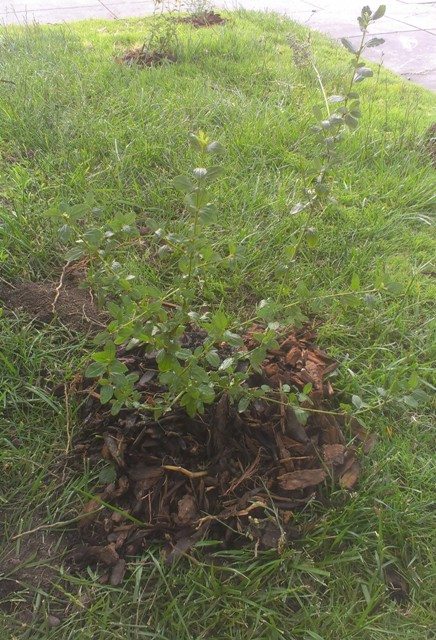
mulch Ceanothus

A Ceanothus with mulch

The mulch is made from 100% recycled yard trimmings and is processed in a composting windrow for 15 days. The Greenery also has other types of mulch, wood chips, and compost available for sale if needed. Before heading out to pick up your mulch give them a call at (858) 492-6100 to confirm availability of product.

Why use mulch?

The Cochise County Extension in Arizona gives the following reasons:

  • Mulching prevents moisture loss, therefore extending periods of watering by days, sometimes even by weeks!
  • By shading the soil, mulches inhibit weed growth. What weeds do get through are easy to pull, and weeding will decrease as time goes by.
  • Keeps soil from splashing onto plant leaves, thereby reducing certain diseases.
  • Matching the right mulch to the type of plant or crop can enhance plant growth.
  • Gravel or rock mulches can prevent rainwater runoff.
  • Best of all, mulches reduce work and adds a finishing touch to the landscape.

Less water, less weeds, less work, healthier plants – does it get any better?

If you prefer to have mulch delivered there are many landscaping and tree trimming companies in town that take requests for free mulch. Most of them require acceptance of a larger amount of mulch (20 cubic yards is the amount I’ve most often seen) and to have access for a large truck to dump the product. A couple of examples of this service include the forestry group and San Diego Tree Care.

mulch Free-camellia-Craigslist

A free Camellia tree from Craigslist.

Another option is to look on Craigslist. I’ve received free fill dirt and many free trees and plants from Craigslist ads in the past and there is always a variety of free plants, dirt, mulch, rock, and other landscaping items in the Free section of San Diego Craigslist.

Happy gardening and here’s to a greener future (literally and figuratively) in San Diego!

Editor: This is from John P Anderson’s weekly column, “SD for Free” at the San Diego Free Press.  John describers his column:

A weekly column dedicated to sharing the best sights and activities in San Diego at the best price – free! We have a great city and you don’t need to break the bank to experience it.