Author Archives:

City receives grant for green space

City receives grant for green space

Published 7:00am Saturday, June 7, 2014

City of Picayune officials accepted $400,000 in Mississippi Transportation Commission grant funding that will help develop the green space on Goodyear Boulevard.

City Manager Jim Luke said an application has also been submitted for an additional $200,000 from the Lower Pearl River Valley Foundation.

“You could do a great bit of work for $600,000,” Luke said.

The MTC grant requires the city to put up $100,000 in matching funds, said Grant Administrator Christy Goss.

There are several plans for the funds, including installing a walking track, decorative lighting and possibly a stage or amphitheater in the green space where the local hospital used to be.

Mayor Ed Pinero Jr., said the funds will help the city get started on some of the ideas they have established, but they continue to seek more funding to make the project a reality as soon as possible.

The city purchased the property in 2013 for $210,000. Another $45,000 was invested to demolish the old hospital building.

Luke said the city received a deal on the property and demolition, estimating the empty lot could be worth as much as a million dollars.

As city leaders pondered what to do with the property, they took into consideration the dangerous nature of the current walking trail on Goodyear Boulevard, which puts pedestrians close to traffic, Luke said.

The problem is not only the traffic on the road, but also the parking spaces in the median that force walkers and runners to dodge parked vehicles.

This situation helped establish the idea to install a walking track at the green space. While the entire project is not funded yet, the approved grant funds from the Mississippi Transportation Commission provide the money to start some of the work, Luke said.

Plans for the area also include a wrought iron fence around the green space, which would not only protect children playing in the area from traffic, but provide regulated entry points special events could utilize to collect entry fees, Luke said.

Benches, litter receptacles and markers denoting the historic nature of the area are also planned.

Since a stage and walking track are planned, Luke feels bathrooms should be constructed on the site. At some point, if Picayune on Stage decides to hold plays there, Luke would like to construct a dressing room actors could use for costume changes.

Even though a public comment period was held recently, the city is still accepting input on what the community would like to see. Comments can be emailed to city hall, or written statements can be dropped off at the display of the plans located at the Intermodal Transportation Center, Luke said.

Landscaping may provide a chance for citizens to purchase memory trees, although the details on that aspect are still in the works.

Goss said the funds will be issued to the city after they complete and submit a memorandum of understanding along with other essential paperwork.

While there are future plans for the site, it also has a rich history, Luke said. In 1922 the first high school football game was played at that location, and before the city was officially named Picayune, the first post office was located there. The site was also a staging area for horse drawn wagons heading to Columbia when the creek was flooded, Luke said. Nearby, in the adjacent lot, stand two oak trees; one is 225 years old, while the other has been around for 175 years, Luke said.

“The mayor, city council and my vision for the green space is to improve the quality of life for our community for years to come,” Luke said in a written statement. “For our children and our children’s children.”

A peek ‘Behind the Garden Gate’: Lilburn Woman’s Club holds inaugural garden …

Part of Fancy Nancys Garden, garden No. 8 off Bainbridge Court, which was featured on the inaugural Lilburn Womans Clubs Behind the Garden Gate garden tour Saturday. (Staff Photo: Deanna Allen)

Part of “Fancy Nancy’s Garden,” garden No. 8 off Bainbridge Court, which was featured on the inaugural Lilburn Woman’s Club’s “Behind the Garden Gate” garden tour Saturday. (Staff Photo: Deanna Allen)

photo

Yvonne Matheny, right, and her daughter, 10-year-old Elyse, check out a mini greenhouse at garden No. 6 off Charlemagne Way on Saturday. This garden was dubbed the “Mad Hatter’s Tea Party.” (Staff Photo: Deanna Allen)

photo

Members of the Lilburn Woman’s Club pose for a photo in front of the art tent where members had created art for sale. (Staff Photo: Deanna Allen)

photo

A peek inside a mini greenhouse at garden No. 6 off Charlemagne Way. This garden was dubbed the “Mad Hatter’s Tea Party.” (Staff Photo: Deanna Allen)

photo

A section of “Fancy Nancy’s Garden” off Bainbridge Court on Saturday. (Staff Photo: Deanna Allen)

photo

Beautiful yellow flowers grow in garden No. 5, dubbed the “Romantic Retreat.” (Staff Photo: Deanna Allen)

photo

A whimsical display in garden No. 8, “Fancy Nancy’s Garden.” (Staff Photo: Deanna Allen)

photo

Succulents grow in a hollowed out tree log in another display inside Fancy Nancy’s Garden off Bainbridge Court. (Staff Photo: Deanna Allen)

photo

Andy Triemer, part of the Lilburn Arts Alliance, paints a scene from garden No. 5, the “Romantic Retreat” off Dunriver Drive on Saturday during the inaugural Lilburn Woman’s Club’s garden tour. (Staff Photo: Deanna Allen)

photo

A vegetable garden planted by Gloria Sill and her grandson Shawn Marshman in the garden dubbed the “Romantic Retreat.” (Staff Photo: Deanna Allen)

LILBURN — It was a first for Lilburn on Saturday as the Lilburn Woman’s Club held its inaugural garden tour, “Behind the Garden Gate.”

The tour featured eight destinations, including seven private gardens and the Lilburn Community Garden.

“We’re declaring it a success,” event co-chair Jane Heyer said after the tour ended. “I think we had a good crowd.”

Elyse Matheny, 10, said her favorite garden was No. 4, dubbed the “Gracious Southern Estate,” on Tom Smith Road. The aspiring gardener helps her mother, Stone Mountain resident Yvonne Matheny, plant flowers.

“I just love gardening and love seeing how people set everything up and hoping to get some good ideas,” Yvonne Matheny said as she perused garden No. 6, the “Mad Hatter’s Tea Party.” She said she had gotten “so many” ideas from the tour. “Just groupings, flower groupings, and yard art, things like that.”

Beverly Carlson of Lawrenceville was meandering through the fifth garden on the tour, dubbed the “Romantic Retreat” on Dunriver Drive, admiring the water features there.

“Just looking at some wonderful landscaping, it inspires you to do something at your own home, so it’s very motivating,” Carlson said, adding she was particularly inspired by the simplistic nature of the gardens on the tour.

“You just think, ‘Oh, I can do this at home.’ That in itself is very inspiring, I think,” Carlson said. “People just taking ordinary backyards and just turning them into something spectacular for their family and friends to enjoy.”

One of the highlights in the Romantic Retreat was a vegetable garden homeowner Gloria Sill planted from seed with her 6-year-old grandson, Shawn Marshman of Duluth.

“I made the labels ahead of time … and he decided where things were going to go and so we planted it wherever he made the decision to go,” Sill said. “Of course, they’re not perfect, but it’s the most beautiful lettuce I’ve ever had, so that’s what love will do for you.”

3rd Annual Woodland Water-Wise Landscape Tour offers money-saving ideas

There isn’t that much heather at the home of Andy and Vivian Walker on Heather Place in Woodland, but their front yard is still a mix of native and exotic plants that pulls in bees and hummingbirds.

The Walker’s residence was one of 10 stops on the City of Woodland’s third free Water-Wise Landscape Tour Saturday, offered to explore attractive, water-efficient landscapes.

“Water-wise landscapes not only reduce water consumption and reduce potential of pollution discharges into the storm water system, they can also beautify a home, lower maintenance, and provide welcome habitat for beneficial insects and birds,” according to Wayne Blanchard, water conservation coordinator for the city’s Public Works Department.

The Walker’s agreed.

Andy, a professor of viticulture at UC Davis, said the front yard of their home on the quiet cul de sac has gone through many iterations over the past decades, but its present mix is both attractive and water smart.

The couple have lived in the home for 24 years, and Andy said there was no definitive plan on how to go about building the yard itself.

“It’s been a lot of work, and I’ll work on it now every couple of months, putting in little bits and pieces,” Walker explained as people started arriving to check out the home.

There were around 100 people who signed up for the tour this year, about the same as in previous years, city officials explained.

“During warm weather months residential customers with traditional lawn landscapes allocate, sometimes unknowingly, about 50 percent of their water use to landscape irrigation,” Blanchard said earlier as a reason for the tour. “A properly designed water-wise landscape can easily cut outdoor water consumption in half during those warm months.”

The Walker’s home was one of 10 sites to be visited. The example landscapes represented a wide variety of settings, approaches and features, including an excellent before-and-after example at 829 Lewis Ave., where owner Sandra Jennings-Jones was able to work around an existing redwood tree and a birch tree grove in this medium-sized front yard.

The landscaping incorporated a dry creek bed to reduce runoff, a flagstone walkway, mounded plantings of drought-tolerant plants, and a seating area for enjoying the results.

Jennings-Jones said, “After installing a water-wise garden, I spend less time maintaining the yard and more time enjoying the view.”

Blanchard said the inspiration for the tour came from residents’ interest in learning first-hand about successful water-wise landscaping in Woodland, including plant selections, designs and landscaping techniques.

Andy Walker, who noted that this was the second time the home was featured, said he loves plants. But he also offered that the “tricky part” was getting the right plants in place that could compliment one another.

He noted that local wildlife seem to enjoy the front yard. There is a constant stream of bees and hummingbirds, seeking out pollen and nectar from the different species of plants.

The homes were selected over the past year by a city intern, who does code enforcement work to make sure people are not overwatering their yards. If the intern spots a “water-wise” home, an invitation will be made to be part of an upcoming tour.

Blanchard said the program is expected to continue.

“We plan on offering this series again in 2015,” he said earlier. “The workshop has been well received the last three years and allows those on the verge of doing this sort of transformation an opportunity to study issues in more depth.”

The self-guided tour continued until early afternoon, and demonstrated how homeowners often removed existing plant material, prepared the sites, addressed challenges and set up irrigation systems.

Homeowners volunteers with Yolo County Master Gardener Program served as tour guides.

Landscaping for Heaven or Hell on Earth

What kind of landscaping embodies the love and stewardship that are expressions of a spiritual way of life? Native and edible. Native, because it honors creation and is the foundation of the food web, feeding the pollinators, birds and other creatures that deliver essential ecosystem services for people and planetary health. Edible, because it makes food for people. Native and edible landscapes are steps toward heaven on Earth, providing sustenance for people and wildlife while acknowledging the awesome complexity of life and how everything is connected.

What kind of landscaping adorns most homes and places of worship? Ornamental non-native landscaping that feeds neither people nor wildlife, landscaping that is typically water and chemical intensive, depleting fresh water supplies to little purpose, contaminating soil and water with petro-chemical fertilizers and pesticides, and contributing to oceanic dead zones. Ornamental non-native landscaping is short-sighted and, however unintentionally, models the ignorance and hubris that are killing life on our planet.

It is time to recognize the wrongdoing at the heart of ornamental non-native landscaping and to make amends. It is time for people to extend the love and respect they show for one another to the land that surrounds their homes and places of worship.

Landscaping native is integral to caring for creation. Native plants require no soil amendments, fertilizers or pesticides and, once established, use a minimal amount of supplemental water. Furthermore, native plants are habitat. Without native plants, 9 out of 10 species of leaf-eating insects die. Butterflies, for example, because caterpillars are leaf-eaters. Caterpillars are the main food of baby birds, and birds provide ecosystem services such as watershed protection, reforestation and natural pest control, which are essential for us.

It is our sacred duty to protect and support creation, not destroy it through the vanity of the superficial, misguided aesthetics of ornamental non-native landscaping.

Since 1970, bird populations in the United States have dropped 60-90% primarily due to loss of habitat. The precipitous decrease in birds is emblematic of the decline in species across the Earth. The extinction rate is now 1,000 times faster than the normal background extinction rate.

Every home and place of worship should be an ark to help save creation, an ark of native plants through which people may re-establish native habitat throughout their communities. With much of the land in the United States devoted to urban and suburban uses, imagine the support of biodiversity that could occur. Imagine the pollinators, birds and other creatures that would find refuge and benefit our edible gardens. When orchards and fruit and vegetable gardens have native plants nearby, yield increases due to the many different kinds of pollinators supported by the native plants.

Native and edible landscaping is a way to care for one’s community and the miracle of life. It is a way to counter the food desert that large parts of our urban and suburban areas have become, both for people and wildlife. It is a way to model the mindfulness, respect and right action needed to help heal our beautiful struggling biosphere. It is a way to practice the deeply spiritual understanding that all of life is connected. It’s also a way to rebel against the conceit that we can kill life on Earth while preserving our own souls.

Society has gained consciousness in so many other areas, making strides against the evils of racism, poverty and the lack of educational opportunity, but that consciousness has still, for the most part, not extended to how we landscape. We have a duty as a society to strive to create utopia on Earth, and many of our religious institutions have been at the forefront of support for civil rights and economic justice. That utopian ideal must extend to care of the Earth itself. There is no better place to start than where we live, worship and pray.

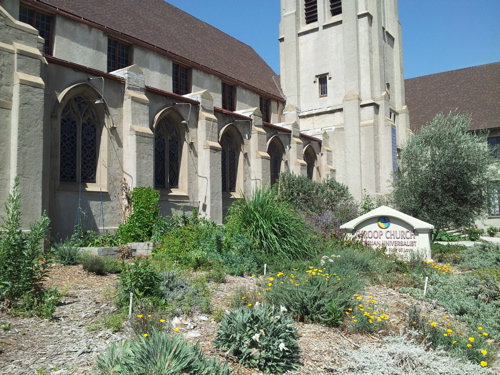
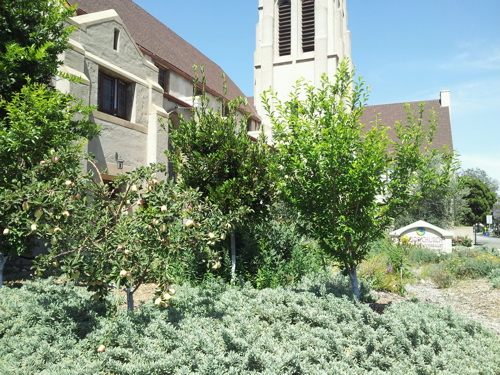
A few years ago in Pasadena, California, Throop Unitarian Universalist Church converted its lawn to a primarily native and edible garden, modeling food production for people and wildlife and support of biodiversity and ecosystem health. We should all emulate this beautiful, affirming act of reverence for life.

2014-06-06-ThroopChurch.jpg

2014-06-06-ThroopChurch2.jpg

2014-06-06-Throopsign.jpg
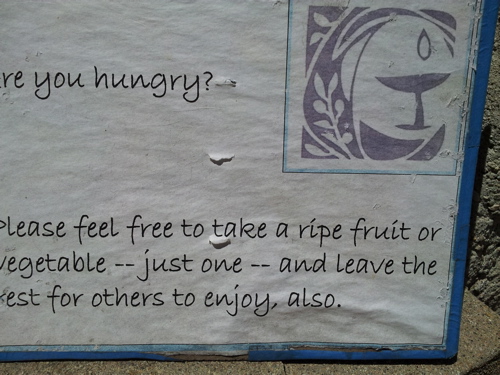
Sign at Throop Church: “Are you hungry?”

The views expressed are solely those of the author and not necessarily of the Theodore Payne Foundation.

Barrington Country Garden Faire worth the trip

Visitors accustomed to wandering around spacious estates at the Barrington Country Garden Antique Faire might hesitate this year when they pull up in front of a classic foursquare house not far from downtown Barrington.

But the garden that John Staab, a landscape architect with The Brickman Group, has created behind the home and a neighboring bungalow are worth the trip.

If you go

What: 14th Annual Barrington Country Garden Antique Faire

When: 10 a.m. to 4 p.m., Friday, June 13, and Saturday, June 14

Where: Buses leave from 800 Hart Road, Barrington

Tickets: $45 through Sunday, June 8, $55 later and at the door. Serious shoppers can buy tickets to enter as early as 8:30 a.m. on Friday, June 13, for $80.

Etc.: Two estates and an in-town garden are open for touring. Visitors can purchase antiques and other treasures and lunch and attend home and garden workshops and musical performances.

Information and purchase: (847) 381-7367 or URL destination=”http://www.handsofhopeonline.org/”handsofhopeonline.org

Benefits: Hands of Hope, which gives impoverished communities around the world sustainable tools to improve their lives and those of their children.

And ticket holders yearning for the wide open spaces, gracious landscaping and peacefulness that only five acres or more can bring will still be able to tour two Barrington Hills estates as part of the faire, Friday and Saturday, June 13-14. In addition, all the fun shopping is still part of the event, including treasures volunteers have collected all year and sell at bargain prices.

In the village, highlights of the formal garden behind the foursquare house include a hot tub and an elegant stone staircase. But when the family that owns it purchased the house next door to use as a guest cottage, Staab and the homeowners decided to join the two areas and make the most of the second space available for active sports — including an ice rink in winter.

“We want to show that in-town landscaping can be dramatic and strong as well as practical,” Staab said.

Savvy garden visitors will notice the circle theme in the garden. It starts with the new entrance between the two houses — a circular path under the arched pergola that is much better than before when the choice was to enter through the house or the garage. Immediately ahead the fountain crafted from a Victorian urn and the aquatic plants it waters also sit on a circle of pavers.

But the elegant stone steps from the rear of the foursquare down to the yard — Staab’s answer to the yard’s previous slope — really highlight the “round” theme.

This area, which includes a circular terrace or landing with a large planter partway down, is almost like an amphitheater and makes great seating for the youth group from the family’s church, said the homeowner.

“The circle is a strong shape that helps link the home with the landscape,” he said.

This part of the garden enjoys a hot tub where bathers can even watch movies on the screen that pulls down from the rear of the garage.

A stone wall beside the steps holds alpine plants — various sedums, lambs ear, catmint and cotoneaster shrubs.

Off to the side, three sections of concrete sewer pipe stained to resemble aged copper sit vertically to form a raised vegetable garden.

“It’s raised for interest and to keep critters out and it’s easier to reach in and garden or harvest without stepping on and compacting the soils,” Staab said.

The family of Disney World fans also points out that the large circle and two smaller ones make a “hidden Mickey Mouse.”

Behind the vegetables, espaliered pear trees stretch along the fence. The fire pit and surrounding sitting area are on the opposite side at the bottom of the steps.

Some day wisteria, hydrangea and clematis will flower from the four pergolas in the garden.

Full disclosure: It’s no secret that the winter was brutal, and at press time the gardens were still under construction. Staab and the homeowner had not made final selections for some items, such as the floral display in the main planter. But the landscape architect promised all would be ready and beautiful for the faire.

Here’s a secret Staab was delighted to discover: The older magnolia in the new part of the yard blooms yellow in the spring, a rare treat for people accustomed to pink and white blossoms. And at the rear of that yard are two impressive oaks, including one that is a naturally occurring hybrid of two varieties.

Bad news: Due to the devastation of emerald ash borer, Brickman had to remove about 15 ash trees from the two yards, including one that was a great specimen in the original garden.

Also on the tour are two Barrington Hills estates. The first is where the faire always headquarters with shops, gardens, entertainment and workshops. Regular visitors know that every year there’s something new here.

The prairie-style home on the second estate was designed by E. Fay Jones, a student of Frank Lloyd Wright. Jones is most famous for Thorncrown Chapel in Eureka Springs, Ark. Check out the massive stone chimneys for the four hearths!

The landscaping uses the same stones as the house, and the hilly terrain probably accounts for many of the charming walls throughout the site.

This gives the free-form swimming pool, hot tub and outdoor kitchen — set lower than the house — a tall stone wall complete with splashing waterfall that creates a remarkable sense of privacy and relaxation.

Up above the pool, a patio runs the whole side of the house.

The wooded gardens around the house present all kinds of perennials, shrubs and ground covers. These include roses, peonies, daisies, daffodils, astilbes, hostas, hydrangeas, pachysandras, bleeding hearts, Lenten roses and hakone grasses.

Extra features include the winding lane through the woods approaching the home, and behind the house a tall grass prairie planted with wildflowers and a small orchard.

The privacy, setting and perennial gardens attracted the homeowners to the property, and they would like to credit Abbott Tree Care Professionals of Wayne for helping to keep it up.

Landscaping contest prompts showy designs, no shortage of opinions

What better way to make a grand splash along U.S. 278 than to encourage developments to compete for the entrance with the highest visual impact from the road?

And who better to judge than the members of the Island Beautification Association, experienced gardeners all?

The association is an offshoot of the Island Beautification Committee that was formed in 1972 to beautify the then two-lane highway. Its mission is to improve the overall aesthetics of the island’s public areas.

The association’s eight members meet once a month under the chairmanship of Steve Tennant, who has been a member since 1985. Also on the committee are Doris Lindner, Helene Gruber, Tom Kurtz, Suzy Baldwin, Carol Totti, George Westerfield and me. Our meetings begin with reports from Alice Derain, contracts and service administrator, and representatives from Hilton Head Landscape, Southern Palmetto, Valley Crest and Ocean Woods.

After their reports, we hit the roads to clean up litter spilled from trash trucks. We are responsible for the newly planted medians, as well as the pruning of well-established shrubs and trees.

Two weeks ago, we piled into a large van and rated the community’s entrance plantings for our annual contest. We used a point system; points were awarded for design, plant material used, texture and harmony. Do you think for one moment that you can easily get eight men and women to agree that, say, purple and yellow look great together?

Palmetto Hall may be off the beaten track, but it’s a plantation entrance. They always have something interesting going on. Carol said the planting reminded her of an English garden, but Tom thought it didn’t jump out at us. Steve thought the marigolds, petunias and geraniums were good mixers.

Helene thought Hilton Head Plantation to be very colorful, and Suzy gave the hydrangeas high marks. There was lots to see at Indigo Run — too much for the eye to take in, according to Steve — and Helene thought the design lacked unity. Doris thought it was impressive from the road, but overall it was deemed very neat.

At Windmill Harbour, the visual impact was deemed low. Suzy thought there was good color harmony, but commented that too much red always dies. At Long Cove Club, Steve commented on how well it was maintained. They had plants in sun colors, but not enough variety, Tom thought. Mostly, everyone liked the plant choices. It was the first time many of us had seen white sunpatiens.

Sea Pines is judged by its first garden in a series of gardens. The red and white geraniums looked great in the spring, but there wasn’t much variety, and Carol thought there was no rhythm. George pointed out that they should trim the flax lily.

Shipyard Plantation featured red and purple flowers, pentas and coleus. Tom said there was not enough variety. Palmetto Dunes Resort also had red and purple, with the added texture of evergreens. It came off looking good, I thought. But there is also yellow hibiscus and pentas, and Carol thought the colors didn’t blend.

On our first look at Port Royal Plantation, we all noted there was a lot to see. George said even with one eye closed, this garden would be tremendous. The orange hibiscus is a standout, and we all liked the way the designer had layered the plants.

On our way to lunch, where we would count up the points and choose the winner, we passed Shelter Cove Harbor and its garden entrance. We all agreed it had huge impact. Too bad it wasn’t a contestant.

The spaghetti at Carpaccio’s was delicious, and ultimately we deemed Port Royal Plantation the winner.

Congratulations go to the the plantation show garden designers; they are winners all. Thanks to their expertise in making a show — their talent in using new and old plant varieties in unusual ways to show them off — getting stalled in traffic is easier on us all.

Sixty-year master gardener and environmentalist Betsy Jukofsky has spent three decades on Hilton Head Island learning the peculiarities of Coastal Lowcountry gardening.

Related content

Gardening parties offer free food samples and healthy cooking tips

If you want to taste locally, grown food and learn about gardening then you should head out to “Reaping the Harvest”.

The Red River Coalition of Community Gardeners is celebrating its fifth year of volunteer contributions to the health and well-being of our regional community.

You can participate in the celebration between 2 p.m. and 5 p.m. Sunday, June 15 at several gardens throughout Shreveport.

There will be family activities, food sampling, nutrition tips and cooking demonstrations.

The three featured community gardens participating in the event are:

  • Northwest Louisiana Interfaith Pharmacy Garden, 909 Olive St., Shreveport. Visitors will sample “Party Soup” made with seasonal vegetables and learn about growing vegetables in containers.  Located between Line and Fairfield.
  • Highland Community Garden, 520 Herndon St., Shreveport. “Confetti Salad” will be featured, along with information about using earthworms to make compost for your garden. Located across from Noel Methodist Church at the corner of Herndon and Stephens.
  • Valencia Park Community Garden, 1800 Viking Dr., Shreveport. Delicious carrot cake will be shared, along with a garden “treasure hunt”.  1800 Viking Dr. next to Caddo Magnet High School.

For more information, contact the Red River Coalition of Community Gardeners at (318) 278-3081.

IT’S THE WEEKEND: Grow It – June gardening tips from National Garden Gift …

IT’S THE WEEKEND: Grow It – June gardening tips from National Garden Gift Vouchers

JUNE is a lovely month to be in the garden. With the evenings getting longer and brighter and the longest day of the year on June 21, the extra light and warmth encourages the garden to put on a burst of growth.

And that includes the lawn, so if you feel like give Dad a day off from mowing to celebrate Father’s Day (June 15) then here are a couple of mowing do’s and don’ts: mow once a week in the summer, don’t mow when grass is wet or during a drought, and raise the mower blades when mowing in very hot weather.

Other plants that are growing upwards and outwards this month are roses. They are a great addition to any garden environment, large or small, contemporary or traditional with varieties for planting in flower beds, borders and planters.

Blue Peter gardener, Chris Collins thinks no garden is complete without a rose or two.

“I suppose the choice of a rose as my favourite may be considered an obvious one when gardeners talk about plants – but the English garden is incomplete without one or possibly many,” he said.

“When I started my apprenticeship with the parks, the hours spent in the rose garden is where I first connected with plants in a professional capacity.

“However, my real love of them came much later when I began to import David Austin Roses into Japan whilst working there. These plants really just give and give and with the minimum fuss.”

There is a rose for every garden situation from Hybrid Teas to miniatures, climbers to floribundas. Roses can be used for all aspects of the garden, from cladding walls and pergolas to providing informal barriers and rambling roses can be used to cover old stumps and unsightly fences or walls.

If you want to find out the best rose for your own garden requirements then go to www.roselocator.co.uk, a searchable database of roses and stockists.

Roses can also be grown in pots – so ask your local garden centre or nursery about the best variety to get and they can give you planting advice and tips on caring for container roses as part of the nationwide “It Starts with a Pot” campaign running through the summer to encourage everyone to give gardening a go.

It’s a busy time in the garden with many tasks to occupy any gardener – so here’s a list of the top jobs for this month from the Royal Horticultural Society and National Garden Gift Vouchers:

1. Hoe borders regularly to keep down weeds

2. Be water-wise, especially in drought-affected areas

3. Pinch out sideshoots on tomatoes

4. Harvest lettuce, radish, other salads and early potatoes

5. Position summer hanging baskets and containers outside

6. Cut lawns at least once a week

7. Plant out summer bedding

8. Stake tall or floppy plants

9. Prune many spring-flowering shrubs

10. Shade greenhouses to keep them cool and prevent scorch

Showbiz news
  • Jamie Oliver: I want to do less

  • Hynde: I won’t play my old hits

  • Lucas: Ford asked for screen death

  • McFadden gets fit for dating game

  • Neeson has no bum note for Theron

  • Mary Berry awarded freedom of Bath

Gardening Tips: Water at the right time and deep

Matthew Stevens

Matthew Stevens


Posted: Friday, June 6, 2014 11:48 am

Gardening Tips: Water at the right time and deep


0 comments

It is amazing to me sometimes how quickly things can change in the gardening world. Back in April, we were all complaining about how wet the garden was and how the rain we’d had up to that point had delayed a lot of our planting and yard work. Now, nearly two months later, the weather has gotten warmer and the rain has slowed down and the hottest, driest part of the year is looming. While we are certainly not in any immediate danger of facing the kind of drought that we had in 2007 and 2008, I have started to hear more and more people mumbling things like: “We sure could use a bit of rain.”

Subscription Required


An online service is needed to view this article in its entirety.


You need an online service to view this article in its entirety.

Have an online subscription?


Login Now

Need an online subscription?


Subscribe

Login

Or, use your
linked account:


Login Now

Need an online subscription?


Subscribe

Login

Or, use your
linked account:

on

Friday, June 6, 2014 11:48 am.

Garden Tips: Herbicides can curl leaves too

This is the time of year that weeds get our attention. As soon as warm weather hits, they seem to be everywhere. Then out come herbicides (weed control chemicals) aimed at killing these unwanted pesky plants in our lawns, landscapes and gardens. Unfortunately, not using these chemicals properly can injure or kill desirable plants.

Symptoms of herbicide injury vary depending on the chemical, but common culprits are the growth regulator-type herbicides used to kill broadleaf weeds, such as dandelions, in lawns. Exposure can cause leaf cupping, twisted or distorted growth, and strap-like leaves. The common growth regulator herbicides found in home garden products for lawns are 2, 4-D, MCPA, MCPP and dicamba.

These products are available in liquid or dry form. However, because of the wind, it is easy for spray to drift away from the target area. Therefore, these sprays should only be applied when there is no wind.

In our region, where it is frequently windy, this is difficult. The potential for drift can also be reduced by using large spray droplets instead of a fine mist, and applying the spray as close to the ground as possible.

The other application choice is a dry form, but desirable plants can still be damaged because of uptake of chemicals through the roots. The labels of products containing dicamba indicate that it should not be used “in the root zone of desirable plants.”

If you have trees in or adjacent to your lawn, it is almost impossible to avoid applying the chemical in the root zone. Tree root systems can extend as far as a tree is tall and even further. Garden plants situated next to a treated area could also become damaged via root uptake.

Plants can also be exposed to herbicides when grass clippings from recently treated lawns are used as mulch in the garden. Check product labels for how long you must wait before using the clippings. If you place treated clippings in a compost pile, it is best to compost them for several months before using it in the garden.

Other ways to reduce the chance of herbicide injury in the yard and garden include:

w Avoid applying herbicides in late spring and summer. They can vaporize during warm (above 80 degrees) weather and float in the air, settling down on plants a long way from the point of application and causing damage. If you plan to use liquid or dry herbicides, do it when the weather is cool in early spring or fall.

— If you have a few weeds in the lawn, spot treat them individually or dig them out. A weed popper tool works great for this.

— In landscape beds, apply a 3- to 4-inch layer of bark mulch to discourage weeds.

— In and around the vegetable and flower garden beds, use shallow cultivation or pull the weeds. I like a stirrup-type hoe with an oscillating head. Cultivate frequently to get the weeds when they are small. It is much easier.

— Marianne C. Ophardt is a horticulturist for Washington State University Benton County Extension.