Author Archives:

The Eco-Unfriendly Appeal of a Lush Green Lawn

What does your shrubbery say about you?

It may seem like a silly question, but newly published research suggests people infer things about homeowners by looking at their lawns and gardens. And for eco-minded policymakers who are encouraging residents of the American Southwest to opt for drought-resistant landscaping, that’s a problem.

The results of three experiments “suggest that the elements used in residential landscaping have broad symbolic and self-presentational significance,” a research team led by University of Iowa psychologist Rebecca Neel writes in the Journal of Environmental Psychology.

Specifically, lush green lawns dotted with trees and shrubs confer an aura of high social status on a household, among other positive implications. The researchers believe this association may make people hesitant to opt for natural landscapes requiring low water usage.

“When the decision maker chose high-water-use landscaping, they were seen as higher in status, sexual attractiveness, family orientation” and even religiosity.

The first experiment featured 171 students from a large university in the Southwestern U.S. Participants read a short vignette about a man, woman, or couple who moved into a home with either “typical desert landscaping with cacti and other plants,” or one with “typical grass landscaping with trees and shrubs.”

They were told that the homes were “quite similar,” so the only real decision the new homeowner had to make was the type of landscaping. They then rated the person or couple on a variety of characteristics.

“When the decision maker chose high-water-use landscaping,” the researchers write, “they were seen as higher in status, sexual attractiveness, family orientation” and even religiosity. All in all, such people were seen as higher in status as their counterparts with the low-water landscaping.

A second study, featuring 376 university students, added another variable to the mix. Participants read the same scenario and made the same evaluations, but some were told the homes were in a middle-class neighborhood, while others read that they were in a working-class or upper-class area.

Across the board, those choosing traditional landscapes were similarly judged as higher in status.

A final study was conducted online, via Amazon’s Mechanical Turk. Fifty-three people from California, Utah, Nevada, Arizona, New Mexico, and Texas completed a survey in which they reported which type of landscaping they would choose “if they were trying to convey a specific trait.” Traits included conscientiousness, environmentalism, family orientation, political ideology, masculinity, femininity, religiousness, and youthfulness.

Confirming the results of the first two experiments, “high-water landscapes were selected to communicate higher social status, a more positive general impression, family orientation, political conservatism, femininity, religiousness, youthfulness, agreeableness, extraversion and prosociality,” the researchers write. The low-water option did convey one positive quality (the expected one): environmentalism.

It all suggests that “self-presentational considerations may thus constitute a barrier to the adoption of low-water-use landscapes,” the researchers conclude.

With much of the Western U.S. suffering from a long-term drought, encouraging water conservation is a vital public policy goal; this research provides valuable evidence of one major obstacle toward achieving it. For low-water landscaping to really catch on, it may be necessary to change public perceptions, so that the choice signals affluence and importance.

Is it time for high-end nurseries to start selling designer cacti?

Garden Tips: Growing orchids is easy

Several weeks ago, I was in a big box store and noticed that the gorgeous orchids for sale were flying off the shelves while the traditional pretty potted Easter lilies were sitting there. I suspect that many of these orchids were destined to be gifts for someone special.

The owners of gifted orchids are often orchid novices. They are faced with the dilemma of what to do with a beautiful orchid after it stops flowering. Orchids have the reputation of being hot house plants that need to be pampered. In fact, many types of orchids are easy to grow, and novice owners can save their gifts from an untimely demise with just a little knowledge.

While some orchids are fussy about temperature and light, the ones typically sold in big box and grocery stores are Phalaenopsis orchids. Phalaenopsis orchids, also known as moth orchids, are considered low light orchids and can be grown easily in the home. However, “low light” is a relative term. They still need a good amount of light and will do best in an east-facing window. You can also situate them in a southern- or western-facing window, but they will need the protection of a sheer curtain to block them from direct sunlight.

The Phalaenopsis orchids do not need the warm temperatures of a greenhouse. The temperatures that keep us happy indoors will keep them happy too.

When it comes to potting mix and watering, Phalaenopsis orchids, as well as other orchids, are a bit finicky. Orchid growers each have their preferred mixes. Generally, the mixes should drain quickly but also retain some water for good root growth. Orchid potting mix ingredients may include fir bark, tree fern, sphagnum moss, perlite, lava rock and other materials.

Many of the mass market Phalaenopsis orchids come planted in potting mixes that consist mostly of fir bark. It fits the requirements of being fast draining while holding some moisture, but bark-based mixes tend to break down with time. As fir bark gradually decomposes, it becomes a finer and finer texture.

The broken down bark holds more moisture and nutrients, but also does not allow the roots to get as much air as needed. That is when you need to repeat . Local orchid experts tell me that most orchids planted in fir bark will need to be repotted at least every two years. If you don’t, the roots will start to rot and the plant will die.

I have six miniature orchids sitting on the sill of my east-facing kitchen window. Because orchids like some humidity, I have them sitting on a bed of moist pebbles in window-box trays. Occasionally, one of my orchids bloom, providing me with a great reward in return for little effort.

— Marianne C. Ophardt is a horticulturist for Washington State University Benton County Extension.

Fine Living: Head beyond the garden gate in Rosss

IF YOU’RE a fan of Beyond the Garden Gate, the popular garden tour of great Ross gardens on Mother’s Day weekend, make sure you go this year — there won’t be another until 2016.

“We are trying to pace our volunteer efforts over a two-year budget,” says Erica Hunt, chairwoman of the May 10 tour that benefits Ross School’s fine arts program. “Ross is a very small community with 800 homes, and finding homeowners who are gracious enough to open up their gardens to us should be easier on a biannual cycle.”

To tempt you, she and her team have assembled a roster of four gorgeous landscapes distinguished by their A-list creators — Janelle Hobart, Brandon Tyson and Michael Yandle.

“Visitors will enjoy a variety of gardens that offer not only beauty and elegance, but also incorporate practicality ranging from an edible garden for family dinners to smart use of natural resources through recycling rainwater and catching irrigation run-off,” she says.

Here’s a preview of each garden:

• “Magnificent Mediterranean” is a hillside landscape on a grand scale, designed by Michael Yandle of Michael B. Yandle Landscape Architecture.

Its stunning components include a beautiful entrance fountain, magnolias and live oaks, white azaleas, climbing roses and clematis, rose-planted terraces, stately cypress and palm trees.

The pool and pool house have spectacular views of Mount Tam, and it has a potager and a grape arbor over a dining area defined by limestone columns along with an outdoor fireplace.

The garden also includes a tropical waterfall and a stone-edged pond.

• “Japonesque on the Hill” is a garden inspired by the owner’s love of the Japanese Tea Garden in Golden Gate Park and designed by Sonoma County-based designer Brandon Tyson.

It honors the tradition of Japanese design without the precise adherence to its strict principles.

The centerpiece is a moon bridge that crosses a pond, bordered by carefully selected boulders, lending sound and movement to the garden.

A path meanders through the garden full of various trees and plants that celebrate the Japanese influence on gardening. Japanese maples, weeping cherries, conifers and cypress give the garden dimension and color in shades of greens, reds, gray-greens and purples. Smaller plants introduce black leaves, spiked bunches and lime-colored mounds.

• “Sunny Respite” is a productive garden designed by Janell Hobart of Denler Hobart Gardens that marries edibles with ornamentals.

A large oak shades the remnants of an old Japanese garden with mature camellias, azaleas and rhododendrons in one area. More shade comes from valley oaks and redwood trees. White crabapple trees border the pool terrace, behind it is a garden filled with roses and foxglove for summer color and at its end is a small orchard of apple, peach, and pear trees nestle.

Behind the pool house is the vegetable and cutting garden composed of raspberries and blackberries, espaliered apples and pears, and masses of blueberry bushes.

Tuteurs and obelisks decorate the raised boxes that are filled with rotating summer and winter vegetables, flowers, and bulbs.

• “Family Frolic,” a second garden on the tour created by Hobart graces the sloping site of a brown-shingled home. Its several layers have been created for family fun.

There are daffodils, tulips and flowering trees that bloom in spring, and roses, hydrangeas, foxglove, anemones for summer color.

An old stone retaining wall borders the lawn that leads to a new terraced flower garden with each bed of roses and peonies centered by a pyramid tuteur.

Another flight of stone steps leads to the family playground with trampoline and swings and where two antique fountains offer a charming bath for birds and support for the climbing clematis.

PJ Bremier writes on home, garden, design and entertaining topics every Saturday and also on her blog at DesignSwirl.co. She may be contacted at P.O. Box 412, Kentfield, CA 94914, or at pj@pjbremier.com.

if you go

What: Beyond the Garden Gate garden tour
When: 9 a.m. to 3 p.m. May 10
Where: Ross School and Common Park, 9 Lagunitas Road, Ross
Admission: $40, $50 at door
Information: rossgardentour.org
More: Shuttles leave to tour headquarters at College of Marin’s Lot No. 15 on Kent Avenue every 15 minutes from 8:30 a.m. to 1:30 p.m.; optional boxed lunch costs $10, pre-ordering recommended

When planning a garden, do your homework

As a veteran nurseryman who appreciates how gardens affect real estate values, I’m pleased to be a part of this new section. Horticulture is my primary passion, and I’m our third generation to run our family business. Over the years I’ve composed articles for local newspapers, nursery industry publications, Yankee Magazine, and others, and I enjoy giving presentations to groups who want to learn more about using plants effectively. I’m hoping you will find my comments interesting and relevant and, of course, that they add to your enjoyment of the plantings around your home or workplace.

This column will soon be answering your questions about plants and garden design, and I await your inquiries. Gardening should be fun and rewarding. I’ll show practical and economical ways, even for “non-green-thumbers,” to simplify what may seem overly complicated. To start, a few universal fundamentals apply whenever we use plants, trees, and shrubs in the landscape. Once these elements are addressed, the steps that follow become a lot easier to accomplish.

Continue reading below

First, discuss and describe in detail the effect you’re trying to create and how you will want to use the space you’re improving. What is the purpose you seek to achieve: an appealing view from the street, framing a pleasing vista or screening an undesirable one, an attractive entry to your home, play space for children, an outdoor-dining room, a particular garden (herb, vegetable, orchard, etc.)? Fully defining the function you desire for your design will help simplify your choice of plants.

Next, it’s critical to understand how the trees, shrubs, and plants you are using will change as they grow. So many gardens that look beautiful that first year or two soon become overcrowded and in need of revision because how different the plants become as they mature was not considered in the design. Understanding this needn’t be time-consuming or expensive. Lots of information is readily available at your local garden center, from specialists like landscape designers and architects, in publications, and on the Internet. Before investing in your plantings, be sure to do your homework by taking the time to ask questions about your choices and consider alternatives.

Last, and possibly most important for the continuing health of your plantings, be sure your soil and locations are suitable for growing the plants you’re choosing. Few plants are adapted to thrive in all soils or exposures; most have particular preferences for best performance. It is unwise to expect a tree that enjoys humusy soil to do well in a sandy, dry location, or a shade-loving shrub to prosper in a hot, sunny area. Many disappointing results can be traced to root systems being ineffectively nourished by soils that are not properly prepared. When you visit your local garden center, describe your site and ask the experts for their advice; most offer kits for basic soil testing. More detailed recommendations are available by sending samples to the Soil and Plant Tissue Testing Laboratory at the University of Massachusetts Amherst for professional analysis.

A Wild and Playful Portland Garden


As Cynthia Woodyard likes to tell the story, she “married” her garden. 

The affair began in 1972, when she moved with her then-husband into a ’20s-era Arts Crafts bricker in Sylvan Heights, built with a picturesque flair by an English contractor and his Scottish wife. Woodyard liked the lot: it had five sides, none of them parallel. 


Early flirtations included an herb garden, and then some vegetables. The relationship evolved. Woodyard put up a fence and, with her father and brothers, rebuilt a tattered greenhouse once occupied by a giant lilac. She tried her hand at perennials and, one day, put some out in a garage sale. Buyers snapped them up. Within a couple of years, Woodyard had lines down the block from her garage for an annual sale of hostas, astors, irises, and campanulas. 

She and her husband divorced in 1988. Her horticultural soul mate became a passport.

“[The garden] was my freedom,” Woodyard says, recalling how she once made $11,000 from one three-day sale. Her talent with perennials earned her landscape design jobs with Portland’s elite families and funded travel abroad to learn more. The lessons, in turn, took root at home in her own three-quarter-acre phantasmagoria. 


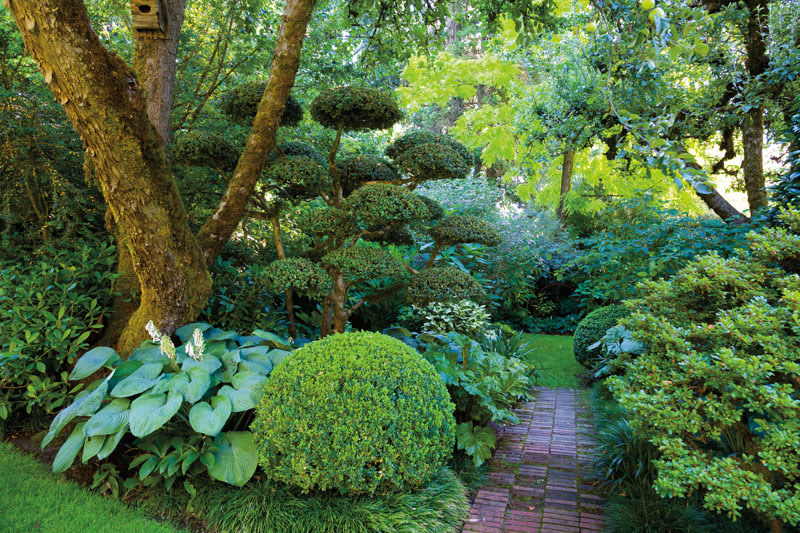
No xeriscaping here. Think English Victorian meets early Walt Disney; Edward Scissorhands snipping a topiary bubble bath to a French pop beat. Woodyard is fearless, freely mingling the sturdiest hardy plants with delicate exotics. (Many spend winter in a heated garage.) The density of her contrasts—spiky and soft, espaliered, climbing, and upright, green upon green upon green—attests to plenty of long mornings and evenings with the soaker hose. “Any real gardener only hand-waters,” she says. “You get to know the plant, what it needs, what’s eating it.” 

“The textures, the shapes, the juxtaposition of formal and informal plants—not everyone can do that, but she sure can,” says esteemed local landscape architect and garden historian Wallace K. Huntington. “Cynthia can grow hostas like no one in the slug belt. There’s not a chewed leaf. And she handles boxwood better than anyone I’ve ever seen. She uses it so imaginatively that there isn’t any longer a memory of ancient pictorial gardens.”

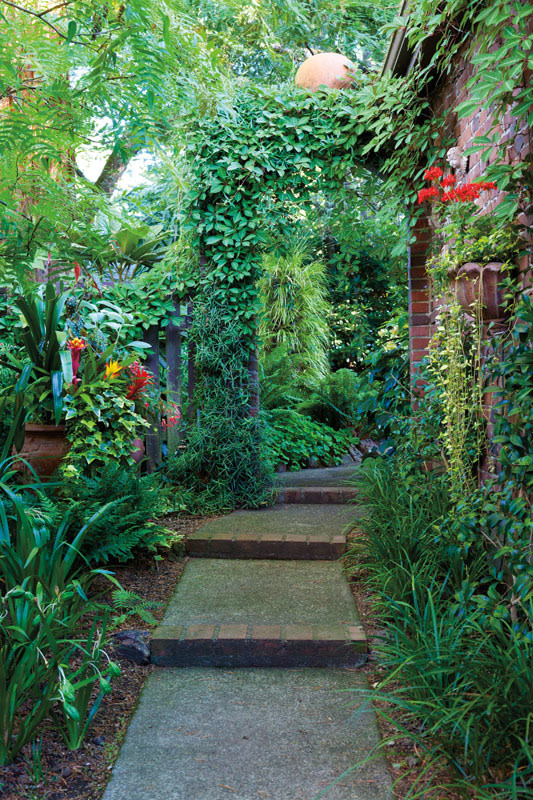
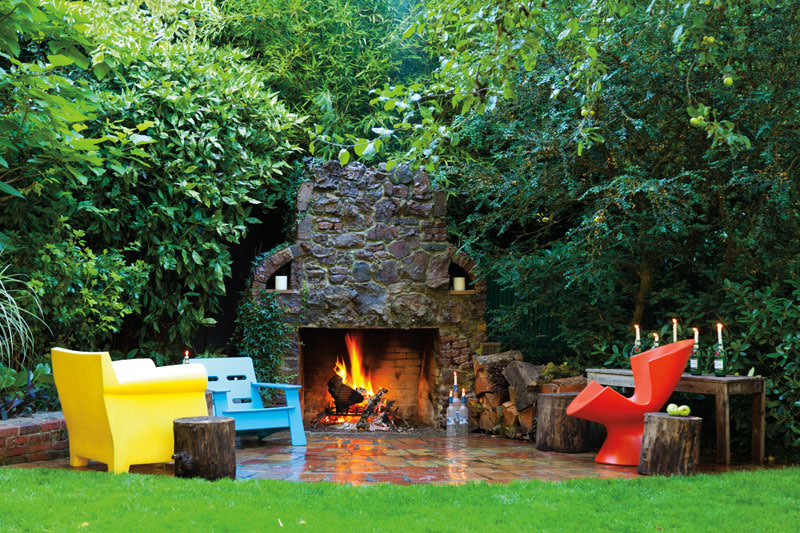
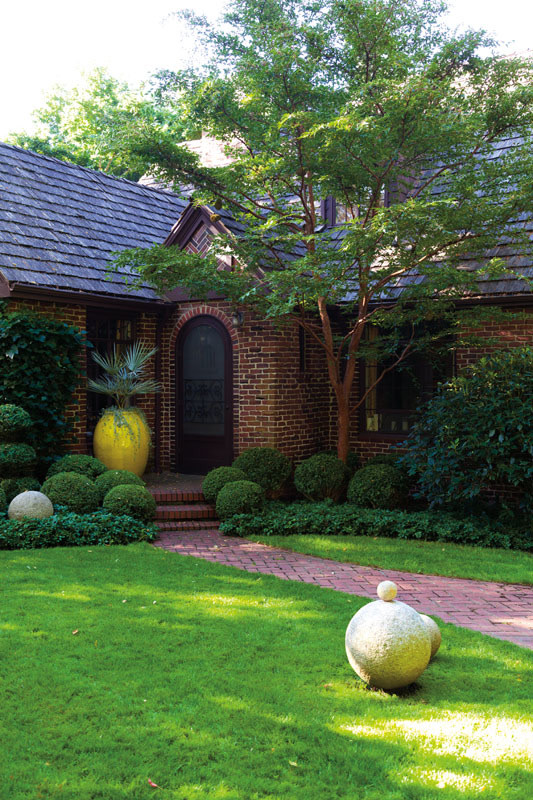
And then there is her humor. Woodyard likes balls: boxwood orbs rising against the blooms like pom-poms, drifting through the green like glass floats, or clustering around a granite globe like it was the cue ball on a crowded pool table. Against the bending mortar lines of her brick outdoor fireplace, Woodyard prefers brightly colored Philippe Starck chairs and, on her porch, a classic Marilyn lip-shaped love seat. The curving paths through the garden’s pentagonal shape make the three-quarter acre feel infinite—getting lost in Woodyard’s garden fantasy is easy. There is nothing quite like it in Portland.


Small wonder. Woodyard’s early self-taught mastery soon took her around the world, forging connections with some of its greatest gardeners and allowing her to broaden her repertoire far beyond the Pacific Northwest’s usual palette of rhodies and roses. A 1980s Sunset magazine article on her garden earned an invitation from the editor to do a “process story” on dividing perennials. So she picked up a camera for the first time and quickly learned that her natural flair with plants translated to pictures, and in turn, photography assignments from Horticulture, Better Homes Gardens, and Organic Gardening, among others. She’s contributed to a shelf of books: The Complete Kitchen Garden, The Garden in Autumn, Gardening with Ground Cover and Vines, Annuals, The Inviting Garden, and Secret Gardens: Revealed by Their Owners (the last two featuring Woodyard’s own garden) written by or featuring gardens by a generation of master gardeners now past, from Princess Greta Sturdza to prolific English garden designer Rosemary Verey. Woodyard gleaned lessons about both horticulture and life. (Verey, she says, “taught me how to drink.”) She also brought back plants from her travels: “Back then,” she recalls, “you could still smuggle.”


Now 71, Woodyard’s most recent influence evolved out of her 13-year mentorship of Francisco Puentes, whom she first met on the crew of one of her contractors. Now 32 and a sculpture major at Portland State University, Puentes recalls how his first encounters with Woodyard and her garden opened up a world. “I could just tell that I could progress in the realm of plants,” he says. “I felt a strong desire.” He quickly became her right hand in tending the garden—today, the two gardeners finish each other’s sentences. “I can prune, but not like him,” Woodyard says. “He has good ideas. The design is going more and more his way. It is simplifying.” 

Puentes has also expanded the garden’s giddy freedom. Using welded-wire cages, mesh, soil, and ornamental grasses, he invented what he simply calls “columns” that stand like a family of odd sentries at the gate. His tiny lighted “nests,” spun out of sisal, hang like glowing cocoons in the trees. 

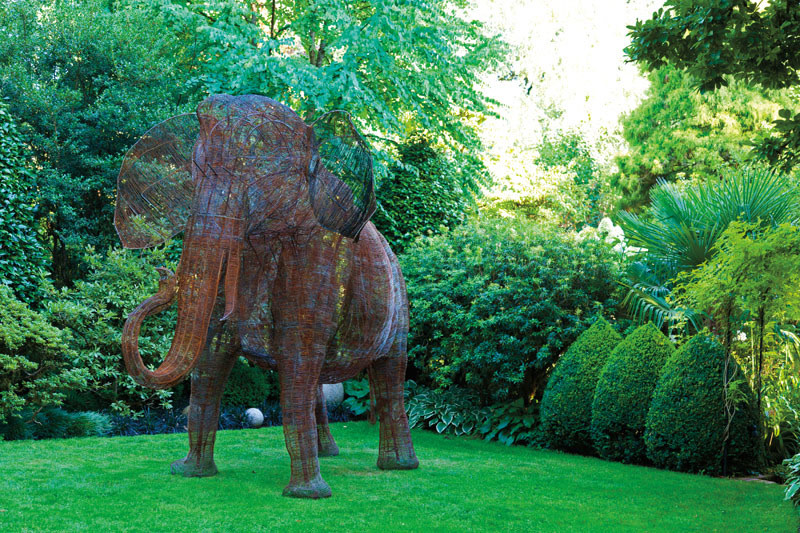
Working every evening for nearly a year, Puentes wrapped a woven steel armature with wire to create a life-size elephant. Knees seemingly cocked to launch into a dance—or maybe a charge—the rusted-red giant has the visual strength of a basket but the dynamism of a fast line-drawing. The inspiration? He recalls his first trip to the Oregon Zoo and the instant affinity he, as a fellow immigrant, felt toward the elephants. Puentes is now at work on “a baby,” he says. “Maybe one day a whole family.”

Woodyard’s mentor Verey, who edited the 1994 book Secret Gardens: Revealed by Their Owners, titled the chapter on Woodyard’s garden “A Paradise From Many Lands.” Yet, in it, Woodyard muses less on her global reach than her love of boundaries and the garden’s daily drama of plants, insects, and weather. “Here was a little piece of land,” she says. “Season after season. Nature. Working is what happens. It’s been a long experiment, you have to admit, in one place.”

woodyard’s plant picks


1. Mood Indigo, Agapanthus inapertus: “Hardy, sexy, dangling.”

2. Veitch’s Blue, Echinops ritro: “It’s dependable, blue, and bees love it. Stands on its own and is fairly drought tolerant.”

3. Fire Lily, Clivia miniata: “Not hardy, but easy to keep over the winter—very sturdy green leaves, good bloomer, floriferous and orange, red seed pods.”

4. Francisco Puentes tiny lighted “nests,” spun out of sisal, hang like glowing cocoons in the trees. 

5. Nymansay, Eucryphia x nymansensis: “A small, woody tree with a dogwood-like flower.”

6. Kangaroo Paw, Anigozanthos: “Totally tropical. Reminds me of Australia.”

7. The Swan, Hydrangea paniculata: “Very unusual, big pure-white flowers, yet loose white flower heads. Very sturdy. Nothing eats it.”


Sounding Off: Plano readers tell us what issues they think the City Council …

RAISE YOUR VOICE: Share your own opinion online at dallasnews.com/sendletters. Sign up for Sounding Off or submit a guest column (and include your full name and contact information) by visiting dallasnews.com/voices.

Early voting for the May 10 general election began Monday. What issues concern you the most? If your city is not holding elections, what initiatives, if any, would you like to see your City Council take on this year?

Jerry Frankel, Plano: As a longtime Plano resident, there are several areas where our community does not provide vital services. In Plano, we have thousands of residents who lack access to health care because they are under- or uninsured. Many suffer in silence, eventually forced by severe illness to go to the ER late in their illness. Plano is a wealthy community, and nothing is more important than one’s health.

Besides establishing primary clinics throughout Plano, elected officials need to discuss with county commissioners how to re-establish hospital services for the uninsured as it was done before selling off the county hospital. There are several affordable options to provide these services besides building a public hospital. Related to public health, the air we breathe is polluted by a cement factory south of Dallas. Elected officials need to exert their authority as the responsible party for a healthy environment and urge the EPA and the state to clean the air we breathe by taking appropriate action against polluters and, if necessary, sue the major polluters of our land, water and air.

Charles Raper, Plano: My fear for the future of our nation is the loss of constitutional government and the laws which protect it. Another concern is the overt attacks by the administration on Christianity, the religion which has been the root of our form of government. I think Plano is a well-managed city, but I think we should go to single-member districting to get more people involved in the management and reduce the cost of running for city positions.

Carol MacDonald, Plano: My current pet peeve is drivers sitting in the right lane but not turning right. Especially during rush hour at Plano Parkway and Preston Road. Because there is no designated right turn only lane, it can take several cycles to make a simple right turn because one car is holding up six cars wanting to turn right. Perhaps there are other such intersections needing new lane designations?

Something the City Council needs to address soon is the deplorable condition of many of the aging community walls along our major thoroughfares. Back where I grew up outside of Texas, ownership of property extended from curb to back line and driveway to driveway. But not in Texas. Our homeowners associations are supposed to take care of the walls and landscaping facing the streets outside the walls. Evidently landscaping remains HOA responsibility, but walls are city responsibility. It’s quite clear that some walls are being ignored by both and those walls need to be identified and repaired. Perhaps a team of vigilante digital photographers can help document the worst areas. Park, Parker, Independence, Coit, Custer and Alma come to mind, but there are other areas as well.

Bob Jackson, Plano: We are very fortunate to have City Council members who study the issues from all angles before making any decisions with how our tax money is spent. For this we should all be very grateful. I’ve lived here for almost 40 years now and can truly say that for the most part, during those 40 years we have elected citizens who take their job very seriously and represent themselves in a very responsible manner. I really do not have any suggestions or ideas at this time. I truly do appreciate the time, efforts, and commitments that these men and women serve our community in representing our needs and making our city such a desirable place to live.

Ted Gold, Plano: The three most important issues to address both a locally and statewide: water, water and water. Nothing else to say.

Don Proeschel, Plano: I would first like to focus on what is right with Plano, having lived most of my last 34 years in Collin County and Plano. The changes in our population size — from 72,000 to 270,000 — and the addition of a number of world-class companies since 1980 have been wonderful to observe. We have an excellent public school system, low crime and numerous well-maintained libraries, parks and trails.

With the city nearly completely built out for constructing new residences, I believe our focus needs to be on continuing to attract new jobs and businesses to Plano, maintaining our infrastructure (roads, bridges and utility lines), eliminating decay in our older homes and apartments, and continuing to implement the county’s open space plans by building and repairing hike and bike trails.

Let’s energize our community even more to help repair and clean up aging residences. Recently, the Love Where You Live projects, involving more than 300 residents, many churches, businesses and city staff working together, was a terrific success, with potential for even greater impact. Finally, we need to determine how we can best serve the needs of our increasingly diverse population in our schools, places of worship and businesses.

Arnell L. Engstrom, Plano: In this time of serious drought and severely low lake reservoir levels, I would like to see Plano more vigorously pursue lawn sprinkler violations because, if truth be told, they seems a bit lax currently. And do it even if that means more money spent on enforcement monitoring.

I would also like to see Plano set up an annual or semiannual community-wide garage sale at one of their recreation centers the way Dallas does at the Campbell Green Recreation Center.

We want your feedback

The Dallas Morning News is always exploring new ways to serve our audience, and you can help. Sign up to join the DFW Opinions Matter Advisory Panel. If you’re selected, you could earn exclusive gifts and special offers. If you are curious about how people get their news in a digital age, you’ll enjoy offering feedback on our products and services, often before they are available to the public. Your input could make a difference. http://d-news.co/vZzt

Your landscape can be greatest show on earth

Color is the candy of life. Without splashes of color, our world would become tasteless and much of the sensory enjoyment we derive from our surroundings would cease. Colors season our world with delicious excitement and beauty, both indoors and outdoors.

That is why it is so important to consider the many shades and hues of plants, trees and even outdoor furnishings when planning our yards. Making sure that, as much as possible, there are ever-changing splashes of color outside our homes during each season and also ensuring that those colors complement each other is key to making a splash with our landscapes.

Get Your Summer On

For five Sundays, the Home Garden section will feature great ideas to get your outdoor space in shape. Here’s the lineup:

May 4: Many shades of color

May 11: Room to grow food

May 18: Fire up the grill

May 25: The right equipment

June 1: What homeowners want and need

Hard to believe, but summer will arrive. (We promise!) That means it’s time for our backyard makeover contest.

For the third year, Daily Herald readers submitted photos with essays telling us why they needed to get their patios and yards in shape as part of our “Get Your Summer On” series and contest.

The responses this year had a, well, they had a desperate tone to them. After being cooped up for the last several months because of the winter that would never end, we know how much you want to spend some time outdoors. And you need an attractive backyard to do that.

A panel of experts selected 15 backyards, which will be featured for the next five weeks in Home Garden, along with transformation ideas from our contest sponsors to fit various tastes and budgets. All 15 of the finalists will receive a $50 gift certificate from Northwest Metalcraft.

In the end, four winners will receive backyard improvement packages ranging in value from $1,000 to $5,000 each, consisting of donations from a variety of our sponsors. The winning entries will be featured June 15. Check online for more photos and ideas from our contest sponsors — everything from patio furniture and grills to outdoor lighting, patios and landscaping. Go to dailyherald.com/summer.

Check each week to see if your yard was selected. Even if your yard wasn’t picked this year, we know you will get lots of ideas on how to spruce up your outdoor living space.

In addition, make sure to check out our Food section starting on Wednesday for advice and tips on how to give that grill of yours a workout.

Our five-week grilling university offers recipes and advice on cooking everything from burgers to pizza to grilled side dishes, as well as tips on the drinks to serve your guests.

Hey, the weather is finally warming up. It’s time to get your summer on!

Jean Bragdon, operations manager at Lurvey’s Garden Center, 2550 E. Dempster St., Des Plaines advocates the use of evergreens and colorful perennials in garden beds, interspersed with annuals, which bloom from spring to fall.

“Bright, bold colors, like tangerine, purple and bright greens, are hot this year. They are more popular than pastels right now,” she said. “But you can do whatever you want and we also suggest planting bulbs that will come up early in the spring and using colorful garden art like gazing balls and bird baths to make a yard look instantly bright and cheery.”

Bragdon also loves to see portable gardening containers of various sizes, filled with annuals and set out on decks, porches and patios.

“They enhance what you have and make your landscape instantly look alive. Buy a pre-made hanging basket and cut the wires off if you want to use what someone else already put together, or pick the flowers and put them together yourself. We usually say that you want a thriller (a tall, upright plant), a spiller (a plant that cascades over the side) and a colorful filler.”

Colorful resin Adirondack-style chairs, as well as deep-seating sectionals and other seating with colorful cushions, also add splashes of color to local yards. The Adirondack chairs, which are comfortable without cushions and come in more than 15 different colors, are particularly popular around fire pits and along front porches, according to Dan Mayer, owner of Northwest Metalcraft, 413 S. Arlington Heights Road, Arlington Heights.

“We are also seeing a trend toward more lounging furniture. People are still dining outside, but they also want to sit out there and kick back and relax in their free time on round or L-shaped sectionals and while the wicker or aluminum frames are still mostly brown, black, gray or beige, the cushions being chosen are generally colorful,” Mayer explained.

“People are entertaining more at home so they don’t have to drive anyplace and they want their yards to look nice. They want to live the whole outdoor lifestyle, even in this climate. It really adds to their living space. So, it is amazing how much money people are putting into their outsides these days,” he added.

Colorful free-standing umbrellas that swivel 360 degrees and come in different shapes are also dotting yards around the area. Most people today seem to choose solids instead of patterns, stripes or florals, according to Mayer, and the umbrellas are so large that they cover much more furniture than the smaller ones we remember from yesteryear.

“But this isn’t Florida, so you don’t see as many homeowners choosing bright colors as you would find down there. Most people in this area are still pretty conservative. They try to have their umbrellas blend in, using beiges and browns. But you do see primary colors every now and then,” Mayer acknowledged.

Those gorgeous colors should not just fade away when the sun goes down, however.

If you choose your exterior lighting carefully, those beautiful colors in your gardens and on your patios and decks can continue to enhance your home after dark, according to Thomas Reindl Jr., commercial lighting manager for NorthWest Lighting and Accents at 600 E. Rand Road, Mount Prospect and at 2414 W. Route 120, McHenry.

There is much more to selecting landscape lighting than just going to the store and buying something that looks nice, Reindl said. You need to have a professional who understands the intricacies of lighting consult each fixture’s specifications to see where it falls on the color rendering index in order to correctly light up your landscape’s unique attributes.

On a scale of 1-100 percent, you want the lights you choose to fall in the mid-80s to 90s if you want the lights to correctly illuminate your home and landscaping. Unfortunately, those ratings do not appear on the boxes of most outdoor lights. They can only be found in the fine print of the online specifications or by making a phone call to customer support for the manufacturer.

Hence, it is important to consult a knowledgeable professional before you choose either a low-voltage halogen or an LED landscape lighting system.

“Without getting into too much detail, halogen bulbs are very biased toward reds, yellows and oranges and without adding colored lenses to the bulbs, they don’t adequately light up blues, blacks, greens and purples. It is like when you have a hard time telling the difference between navy blue and black when you are standing under an incandescent bulb, but it is easy to tell the difference under a fluorescent bulb,” Reindl explained.

Similarly, he said, LED bulbs are biased toward the blues, greens, purples and blacks. An amber lens needs to be added to an LED bulb if you want it to highlight red flowers, brick or natural stone.

“Red is the hardest color to illuminate with an LED bulb,” Reindl said.

Despite their limitations, Reindl recommends the use of LED bulbs because they last much longer, use less energy and need smaller transformers and less wiring because they are so much more efficient.

“Because of those savings, we can now install an LED system within 10 to 20 percent of the cost of installing a low-voltage halogen system. So, it is starting to make sense for the average homeowner,” he stated. “These systems also lend themselves very well to do-it-yourself projects. You can just plug the transformer into any outdoor outlet and it is easy to run the low voltage wires and since you don’t need as much wiring, you don’t have to spend hours trenching.”

But, Reindl cautions, no matter what you do, do not purchase the inexpensive solar lights that you see in some big box stores. On that 1-100 scale, they average 65 and consequently, they tinge everything blue.

“Anything you light with them just dies under those lights,” he stated.
Week 9 with Neil Sperry: Landscape design starts with an overall idea

Large journeys begin as small steps, and that’s certainly the case with landscape design. Most of us look at a plot of bare ground as a big mass of empty space. The idea of turning it into an appealing garden creation is almost overwhelming.

In reality, designing a landscape is no different than decorating the inside of your house. You start with an overall idea of what you want your décor to look like.

Your next step indoors is to assemble the big pieces of furniture. They become the “bones” of your interior décor, and, until you have them, you really can’t do much other decorating.

Outdoors, the equivalent to those structural elements would be the major shade trees and the anchoring shrubs that form the framework of your basic garden design. Any berms you might add would be included. There might be a few important vines, and you’ll probably end up with a big bed or two of trailing groundcovers.

You’ll also need to include the “hardscape” elements, that is, the important non-living parts of your garden’s designs. Put them in place as early in your planning as you can, because it’s hard to develop the gardens that will surround them until you do.

Once you have those major architectural elements in place, it’s time to start fine-tuning each room individually. That’s when you bring in the secondary pieces of furniture, and outdoors their equivalent would be decorative retaining walls, vines for the patio cover, water gardens, landscaping stones and street lamps.

Once all of the woody plants and major hardscape elements have been stirred into the landscape, it’s time to turn your attention to the finishing touches. You should be thinking about annual and perennial color, hanging baskets, topiary, patio furniture and garden antiques and how they will all fit into the final package.

So you begin with the small spaces, and you start fitting them into the much larger puzzle. People tell you that your landscape should have its own “rooms,” where your family conducts different aspects of its life. You’ll have space for cooking and dining, and you’ll also set aside room for reading and recreational activities. Where you’d have a washer and dryer indoors, you’ll have the toolshed and compost pile outside.

As you walk through your landscape, these rooms will unfold. The bigger the space that you’re landscaping, the larger the number of rooms you’ll be able to accommodate. If you plan things carefully and implement the plans faithfully, they’ll all be comfortable together, but each will have its own distinct personality.

Set out to get the best possible results in each of your outdoor living spaces. Begin with those areas that are nearest your house, since they’ll be the ones that get the most traffic. Finish each one to your own satisfaction before you move on to the next. Before you know it, you will have assembled many individual areas into a lovely landscaping quilt.


Neil Sperry, a McKinney resident, hosts Neil Sperry’s Texas Gardening from 8 to 10 a.m. Sundays on WBAP-AM (820). He is the publisher of Neil Sperry’s GARDENS Magazine. Learn more at neilsperry.com.

Landscaper Charged with Stealing from Uncle’s Croton Garden-Supply Business

Landscaper Charged with Stealing from Uncles Croton Garden-Supply Business

Pictured: Anthony Congello, Jr.

CROTON, N.Y. – The nephew of the owner of a Croton garden-supply store has been charged with a litany of felonies for stealing more than $140,000 from the business, as well as failing to file his New York State personal income taxes.

Westchester County District Attorney Janet DiFiore and New York State Department of Taxation and Finance Commissioner Thomas H. Mattox said Friday that a joint investigation by the Croton-on-Hudson Police, the DA’s Office and the Department of Taxation and Finance, resulted in the arrest of Anthony Congello, Jr., 26, of 10 Pennyfield Ave,, the Bronx.

Congello was charged with one count of second-degree grand larceny; two counts of first-degree identity theft, two counts of second-degree criminal possession of a forged instrument; and one county of fourth-degree criminal tax fraud – all felonies.

DiFiore said that Congello is the nephew of the owner of Croton Country Gardens, a garden supply store in Croton. Congello was helping his uncle keep an eye on the finances for the store and, in return, his uncle allowed him to keep equipment from his own landscaping business, Anthony’s Landscape and Construction, at the store.

DiFiore said that between Aug. 27, 2012 and Jan. 8, 2014, Congello began to steal from Croton Country Gardens. She said that he initiated an automated bank draft from the store’s account to pay a loan and he cashed checks from the store’s account with his uncle’s forged signature on them.  He also allegedly made cash withdrawals using withdrawal slips with his uncle’s forged signature on them, and made unauthorized ATM withdraws using the store’s credit card at various Atlantic City casinos. DiFiore said he also charged large sums onto the store’s credit card to benefit his own business.

The approximate amount of the larceny is $140,658.

In addition, the indictment charges that Congello failed to file his New York State personal income taxes for tax year 2012.

Congello was arrested by the Croton-on-Hudson police. He is due back in court Wednesday. DiFiore said that, if convicted, he faces up to 15 years in state prison.

Assistant District Attorney Robert Mayes of the Economic Crimes Bureau is prosecuting the case.


Best Tips To Grow Radish In Containers

CACTUS GARDENING TIPS

Size of the container – Before starting with gardening radishes in containers indoors, you must decide on the size of the container. The size of the container will help you to understand how many seeds need to be planted in the container. The container should be big enough for the seeds to grow properly and get all the nutrients equally. The container should also be able to give proper space to all the plants. This is a good gardening tip for radishes.

Select the radish type – You must select what species of radish you want to grow in your container. For gardening radishes in containers indoor, you should be sure of what radish plant you want to grow. Cheery Belle, Icicle and Scarlet Globe are some of the options you have. You can choose the radish type according to your liking.

Soil – Before planting any seeds you must make sure to get the pre mix soil which contains enough nutrients and natural fertilisers that would help in the growth of the radish. Soil is an important characteristic which is needed for the growth of any vegetable. It holds the same importance for radish as well. The soil should be good enough to carry water as the plant roots have just one source of water and minerals. A good gardening tips for radish is to use a good soil mixture that would help in accelerating the plant growth.

Water – After seeding, germination will take place in a week or so. Once the seed is germinated, you need to start watering the plant on a regular basis. Do not use a lot of water as radish grow underground. The plant will rot if there is excess water.

Harvest – Once the plant above the ground in the container starts drying off and it becomes long enough, you must harvest your radishes. The white and red vegetable will be ready for harvest in a month or so of planting the seed. You will get good results of gardening radishes in containers indoor.

Supervise – An important gardening tip for radishes is that it needs a lot of supervision initially. Radish is a delicate plant which grows generally in the winter. But when you grow it in a container, it needs more care.