Author Archives:

Bay View couple installs innovative 750-gallon graywater system

December 1, 2013

By Kevin Meagher
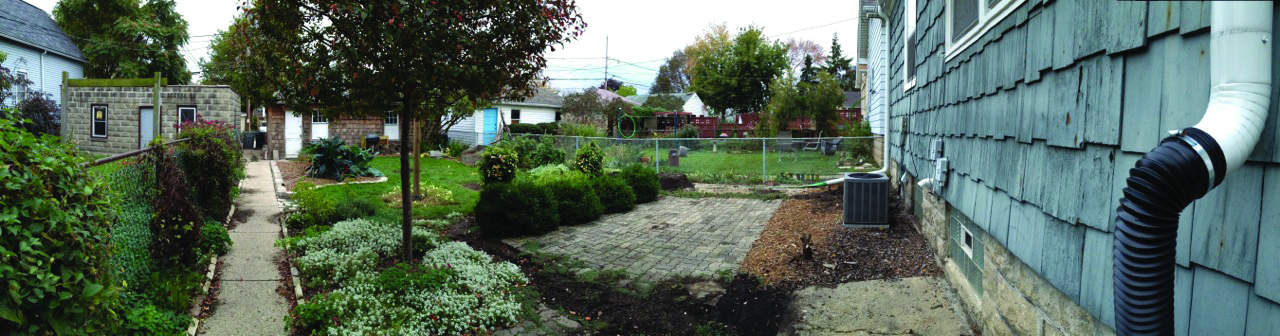
Lisa Pampel and Jodi Schmeling’s beautifully landscaped backyard on East Dover Street before it was torn apart to install their underground rain collection system late this fall. —photo Lisa Pampel

Lisa Pampel and Jodi Schmeling’s beautifully landscaped backyard on East Dover Street before it was torn apart to install their underground rain collection system late this fall. —photo Lisa

PampelHarvesting rainwater is nothing new in Milwaukee. City residents been purchasing barrels from the Milwaukee Metropolitan Sewage District (MMSD) and other retailers to collect rainwater for years. The rain barrel kits that include hardware cost about $50 per barrel and hold 55 gallons of water.
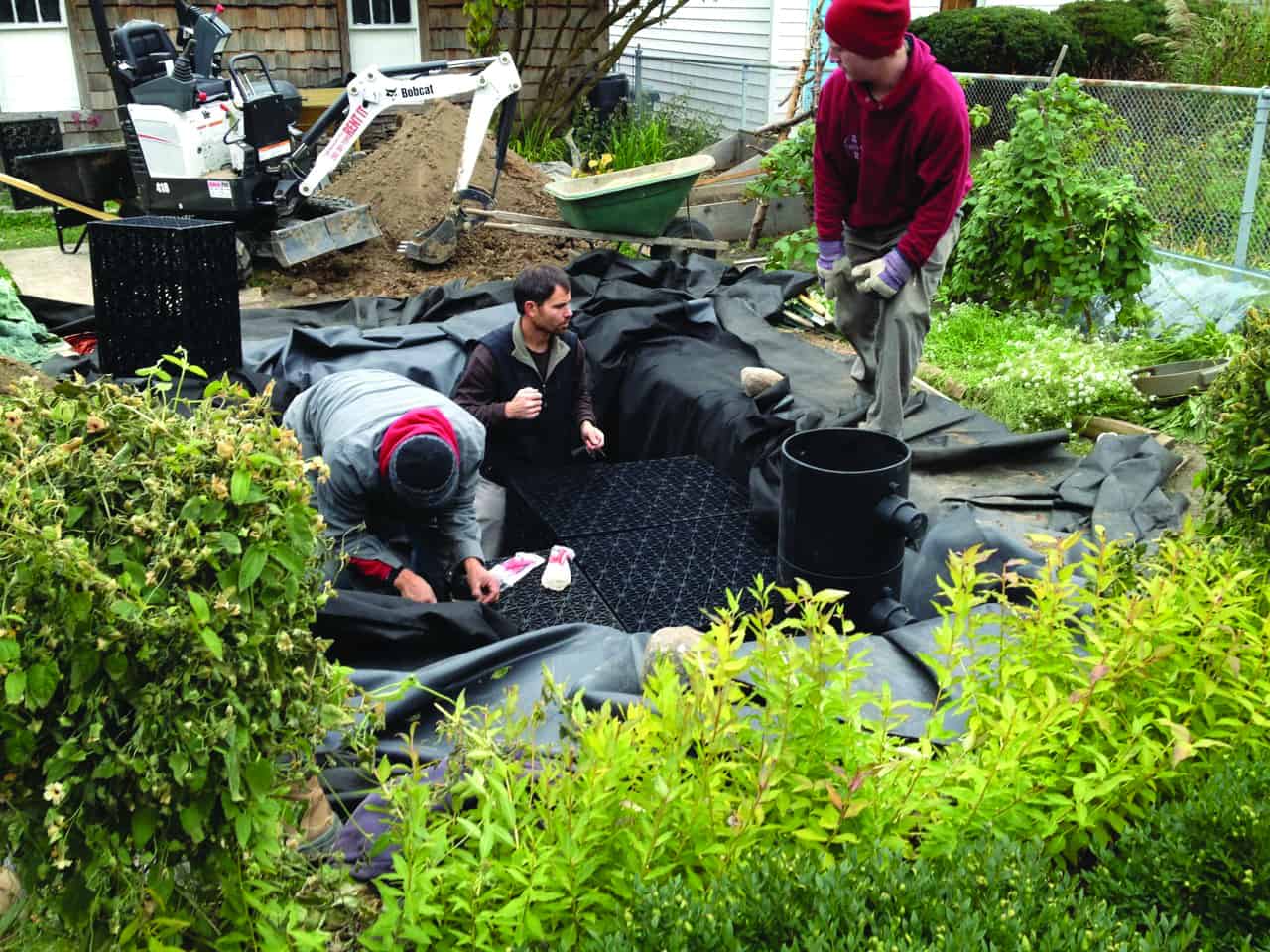
The 750-gallon-capacity reservoir was filled with structures called AquaBloks. —photo Lisa Pampel

The 750-gallon-capacity reservoir was filled with structures called AquaBloks. —photo Lisa Pampel

For Lisa Pampel and Jodi Schmeling of Bay View, the MMSD barrels were a good start, but the couple decided they wanted something a little more advanced.

“One barrel will fill up in about 10 minutes of a gentle rain. The five-barrel system will fill up in about half an hour or so…and you just start having water coming out of the top of them, and it’s a very bad situation,” said Pampel.

The five barrels stood on a brick-paved  patio behind their house and became problematic when the full-barrels’ weight depressed the concrete pad at the base of the house. Water collected in the depression during storms, Pampel said, which damaged the home’s foundation and created water seepage issues. After talking with John LaPointe of Greener Roofs and Gardens, Pampel and Schmeling decided to ditch the barrels and install a 750-gallon underground Aquascape rainwater-collection system (or graywater system) in their backyard at 517 E. Dover St.

The system, similar to one at Boerner Botanical Gardens in Hales Corners, would be the first of its kind installed on residential property in the Milwaukee, according to Pampel. LaPointe had installed the systems on residential properties in other areas of Wisconsin, including a 2,200-gallon system in Stevens Point, and smaller ones in other parts of the state, but none in Milwaukee.

Schmeling is a master gardener and has worked in the landscaping industry for more than 15 years. In order to install the system, the couple began by ripping out their paved patio and digging up part of their beautifully landscaped backyard.

The Aquascape system is connected to rain gutters on the back of the couple’s house, just as the rain barrels were. But now the water is transported away from the foundation.

Drain tiles direct water from the downspouts to the underground reservoir. Inline filters were installed in the downspouts to prevent leaves, twigs, and debris from passing into the underground water reservoir.  —photo Lisa Pampel

Drain tiles direct water from the downspouts to the underground reservoir. Inline filters were installed in the downspouts to prevent leaves, twigs, and debris from passing into the underground water reservoir. —photo Lisa Pampel

Filters in the downspouts remove twigs and other debris from the rainwater before it flows to underground drain tiles (4-inch diameter) that transport the water to an underground reservoir.

The main components of the collection system are the downspouts, drain tiles, reservoir, plastic structural-components in the reservoir,  and two pumps. One pump supplies a feature and the other delivers water to the couple’s garden. The reservoir’s capacity is 750 gallons.

A rubber pond liner is sandwiched between two layers of landscape fabric. The fabric protects the rubber liner from punctures from stones and other sharp objects in the soil.

The reservoir’s void is filled with 21 “AquaBloks,” plastic forms that resemble milk crates. Their purpose is twofold. Filling the void with these forms displaces far less water than stones, and they support the earth that covers the reservoir, preventing it from sinking or collapsing. The rubber and landscape fabric material line the pit to keep the water from seeping away. They wrap the underground system “like a burrito,” Pampel said.

Pampel and Schmeling decided to include a water feature, a 200-pound bubbling boulder, placed over the reservoir. After they selected the boulder from a landscaping firm, it was bored to receive tubing from the pump. The pump draws water from the reservoir, delivering a burbling stream of water that flows from the top of the stone.

The water feature also prevents the underground water from getting stale because it is aerated as it flows over the boulder. Smaller stones at the base of the boulder filter the water before it flows back into the reservoir.
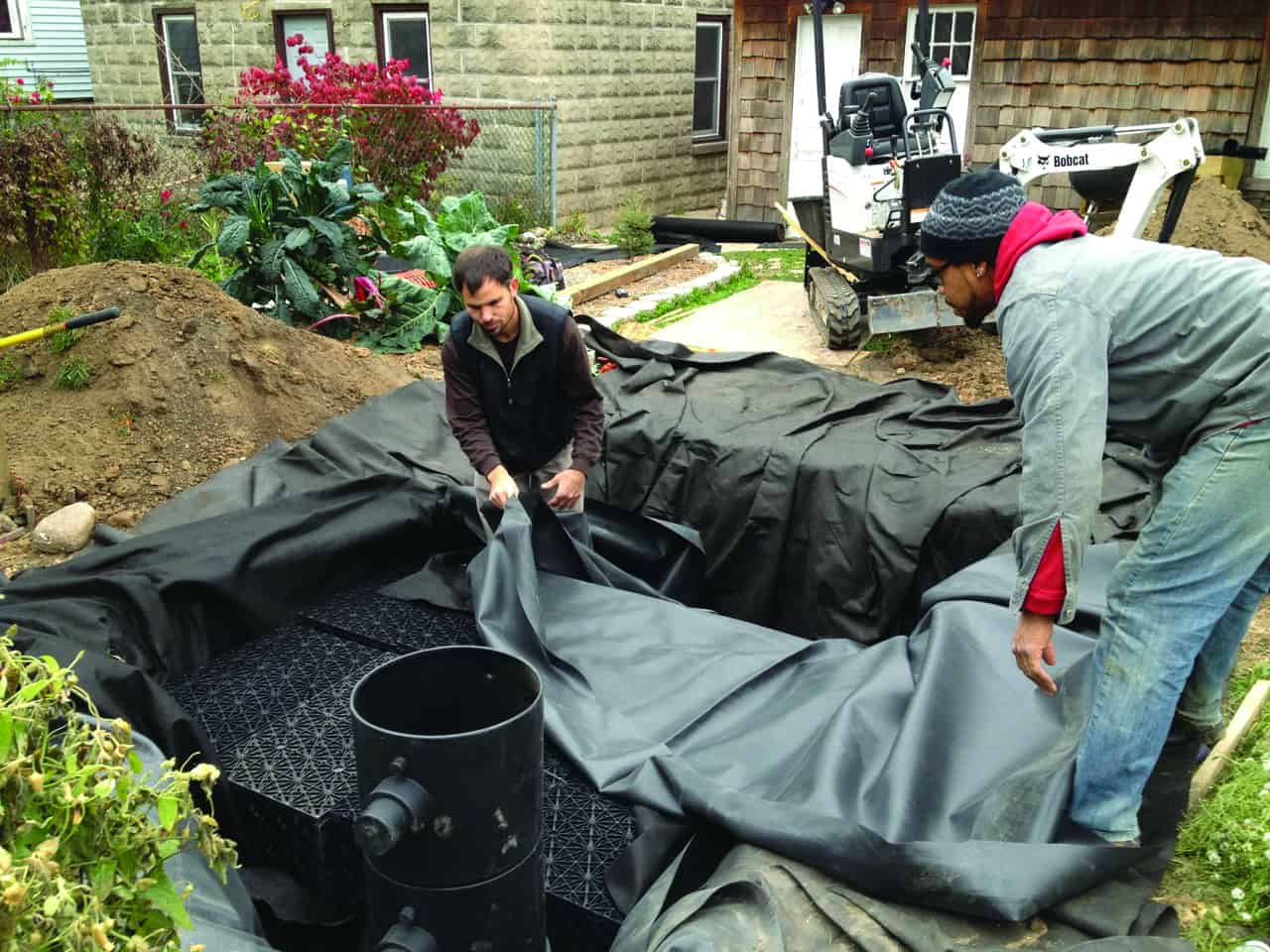
A pit was dug and lined with a layer of rubber pond-sealer sandwiched between two layers of landscape fabric. The rubber liner prevents the collected rainwater from seeping away. —photo Lisa Pampel

When the reservoir is filled, excess water flows to a rain garden in the backyard.

The project’s $14,000 price tag covered the downspout filters, drain tiles, Aquascape system, foundation repair/sealing, new patio, and labor. Pampel and Schmeling estimate that a similar system would cost between $5,000 and $8,000, not including the cost of any foundation or other repairs. Because they were able to purchase some of the materials at a discount, Pampel noted the cost for the same system would be higher for someone who would pay the full retail price.

Pampel said they inquired about applying for a grant for the project from the city of Milwaukee’s Office of Environmental Sustainability, but they did not receive a response. “My understanding is that they’re geared more towards the commercial buildings. That’s where their grants and funding are at because they realize that a lot of the rainwater runoff is coming from the large concrete buildings downtown,” Pampel said.

For Pampel and Schmeling, their material investment in the underground system is offset by its potential to introduce a new sustainability option to Milwaukee’s residents. “I have to believe that if we continue to get massive rainstorms that cause people’s basements to cave in like we did a few years ago in the North Shore, this [system] will start becoming a more attractive option. But the thing is, nobody even knows this exists because it’s not really advertised or publicized anywhere…I think it’s a relatively cheap expense considering what the alternative is, of having to rebuild your foundation after a storm,” Pampel said.

Although it is a strong advocate of rainwater harvesting, MMSD is a government agency and is not allowed to favor one product over another, which is why you won’t find any mention of Aquascape on their website. The sites does, however, stress that rainwater harvesting helps protect the city’s rivers and Lake Michigan from runoff pollution.
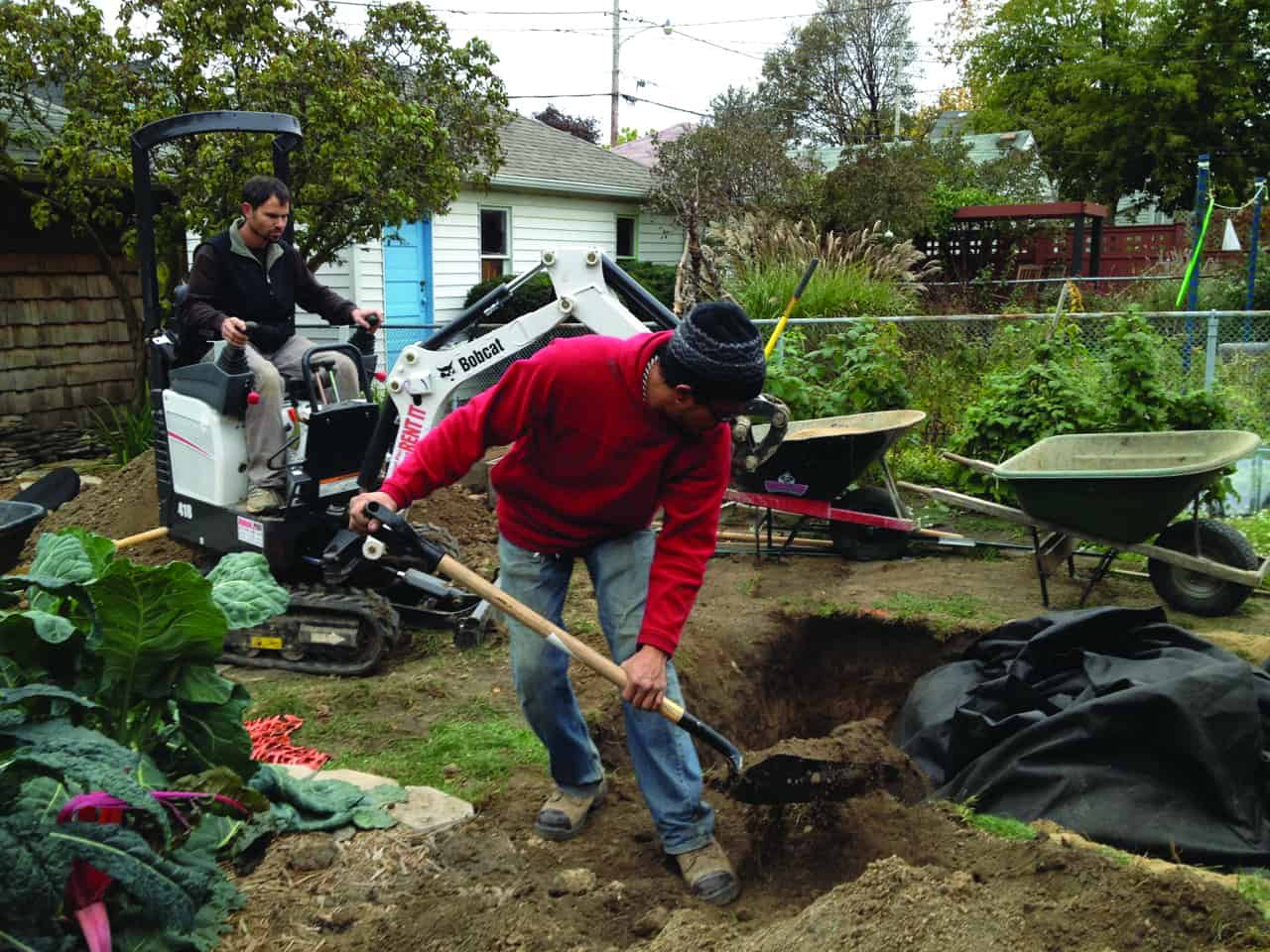
Soil is being backfilled around and over the rubber-lined underground system. —photo Lisa Pampel

Soil is being backfilled around and over the rubber-lined underground system. —photo Lisa Pampel

“By managing rain where it falls, we reduce the risk of it overwhelming sewers and from becoming polluted runoff, the biggest remaining threat to water quality in the United States,” said Tim Bate, MMSD’s Director of Planning, Research and Sustainability.
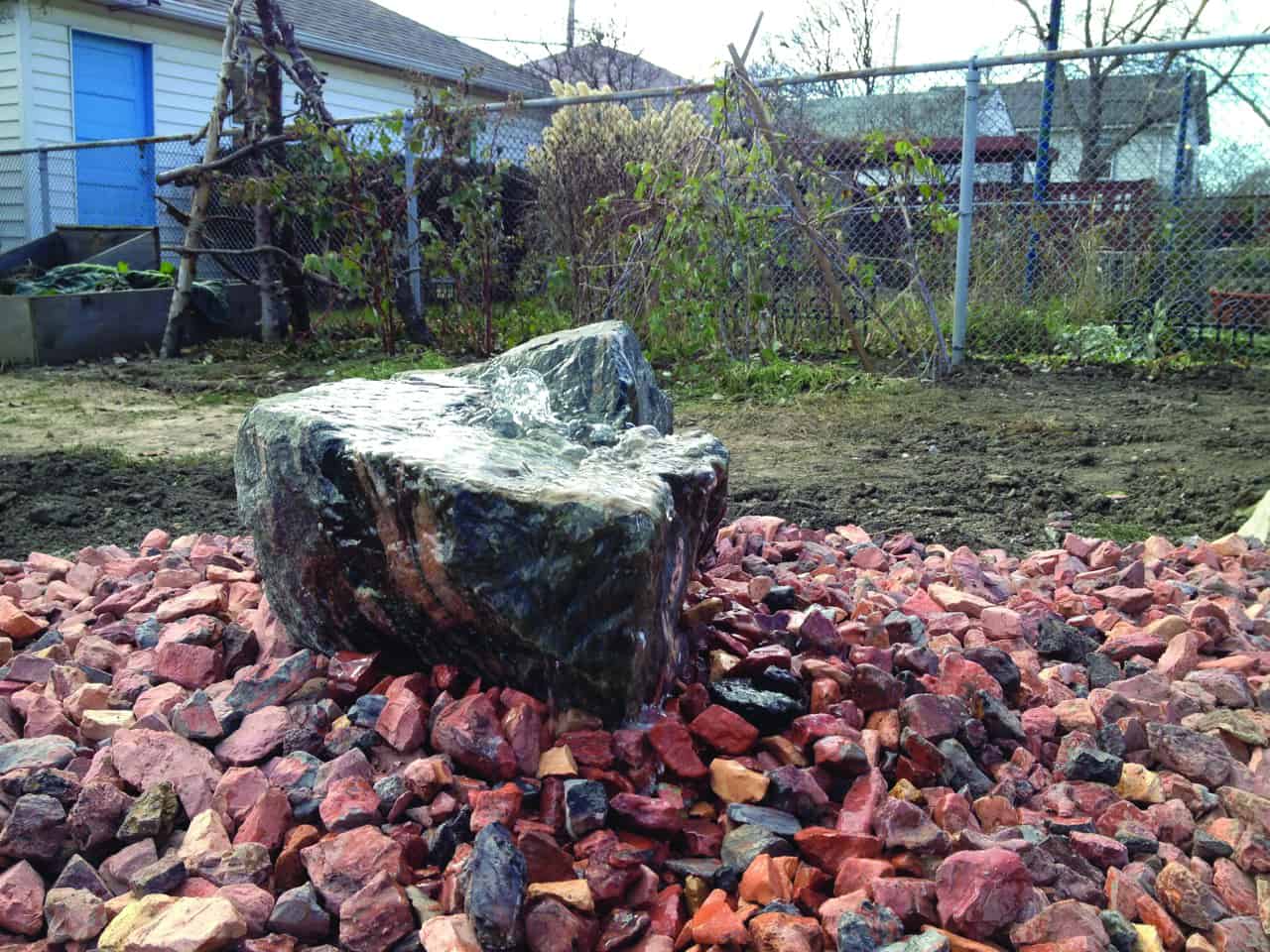
A  200-pound boulder was drilled with holes to accept tubing that transports water from underground reservoir. In addition to the charm that a bubbling water feature adds to their backyard landscape, the water feature also aerates the underground water and keeps it fresh. —photo Lisa Pampel

A 200-pound boulder was drilled with holes to accept tubing that transports water from underground reservoir. In addition to the charm that a bubbling water feature adds to their backyard landscape, the water feature also aerates the underground water and keeps it fresh. —photo Lisa Pampel

The Aquascape system possesses significant advantages for its ability to maintain rainwater quality. Storing rainwater underground, out of direct sunlight, helps protect it from bacteria and keeps it at a reasonable temperature (around 40 degrees on average), according to LaPointe.  Maintaining clean water is crucial for Pampel and Schmeling, who will use the graywater for their garden and lawn. They grow organic vegetables in their backyard and take pride in healthy gardening.

“We don’t use any fertilizers or anything. I’ve owned the property for 15 years and I’ve never once used any fertilizers on the yard at all, so it’s all organic. Anything that we do put on it is going to be organic matter. We do our own composting, so we supplement the soil with compost in the spring in case we run into a nutrient deficiency somewhere,” said Pampel.

Another step Pampel and Schmeling said they may consider in the future is connecting the system to the plumbing in their home and using the graywater for their toilet, laundry, and other non-drinking uses.

“This is by no means a system to install for a casual gardener. We have been thinking about this project for a few years now. Once we decided we would be staying in our home, we decided it was the right thing to do,” Pampel said. “Considering the benefits of clean water, not laden with chemicals like city water, for use in the gardens and washing cars/bikes, the large storage capacity to handle what comes off our roof and not returning it to the sewer system, it seemed like the right thing to do. We have the option to someday hook it into the house for use in laundry and toilets. But for now, the next project on the horizon is installing solar panels on the roof for generating electricity.”

While installing an Aquascape system may not be the most economically viable option for all city residents, harvesting rainwater is definitely something all residents can participate in with the proper guidance.

The system is installed and the couple’s new patio is in place. The “bubbling boulder” on its bed of stones can be seen in the photo’s middle ground. When spring arrives, Pampel and Schmeling will reestablish displaced landscape features, and their vegetable and flower gardens. And they will draw water from their new system to help their plants thrive. —photo Lisa Pampel

The system is installed and the couple’s new patio is in place. The “bubbling boulder” on its bed of stones can be seen in the photo’s middle ground. When spring arrives, Pampel and Schmeling will reestablish displaced landscape features, and their vegetable and flower gardens. And they will draw water from their new system to help their plants thrive. —photo Lisa Pampel

“The type and size of system used should be chosen based on the user’s needs and ability to maintain the system,” Bate said. “MMSD encourages residents and business owners to contact their local municipality to discuss codes and ordinances related to rainwater harvesting systems, as well as to determine the appropriate permits needed for installing a rainwater harvesting system.”


Copyright 2013 by Bay View Compass. All rights reserved.
This material may not be published, broadcast, rewritten or redistributed.

Super-Sod is Donating their Doc’s Raised Garden Kits to Families and …

  • Email a friend

100 of these kits to give away at a $200 value/each.

100 of these kits to give away at a $200 value/each.

Atlanta, GA (PRWEB) November 29, 2013

Super-Sod is giving back to the communities that support them. They have 5 farms and 11 outlets in Georgia, North Carolina, and South Carolina and so are giving away 100 of their Doc’s Raised Garden Kits in those states.

They’re asking communities to help them give away the 100 Doc’s Raised Garden Kits by nominating community gardens and families in need. Their hope is that these kits will be a part of providing nutritious food to families who might not have access otherwise. Super-Sod is a horticultural enterprise that employs expert gardeners – many who go home to continue gardening. It’s a company of gardeners who know that growing one’s own food is rewarding.

Each individual may nominate one family or community garden (in GA, NC, or SC – Super-Sod’s home states) to receive a Doc’s Raised Garden Kit. Each Doc’s Kit is valued at $200 each, plus organic seeds will be included for this give-away.

One Doc’s Raised Garden Kit is composed of:

  • 1 wood bed made of rot-resistant wood that’s fastened with handsome mortise and tenon joints (no tools required for assembly);
  • 17 bags of Soil3 organic humus compost to fill the bed;
  • And for this give-away, 4 packs of organic winter vegetable seeds from Sow True Seeds.

The company has created an app on their Soil3 Facebook page and Soil3 website where you can submit your nomination. Please visit either of these two sites to nominate:

Super-Sod is a family-run business that employs experts in turf and horticulture. One of their most popular products has been their Soil3 organic compost which they make partially from composted grass clippings from their sod production. They continue to develop new products, foster gardening and landscaping, and always seek to improve their knowledge, farming practices, technology, and environmental stewardship.

Email a friend


PDF


Print

Westmoreland Museum of American Art’s expansion to feature lush landscape – Tribune

Westmoreland Museum of American Art officials didn’t forget a new Greensburg resident’s comments when considering the expansion of the city cultural attraction.

The man said, during a focus-group meeting months ago, that “by the time I was (at the museum), I realized I passed it already,’â€� recalled Judith O’Toole, museum chief executive officer and director.

Officials pledged to make the museum more visible from North Main Street and North Maple Avenue as they planned the expansion of the building to add 12,500 square feet of galleries, classrooms and studios.

“Pedestrians (and motorists) will be able to see the museum itself and see into the museum,â€� O’Toole said.

The heaped mound of earth on the downtown side of the building will be leveled, improving visibility, and be replaced by tiered gardens. Lush native plants and trees, along with a meadow, will be planted.

Workers will add three interconnected walkways and a new parking area.

“My hope is that people will be delighted by it and use it and see it as a new public green space,â€� O’Toole said. “We want it to be a place where people come … during lunch hour, after the end of work.â€�

More than 75 trees will be planted, including maples, beeches, birches, flowering dogwood and Eastern redbud.

And 200 shrubs and 2,500 meadow plants, including native grasses and native perennials, will be added.

On the side of the museum facing Greensburg Salem Middle School, workers will plant trees in the “bosque� fashion, giving the area a “Parisian� feel, said Frederick Bonci, founding partner of LaQuatra Bonci of Pittsburgh, which designed the landscaping plans. The Spanish word “bosque� means “grove of trees.�

The plants outside the museum will be designed to eventually rely on water supplied by nature, Bonci said.

Workers started the building expansion about six weeks behind schedule, but O’Toole said she has been assured the museum will meet its May 2015 target date for opening.

The construction is part of a $38 million, five-year capital campaign, with $18 million for capital, $16 million for a new endowment and $4 million for operating costs.

Museum officials are using the Unity building that formerly housed Stickley Audi and Co. on Village Drive, off Route 30, as a temporary site for the museum, called Westmoreland @rt30.

O’Toole and Bonci said they hated to see the oak tree on the North Maple Avenue side of the museum be cut down earlier this month.

“I had quite a few calls on it,â€� O’Toole said. “What I said, ‘It bothered me as well, but that particular tree had to come down.’

“We took one tree down, but we’re going to be planting dozens of them,â€� she added.

The tree was felled for practical purposes, Bonci added.

“We always hate to remove trees … but it was the only place from which the museum could expand its existing services,â€� he said.

Workers spared a twin oak on the North Main Street side of the museum, Bonci said.

Some crabapple trees on the property will be removed, but he said they are deteriorating and need to go.

Most of the landscaping work will be done in the latter stages of construction and take about two months to complete, Bonci said.

“I’m hoping it’s a landscape that provides value, is cherished and can be learned from,â€� Bonci said.

Bob Stiles is a staff writer for Trib Total Media. He can be reached at 724-836-6622 or bstiles@tribweb.com.

Teague: A few tips before pruning trees

Most deciduous trees are pruned and shaped in winter, after leaf fall, which varies according to the tree species. Some spring-blooming trees including dogwoods, redbuds and deciduous magnolias are pruned in spring after they’ve finished blooming. Evergreen trees such as Southern magnolias are also best pruned in winter to avoid sunburned on newly exposed bark. Redwoods and deodoras can be shaped lightly in winter to remove congested interior branches and hazardous limbs, but “thinning” or the removal and stripping of major branches is not recommended. Different tree species require different types of pruning to maintain a strong structure and good health.

These are a few examples of basic rules of pruning that every tree trimmer, including handy homeowners, should know. Homeowners can and should educate themselves on pruning techniques (at least on what not to do) as well as who should be hired to do pruning.

Ortho’s “All About Pruning,” available at most garden centers, has excellent illustrations of both proper and bad pruning. If you’re considering having major work done on trees on your property, it’s worth the price of the book ($11.95 the last time I checked) to get the job done right. Poorly pruned trees actually will cost more to maintain over the shortened life of the tree. Restructuring a badly pruned tree takes about seven years of good, expert annual pruning. Trees that are so badly pruned that limbs die and the tree structure is unbalanced are hazardous and are liabilities that cost money to remove. Take the book with you as you walk around your neighborhood. You might be surprised at how many trees have been improperly pruned.

Certified arborists have received extensive training in tree care, have taken and passed licensing exams and are expected to follow a code of ethics. They’re also the only professional tree pruners, by law, who can work on trees taller than 15 feet or trees near power lines. Their bids often are comparable to other tree pruners and you’ll have the security of knowing that their work is guaranteed. Look for tree care companies that have a certified arborist on staff and get three bids before hiring.

One of the major reasons to avoid hiring unlicensed and uninsured tree pruners is the potential for major liability costs to the homeowner in case of injury to the pruners while working or if the tree falls and causes injury or property damage. Do not hire any tree pruners who cannot produce a business card listing their contractor’s license number or who do not display the contractor’s license number on their work trucks. Then check their record with the Better Business Bureau and the Contractor’s Licensing Board.

Elinor Teague is a Fresno County master gardener. Send her plant questions at etgrow@comcast.net or features@fresnobee.com (“plants” in the subject line).

The best gardening short courses for 2014

Writtle College

Lawn care: a generic guide This course offers an overview of how to
care for your lawn, with a mixture of theory and practical sessions.
Suitable for beginners and intermediate turf masters.

£77, February 15, 10am-3.30pm, Writtle College, Chelmsford, Essex (01245
424286; writtle.ac.uk)

Ness Botanic Gardens

Snowdrop and winter garden photography This course gives you a
grounding in the principles of winter garden photography, showing you how to
make the most of winter structure and early spring plants.

£90, February 20, 10am-4pm, Ness Botanic Gardens, near Neston, Cheshire (0845
030 4063; nessgardens.org.uk)

Pershore College

Hedgelaying This practical one-day course in hedgelaying provides basic
instruction in good technique and safe practice in this ancient country
craft, which is also an important conservation feature.

£90, February 22, 9.30am-4.30pm, Pershore College, Pershore, Warwicks (01386
551224; warwickshire.ac.uk)

National Botanic Garden of Wales

Willow frame baskets for beginners Participants will be shown how to
weave a frame basket with a selection of willow using traditional
techniques. Suitable for complete beginners.

Members £30, non-members £35, February 8, 10.30am-4.30pm (01558 667150; gardenofwales.org.uk).

Waterperry Gardens

Grow your own veg Suitable for allotment holders, vegetable patch
gardeners or even those with only a balcony, this will guide you through
everything from planning to harvest, with tips on soil preparation, sowing
and planting.

£45, March 1, 10.30am-3.30pm, Waterperry Gardens, Waterperry, Oxon (01844
339254; waterperrygardens.co.uk).

RHS Harlow Carr

Natural Christmas decorations One-day workshop giving you everything
you need to know to make your own Christmas garlands and other decorations
using natural materials.

£55 RHS members, £60 nonmembers, November 30 and December 6, RHS Harlow Carr,
near Harrogate, N Yorks (01423 565418; rhs.org.uk/gardens/harlow-carr).

Jekka’s Herb Farm

Herb Garden Design One-day masterclass from Jekka McVicar, the
Chelsea-medal-winning doyenne of herb gardening, based on the farm in South
Gloucestershire that she has been running for 25 years. Pick up tips on
planting combinations, soil preparation and design ideas.

£165, April 12,10am-4pm, Jekka’s Herb Farm, Alveston, nr Bristol, Gloucs
(01454 418878; jekkasherbfarm.com).

Academy of Flowers

Vintage Flowers Flowers, like clothes, go in and out of style. Learn
how to create a vintage-style arrangement with old-fashioned flowers and
containers.

£195, January 17, February 7, September 19, 10.30am-4pm. Academy of Flowers,
Covent Garden, London WC2E (020 7240 6359; academyofflowers.com).

MID-LENGTH COURSES

My Garden School

Garden history course The first online-only garden school, My Garden
School offers videos, support and tuition on a wide range of courses, all
through the internet. This four-week course, with author and expert Toby
Musgrave, runs through 4,000 years of garden history, from Ancient Egypt to
modern California.

£145, starting on the first Saturday of every month (my-garden-school.com)

Galvelmore House

Easy 2D garden mosaics Weekend residential course that will show you
two ways of making mosaics for walls and fences. Start with a glass of wine
on Friday evening, and learn the techniques over the next two days.

£215 per person, March 1-2, Galvelmore House, Crieff, Perthshire (01764
655721; galvelmore.co.uk).

LONGER COURSES

Cotswold Gardening School

Professional garden design This ten-week course, starting in January,
aims to teach how to set up your own garden design business from scratch. It
covers everything from surveying to computer design, costing and marketing.
Lunch, tea and coffee included. All levels welcome.

£895, 10am-4pm, from January 8, Cotswold Gardening School, Gossington Hall,
Gossington, Gloucs (01453 899018; cotswoldgardeningschool.co.uk).

English Gardening School

Intensive 10-week course in garden design This new full-time course,
aimed at designers and advanced gardeners, will teach students everything
from how to survey and plan a site to looking after your plants and costing
and billing clients.

£5,495, January 14-March 27, Chelsea Physic Garden, London SW3 (020 7352 4347; englishgardeningschool.co.uk).

Garden designer Chris Beardshaw talks Eton’s new one-stop design shop

16 Nov 2013 07:30

Advertising feature: Barts Restaurant and Bar

Oh decisions, decisions! You have been lumbered with organising a night out and there is so much to consider. How will you get there, is it too far, is there enough room, what’s the food like, will everyone like it, can we just have a drink and something light, how much will it cost? Thank goodness for Barts Restaurant and Bar on the Wokingham Road.

Social:


Comments0 comments

Cumbres House / Taller Hector Barroso

© Yoshihiro Koitani

Architects: Taller Hector Barroso
Location: Federal District,
Architect In Charge: Hector Barroso
Collaborators: Alejandro Cortina, Rafael Montiel, Flavio Velazco
Area: 635.0 sqm
Year: 2011
Photography: Yoshihiro Koitani

© Yoshihiro Koitani

From the architect. Cumbres House is located inside a residential area in Santa Fe, west of Mexico City. 


Section A

The project is developed around a central patio which provides different views, natural lighting and cross-ventilation to the interior spaces. This void acts as the medullar element on the design process. It is the in situ result of the restricted views, the lack of visual elements in the surroundings and the land’s unfavorable location.

© Yoshihiro Koitani

The different areas of the architectural program are built around this contemplative patio. The living-dining space is set by a visual and functional continuity between interior and exterior creating the effect of the garden blending with the living and dining room, continuing to extend to the interior patio.  When both fronts are completely open, natural light effects, extended views and ventilation are emphasize.

© Yoshihiro Koitani

From the entrance façade, the house materiality is accentuated by a tripartite composition, recreated in a contemporary form. First, a rough and moist basing is materialized in pine wood, resembling a light plinth supporting the weight above. A raw volume on top, made of natural stone reinforces the monolithic and mineral aspect of the house.

© Yoshihiro Koitani

At the end, on the third level, the roof is used as the fifth corbusian façade, where the movement of lines and lightness opposes to the inferior volume. On this last level, the only cover is a floating slab with steel beams shielding a living room with a 360 degrees view over the surrounding mounts. Again, continuity between interior and exterior is made through sliding crystal panels which grant an effect of lightness to the structure.

© Yoshihiro Koitani

Founded in 2010,  is focused on architectural projects at different scales. In each project, an artistic and scientific investigation methodology is used in order to accomplish specific solutions. Being curious about the critic on architecture and exchanging ideas, we give great importance to the collaboration with engineers, designers, landscaping designers, lighting designers and other disciplines, along with the clients, looking for a positive enrichment in each project. We believe that trough design and ethics the people’s quality of life can be improve.

First Level Plan


Casa Cumbres / Taller Hector Barroso  Yoshihiro Koitani

© Yoshihiro Koitani

Casa Cumbres / Taller Hector Barroso  Yoshihiro Koitani

© Yoshihiro Koitani

Casa Cumbres / Taller Hector Barroso  Yoshihiro Koitani

© Yoshihiro Koitani

Casa Cumbres / Taller Hector Barroso  Yoshihiro Koitani

© Yoshihiro Koitani

Casa Cumbres / Taller Hector Barroso  Yoshihiro Koitani

© Yoshihiro Koitani

Casa Cumbres / Taller Hector Barroso  Yoshihiro Koitani

© Yoshihiro Koitani

Casa Cumbres / Taller Hector Barroso  Yoshihiro Koitani

© Yoshihiro Koitani

Casa Cumbres / Taller Hector Barroso  Yoshihiro Koitani

© Yoshihiro Koitani

Casa Cumbres / Taller Hector Barroso  Yoshihiro Koitani

© Yoshihiro Koitani

Casa Cumbres / Taller Hector Barroso  Yoshihiro Koitani

© Yoshihiro Koitani

Casa Cumbres / Taller Hector Barroso  Yoshihiro Koitani

© Yoshihiro Koitani

Casa Cumbres / Taller Hector Barroso First Level Plan

First Level Plan

Casa Cumbres / Taller Hector Barroso Roof Plan

Roof Plan

Casa Cumbres / Taller Hector Barroso Second Level Plan

Second Level Plan

Casa Cumbres / Taller Hector Barroso Section A

Section A

Ethel M botanical garden light display features 500000 lights – Las Vegas Review

Don’t forget that one of the places you can visit to see a holiday lights display is Ethel M Chocolates Botanical Garden at 2 Cactus Garden Drive in Henderson near the intersection of East Sunset and Mountain Vista.

Each year for the past 10 years employees have strung more than 500,000 holiday lights for visitors to enjoy. The facility covers more than 3 acres and features more than 300 species of plants suitable to our desert environment. It is one of the oldest and best examples of desert landscaping in the valley.

Q. With all the beautiful rain that we had recently, what should we do regarding future watering? Has it been enough water to just stop watering until after the first of the year?

A. Rains come in all forms. This one was rather unique in that it came down over a nice, long period of time giving it a chance to soak into our landscapes instead of running off the surface and into the streets.

Landscapes are supposed to be contoured to force rain off landscapes and into the streets. Once water enters the streets they act as “storm sewers” and help remove water from properties. If landscapes are not contoured correctly it is feared that water might accumulate on the landscape and flood homes, causing damage.

For gardeners who are interested in “harvesting” water on their property, this rule may seem to be counterproductive but it is meant for the “general good.” There are ways to store water and improve the effectiveness of rainfall such as dry stream beds and pools, but you must be careful when doing this. I will post some ideas on my blog as examples.

As a general rule we consider about 40 percent of our rainfall to be what we call “effective.” This means that 40 percent of the rain, four-tenths to every inch, actually gets into the soil where it is stored rather than running into the streets. This rain event however was more “effective” than most.

Another problem was that the rain was not evenly spread throughout the valley. This makes it hard to make a general statement about how long to turn off irrigation systems.

For shallow rooted plants like flowers and turfgrass they will still need a couple of irrigations the rest of this year. Deeper rooted plants, such as trees and large shrubs, can probably get by.

Unless you know your rainfall amount, I would count this rainfall as a single irrigation event, skip one irrigation and then continue irrigations unless we get more rain. The savings will still be significant.

Q. I believe you made an error last week about the Chinaberry tree. You said it “is also called Persian lilac and in the United States we sometimes call it the Texas umbrella tree.” I do not believe that the Persian lilac is related at all to the umbrella tree. We had both in our yard years ago, and they were quite different.

A. Thanks for your comment and you are right, there is more than one plant called “Persian lilac.” This is where the common names can be confusing.

The Chinaberry tree (Melia azedarach) can also be nicknamed the Persian lilac because of the perfumy flowers it produces in spring. You can Google any of these names.

There is another plant, also called Persian lilac (Syringa x persica), a hybrid lilac closely related to common and Chinese lilac, which is probably what you were growing.

We have the same problem with another plant we call mock orange. Locally, our mock orange is a Pittosporum. This is not the same mock orange known by most of the country. When I was in school, mock orange was a totally different plant with the scientific name Philadelphus coronarius, a flowering relative of hydrangea whose flowers were used for garlands because they have a strong citrus fragrance.

I do not to use scientific names in my column but common names can be confusing for this reason.

I appreciate these comments because I’m sure others were thinking the same.

Bob Morris is a horticulture expert living in Las Vegas and professor emeritus for the University of Nevada. Visit his blog at xtremehorticulture.blogspot.com.

Gift ideas for gardeners

Worms move abut at Worm Power in Avon. The high-nutrient worm castings product made from cow manure is much richer than compost and works well as an additive to potting soil, among other garden uses.

Livingston County News File Photo
Worms move abut at Worm Power in Avon. The high-nutrient worm castings product made from cow manure is much richer than compost and works well as an additive to potting soil, among other garden uses.
MASTER GARDENER

Gift ideas for gardeners

The holiday season is upon us, and many of us are thinking about gifts. I have a few gift ideas for gardeners you might like to consider:

 A subscription to “Gardening Gazette”, a publication of Cornell Cooperative Extension in Livingston County. Cost for 12 monthly issues is only $10 per year, and includes color photos. This gardening information appears in my mailbox when I need it. Call the CCE office at 991-5420 and they will help you order it. All of the published information pertains specifically to Livingston County.

Worm Power, a high-nutrient worm castings product made from cow manure. The manure is produced at Coyne Farms in Avon, then composted by worms at Tom Herlihy’s business called Worm Power. It is much richer than products sold as compost. It works well as an additive to potting soil, for establishing transplants in the garden, and for top dressing during the season. It is available at J A Farm Market just north of Lakeville, or online from Gardeners Supply (888 833 1412). You can learn more about this product at WormPower.net. A video of the production process is included on this site.

Compost/topsoil mix from Al Landscaping in Lakeville. The owner, Al Roome, donated some of this for a raised bed I had built for some developmentally disabled adults in Lakeville. The plants went nuts! It is available by the cubic yard. You can have some delivered, or he will sell smaller quantities loaded in your truck or in 5 gallon buckets.

Hardscape materials, perhaps a palate of stones. We gardeners don’t often buy materials like this for ourselves, but it can be fun and satisfying to create a path or wall.

Garden Art from The Artful Gardener, 727 Mt. Hope Avenue in Rochester, near Mt. Hope Cemetery. This shop features beautiful art created by local artisans, who are listed on the web page at theartfulgardenerny.com. You should probably involve the gardener in selection of artwork, since taste varies a lot.

A really long-handled trowel. I bought one from Lee Valley Tools (800 871 8158), they call it a micro spade. It works not only for digging weeds without bending, but is also tall enough (38.5”) to serve effectively as a walking stick. It has a nice bicycle-grip handle. Cost is only $9.50 plus tax and shipping.

Gardening books: one of my favorites this year is “Everyday Roses” by Paul Zimmerman. There are lots of good roses available on the marketplace now, that don’t need spraying, and don’t need to be mulched heavily for the winter. He covers many of them. One of my talks this spring at Wadsworth Library in Geneseo will be based on this book.

Of course, the Lee Valley and Gardeners’ Supply catalogs offer a wide array of additional products. I have ordered repeatedly from both of these sources, and have been pleased with the quality and service.

—–


<!–

No Comment

–>

Things to do in Hernando County

Markets and sales

FRIDAY, SATURDAY

Christmas Bazaar and Cookie Walk: The bazaar will include crafts, floral arrangements, Christmas ornaments and other items, as well as gift basket raffles, home-baked goods and food. 9 a.m. to 2 p.m. Spring Hill United Church of Christ, 4244 Mariner Blvd., Spring Hill. (352) 683-4870.

Related News/Archive

  • Things to do: art to car washes, starting April 28

    7 Months Ago

  • Things to do in Hernando County, Nov. 10 and beyond

    3 Weeks Ago

  • Things to do in Hernando County, week of Sept. 29

    2 Months Ago

  • Things to do in Hernando County this week

    3 Months Ago

  • Things to do: Hernando County

    6 Months Ago

Saturday

Holly Berry Bazaar: The event will include crafts, gift baskets, baked goods and free hot chocolate — plus a visit by Santa Claus. 8 a.m. to 2 p.m. Holy Cross Lutheran Church, 6193 Spring Hill Drive, Spring Hill. (352) 683-9016.

Green Thumb

TODAY

‘Blue Gold: Reflections on the Condition of Florida’s Natural Springs’: Stephen Hoda of the Florida Springs Institute will describe a spring and the topography that makes Florida springs unique. The program will discuss problems facing the springs, the sources of the problems and remedies. The talk is part of the Unitarian Universalist Church’s 2013-14 First Sundays movie series. 1:30 p.m. Free. Brooksville Woman’s Club, 131 S Main St., Brooksville. (352) 293-4697.

TUESDAY

‘Fertilizing Appropriately Protects Our Springs’: Applying too much fertilizer too often, or at the wrong time, can cause water pollution. Participants will learn how to have a beautiful lawn while protecting water quality. The focus will be on protecting Weeki Wachee Spring. 10:30 to 11:30 a.m. West Hernando/S.T. Foggia Branch Library, 6335 Blackbird Ave., Spring Hill. (352) 540-6230.

WEDNESDAY

‘What to Do While Your Landscape Sleeps’: Learn what to do during the winter months to ensure a spring landscape recovery from Sylvia Durell, Hernando County Florida-Friendly Landscaping program coordinator. 10:30 to 11:30 a.m. Free. Spring Hill Branch/Harold G. Zopp Memorial Library, 9220 Spring Hill Drive, Spring Hill. (352) 540-6230.

Celebrating Christmas

FRIDAY

Light Up Ridge Manor Christmas Festival: The Christmas celebration includes a DJ, Smokey Bear’s house, Christmas carolers, a performance by John Leggio’s dance troupe, a cakewalk and an appearance by Santa. There will be children’s games and activities, a silent auction and food vendors. Provided by the Greater Hernando County Chamber of Commerce’s Eastside Business Networking Group. 6 to 9 p.m. Free. Sunrise Plaza, 31100 Cortez Blvd., Ridge Manor West. (352) 796-0697. hernandochamber.com.

FRIDAY, SATURDAY

Festival of Trees: The annual event, sponsored by the Brooksville Woman’s Club and St. Anthony Catholic Church, includes vendors, decorated trees, photos with Santa, food, music, storytelling and other activities. The kitchen will be open. 10 a.m. to 7 p.m. Friday, 8 a.m. to 1 p.m. Saturday. Vendors may participate for $30 for the two days and must decorate a tree, which will be on display and judged. St. Anthony Catholic Church, 20428 Cortez Blvd., Brooksville. (352) 848-7988, (352) 796-2096. gfwcbrooksvillewomansclub.org.

Candy Cane Acres: The event includes Mrs. Claus’ kitchen, a parade of trees, a play area, Santa’s workshop and a Florida-style sleigh ride. Hot chocolate, hot cider, eggnog and soda will be available, as well as cookies, fudge and cupcakes. Fridays and Saturdays through Dec. 21. 6 to 10 p.m. $10 per carload, which includes 10 free tickets to be used for food, drinks and games; additional tickets are 50 cents each. Hernando County Fairgrounds, 6436 Broad St., Brooksville. (352) 796-4552.

SATURDAY

La Sertoma’s Pancake Breakfast With Santa: Includes all-you-can-eat pancakes, sausage, juice, milk and coffee. A surprise will be given to each child while supplies last. Raffle tickets will be available for a 19-inch TV, pizza for a year and a wine basket. Hosted by the Hernando County La Sertoma Club. 8 to 10:30 a.m. $3; ages 2 and younger admitted free. Guido’s Pizza Cafe, 7219 Forest Oaks Blvd., Spring Hill. (352) 796-4657.

Holiday in the Gardens: Groups will be decorating evergreen trees at the botanical gardens. There will be a free decorated wreath contest (winner receives $25). Visitors can vote for their favorite wreaths and trees; voting for the trees will continue through early January. The day includes entertainment and refreshments. 9 a.m. to 5 p.m. Free admission; $25 to sponsor and decorate a tree. Nature Coast Botanical Gardens, 1489 Parker Ave., Spring Hill. (352) 683-9933. naturecoastgardens.com.

Christmas on the Florida Frontier: Visitors can experience Christmas on the Florida frontier and make and play with homemade toys, create corn-husk dolls, dip candles, listen to old-time music, sing carols, decorate a Christmas tree, make Christmas crafts and visit a soldier encampment. Refreshments available. 3 to 8 p.m. Park entrance fee is $5 per vehicle, up to eight people. Dade Battlefield Historic State Park, 7200 County Road 603, Bushnell. (352) 793-4781. floridastateparks.org/dadebattlefield.

Arts and crafts

SATURDAY

Dade City Women of the Moose craft fair: Includes crafters and a bake sale. Lunch available from 11 a.m. to 1 p.m. 9 a.m. to 3 p.m. Dade City Moose Lodge 397, 17107 U.S. 301, Dade City. (352) 583-5548.

Faith Evangelical Arts and Crafts Fair: 9 a.m. to 2:30 p.m. Vendor tables are $17. Faith Evangelical Presbyterian Church, 200 Mount Fair Ave., Brooksville. (352) 345-8484.

For the dogs

SATURDAY

Pets in the Park and Holiday Sale: Pets and their owners are invited to participate in games and contests. There will be food for pets and people, entertainment, holiday shopping and pet adoptions through rescue groups. Hosted by the Humane Society of the Nature Coast. 10 a.m. to 3 p.m. Free admission. Tom Varn Park, 306 Darby Lane, Brooksville. (352) 796-2711.

Miscellaneous

MONDAY

Hernando County Computer Club open house: Orientation and light refreshments. 10 a.m. Grace Presbyterian Church, 8375 Spring Hill Drive, Spring Hill. (352) 684-7171. hcc.org.

WEDNESDAY

Green Screens showing of ‘I Like Killing Flies’: The 2004 documentary explores Shopsin’s, a restaurant in Greenwich Village in New York City, and its eccentric and hot-headed owner and head cook, Kenny Shopsin. Refreshments will be served. 5 p.m., Spring Hill Branch/Harold G. Zopp Memorial Library, 9220 Spring Hill Drive, Spring Hill. (352) 666-7576.

Nature, outdoors

SATURDAY

‘Wings Over Florida’: The program includes two field trips and classroom presentations on birding techniques. Bring binoculars (loaners available), pencil, notebook and camera (optional). Dress for hiking and the weather. Space is limited. 8 a.m. to 5 p.m. $30. Chinsegut Conservation Center, 23212 Lake Lindsey Road, north of Brooksville. (352) 754-6722. myfwc.com/calendar.

Hobbies

TODAY

Withlacoochee Rockhounds Gem, Mineral and Jewelry Show: Featuring outdoor and indoor vendors with minerals, gemstones, fossils, handcrafted jewelry and lapidary equipment. There will be demonstrations. 9 a.m. to 5 p.m. $3 for adults, $1 for teenagers and free for ages 12 and younger. Free parking. Suncoast Dance and Party Center, 13383 County Line Road, Spring Hill. (352) 688-7810, (352) 200-6852. withlacoocheerockhounds.com.

HAM R/C Club Big Bird Fly In: Those who own gas, glow or electric radio-controlled aircraft are welcome to participate (minimum 80-inch wingspan for single-wing planes and 60-inch wingspan for multiwing planes). There will be food and raffles. 9 a.m. The fee is $15, which includes a Saturday cookout; spectators pay $3 each or $5 per carload. Hernando Aero Modelers Field at Cemex Entrance Road, 16301 Ponce de Leon Blvd., north of Brooksville. (352) 397-9695. hamrc.com.

Holiday music

Today

Nature Coast Festival Singers Christmas Concert: Featuring works by Britten, Vaughan Williams, Rutter and others. 3 p.m. An offering will be collected. Spring Hill United Church of Christ, 4244 Mariner Blvd., Spring Hill. (352) 556-8549, (352) 848-4484.

‘Christmas in Spring Hill’ concert with Michael Rees Davis: The world-renowned tenor will be joined by members of the Florida Orchestra, the Powell Middle School Choir and church’s Chancel Choir. Two seatings: 4 and 7 p.m. Free tickets available to ensure a seat. First United Methodist Church of Spring Hill, 9344 Spring Hill Drive, Spring Hill. (352) 683-2600.

Concordia Chorus Christmas program: Refreshments will be served. 7 p.m. Free. High Point Community Center, 12249 Club House Road, High Point. (352) 592-2147.

TUESDAY

PHCC College/Community Chorus: The chorus, directed by James Urbanski and accompanied by Ruth Urbanski, will sing holiday selections, folk music and a medley from The Phantom of the Opera. 7 p.m. St. Mark’s Presbyterian Church, 7922 State Road 52, Hudson. (727) 863-5646.

FRIDAY

Christmas with the Hi-Lites: The Hernando Hills Hi-Lites, a women’s barbershop chorus, will sing favorites such as It’s Beginning to Look a Lot Like Christmas, O Holy Night and a comical version of Nuttin’ for Christmas in a cappella, barbershop style. “Chatter,” the Christmas elf, will pass out goodies. After the show, guests are invited to med to meet the chorus and have hot chocolate, coffee and cookies. 7 p.m. Free admission; an offering will be collected. Fellowship Community Church, 11250 Spring Hill Drive, Spring Hill. (352) 540-9192.

FRIDAY THROUGH DEC. 8

Hernando Symphony Orchestra holiday concert: The performance will feature classic holiday tunes such as Gloria, O Holy Night and the Festive Sounds of Hanukkah, plus special features such as Russian Christmas Music. Vocalist Morgan Burburan will sing several songs with the orchestra, including Gesu Bambino, White Christmas and Somewhere in My Memory. 7:30 p.m. Friday and Saturday and 2 p.m. Dec. 8. Individual tickets are $15 for adults and $6 for students; season tickets are $36 for three concerts. Stage West Community Playhouse, 8390 Forest Oaks Blvd., Spring Hill. (352) 683-5113. hernandosymphony.com.

SATURDAY

Christmas with the Marlins: Includes favorites such as White Christmas, Jingle Bell Rock and Blue Christmas. 7 p.m. Individual tickets $25; season tickets for this and the remaining 2013-14 shows $72 (four shows). Hernando High School Performing Arts Center, 700 Bell Ave., Brooksville. (352) 799-5577. hpag.org.

On stage

Saturday AND DEC. 8

‘Forever Plaid’ auditions: Casting requires four men, ages 16 to 30. The director is Leanne Germann, and show dates are March 13 to 23. Auditions will be at 1 p.m. Saturday and at 6 p.m. Dec. 8. Stage West Community Playhouse, 8390 Forest Oaks Blvd., Spring Hill. Send email to leannegermann@bellsouth.net (put “Forever Plaid” in subject line).