Rss Feed
Tweeter button
Facebook button

North End group calls for improved landscaping in Greenway parks

Swain, a North End resident since 2000, said he had participated in early planning sessions for the parks, and at that time the design for the park’s boxwood beds seemed sufficient. “Anything was better than the highway” that stood there before, he said, referring to the elevated Central Artery dismantled during the Big Dig.

But having lived with the parks for several years, he said, he believed the time had come to raise expectations.

“We love the fountains. We love the pathways. We love the lawn. The pergola could use some work, but it is what it is,” he said. “Everyone seems to enjoy the space, and the horticulture — it’s nice but it could definitely use a little bit more.”

Georgia Murray, president of the board, said the conservancy wants to work with friends groups and has partnered with groups in other neighborhoods adjacent to the Greenway. She cautioned, though, that it is “a huge undertaking to redo the boxwood beds. … To do that, we need to figure out if we can make that commitment to really get the design right and really done.”

The open pergolas, which stand along the northeastern edges of both parks and provide structure but not shade, were another issue raised last week at the North End community forum, and at earlier meetings. On Tuesday, Murray announced that the conservancy will allocate $15,000 for the purchase of about 11 umbrellas to provide shade at tables set up along the pergolas.

The umbrellas should arrive by June, according to Linda Jonash, director of planning and design for the conservancy.

A discussion of other potential park improvements took up much of the meeting, as board members brainstormed ideas for drawing more visitors to the park, especially during the winter months.

Murray said creating an ice-skating rink at Dewey Square had been a previous suggestion, and that she had long wanted to see a greenhouse constructed that could be used to teach young people about sustainable agriculture.

Other ideas included bicycling and jogging paths; partnering for events with other organizations statewide, such as the Tanglewood music festival; building upon an existing relationship with the Berklee College of Music to bring more live performances to the Greenway; and more athletic events, such as a volleyball tournament.

Jeremy C. Fox can be reached at jeremy.fox@globe.com.
Follow him on Twitter: @jeremycfox.
Follow the North End on Twitter: @YourNorthEnd.
Follow Downtown on Twitter: @YTDowntown.

Jeremy C. Fox for Boston.com

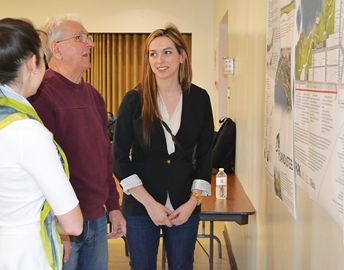
Nate Swain, president of the Friends of the North End Parks, addressed the board of the directors of the Rose Fitzgerald Kennedy Greenway Conservancy at its meeting Tuesday night.

Plans to open, operate New Orleans riverfront park in Bywater, Marigny remain …

Several months after a new $30 million riverfront park in Bywater and Faubourg Marigny was supposed to have been finished, it is still uncertain just when it will open, who will operate it, how it will be paid for and what types of events will be allowed to be held in it. Even its name, once seemingly decided, may be in question.

That was the message from a public forum held this week by an advisory committee created a year ago to give nearby residents a voice in how the park, stretching 1.3 miles along the river from Elysian Fields Avenue to Mazant Street, will operate.

The committee offered a long list of suggestions about when and under what conditions events such as concerts should be allowed at the Mandeville Street Wharf, at the park’s upriver end, but it was unclear just who will make the final decisions.

Landrieu administration officials have indicated for more than a year that they would like to assign management of the park to the French Market Corp., but a deal has yet to be concluded.

Ann Duplessis, interim executive director of the French Market, told the crowd of several dozen Marigny, Bywater and French Quarter residents that she wanted to hear their ideas and would try to see that they are implemented. But she said she could not give them any definite information. “It really is a good thing that we have none of the answers tonight because it means none of the decisions have been made,” Duplessis said.

In the absence of Deputy Mayor Cedric Grant, who is overseeing the project for the Landrieu administration, or any of the park’s designers, it was left to Lucas Diaz, director of the Neighborhood Engagement Office, which oversaw creation of the 11-member advisory committee, to speak for the city at Tuesday night’s event.

Diaz said the park — which less than a year ago officials were promising would open by the end of 2012, and as recently as January were saying would partially open this spring — would open “sometime in the next 12 months.”


map-riverfront-041013.jpg

View full size


Wednesday afternoon, Grant issued a statement saying the city is working to open the park “as soon as possible,” but indicating that it is likely to be a year away.  “The Mandeville shed, Piety Street Wharf and downriver park improvements are currently 85 percent complete,” Grant said. “Landscaping and seasonal plantings are being placed this spring. The remaining work on the project is related to the construction of the Mandeville crossing bridge, which has undergone redesign to simplify it and better accommodate underground utilities. It will be constructed later this year. The entire park is anticipated to be open to the public in spring 2014.”

New Orleans City Councilwoman Kristin Gisleson Palmer, whose district includes the park and the surrounding neighborhoods, said she also has had a hard time getting information about the park, even though she is a board member of both the New Orleans Building Corp., under whose auspices the park was designed and built, and the French Market Corp.

Palmer said she has been asking for a maintenance budget for the park for a year but has yet to see one. One of the chief worries expressed by some neighbors is that the new park — unlike Woldenberg Riverfront Park, a few blocks upriver, which is controlled by the Audubon Commission — will not be well-maintained or policed.

Duplessis said that so far, identified sources of potential revenue are not great enough to cover the park’s projected operating costs.

Palmer said she is not satisfied with plans for access to the riverfront park, primarily via a pedestrian bridge over the floodwall and railroad tracks between Elysian Fields and Mandeville Street, and another bridge several blocks downriver at Piety Street. She said she does not accept claims by the Port of New Orleans, Army Corps of Engineers and Public Belt Railroad that it would be unsafe to allow ground-level access through the floodwall even when the river is low.

Although the New Orleans Building Corp. board and administration officials seemed to have informally decided many months ago that the facility should be known as Crescent Park, Palmer said she wants to hear residents’ suggestions for names. She also said neighbors are not well represented on the French Market Corp. board and will need a greater voice in the park’s management if that agency ends up running the park.

The neighborhood advisory committee recommended limiting special events at the Mandeville Street Wharf — expected to be the principal site in the park for concerts, festivals and other events — to two days per month and requiring them to end by 6 p.m. on weekdays and 8 p.m. on weekends. It also called for setting noise limits, measured by decibel readings in nearby neighborhoods.

Palmer said the group needs to come up with a better definition of “event” and also called for bringing in sound and lighting engineers to advise on any restrictions. She said all the rules need to be in place before the park opens and the first events are held.

Tuesday night’s meeting focused on what activities will be allowed at the Mandeville Street Wharf. A second meeting April 30 will discuss plans for the downriver portions of the park, organizers said.

Plans for the new park were developed as part of a proposed $300 million overhaul of several miles of riverfront wharves between Jackson Avenue and the Industrial Canal, envisioned during former Mayor Ray Nagin’s administration. The “Reinventing the Crescent” project aimed to give the public access to parts of the riverfront that have long been off-limits because of warehouses and cargo-handling activities.

Besides the Marigny-Bywater park, the overall plan called for creating a similar park in the Lower Garden District, redesigning Spanish Plaza at the foot of Canal Street, expanding the Moonwalk opposite Jackson Square, and building a hotel at the foot of Julia Street and an amphitheater at the foot of Race Street, among other projects.

Whether any of those projects will ever come to fruition is unknown. The New Orleans Building Corp. decided to use the $30 million that the Nagin administration committed to the overall project to pay for the park in Bywater and Marigny, where the city already had legal control of the wharves.

The park is being built on wharves and a narrow strip of land on the river side of the floodwall and the New Orleans Public Belt railroad tracks. It will feature a more than mile-long path for walking, jogging and cycling, plus a dog run, play areas and extensive landscaping. Some earlier planned features, including a nondenominational sanctuary or pavilion at the Piety Street Wharf, have been deleted for financial and other reasons.

Downtown Greenway art proposal is unveiled

GREENSBORO — Two Massachusetts artists propose to turn a vacant lot on the Downtown Greenway into public art that celebrates tradition while creating a new gathering spot.

Mags Harries and Lajos Héder of Harries/Héder Collaborative unveiled their design on Wednesday for the West Smith and Prescott streets cornerstone, which has a theme of tradition.

The greenway’s public art panel chose the Cambridge, Mass., couple for their expertise in creating public art across the nation and internationally. In January, they came to Greensboro to seek the public’s ideas.

“We are hoping that this will be seen by folks as an invitation to come have fun here,” Héder told those gathered at the Greenway at Fisher Park Apartments near the site.

Called “Meeting Place,” their design depicts an open tentlike structure measuring 30 feet in diameter with seating, a small grassy stage, an organic orchard and native woodland vegetation.Continue Reading

The structure’s mesh roof will feature stainless steel script copied from letters written by city namesake Gen. Nathanael Greene to George Washington. Greene wrote his observations from Guilford Courthouse during the American Revolution.

Charlie Headington, a local gardening consultant, will plant the vegetation and orchard of cherry, pear, persimmon and plum trees. Local fabricators will create other elements.

Visitors will wander the site, which covers nearly a half-acre, on paths of crushed stone and gravel.

“Meeting Place” is the second of four major art installations to mark corners of the four-mile, paved recreational path developing around the city center. The project will be financed with $200,000 in private money raised for the greenway.

The first cornerstone, a towering metal sculpture called “Gateway of the Open Book,” stands on Lee Street.

Greenway Project Manager Dabney Sanders said she expects “Meeting Place” to be installed by year’s end.

Over the next five years, the nonprofit economic development group Action Greensboro and the city will use $26 million in federal and state money, local bond money and private donations to create the 12-foot-wide Downtown Greenway lined with landscaping and public art.

Those who gathered Wednesday agreed the community would use and appreciate “Meeting Place.”

“The neighborhood adjacent to this site is very active, so I think it’s going to be a great asset to that particular neighborhood especially,” city resident Joe Wheby said.

To Harries, the site can function in a variety of ways, such as an outdoor classroom with the orchard as a teaching tool and a place to celebrate the area’s tradition of music.

“Just come out with your instruments and jam together,” Harries said.

Before Harries and Héder showed their design, city officials cut the ribbon for the greenway’s third section along Smith Street between Eugene and Spring streets.

City Engineer Ted Partrick Jr. also showed the design for the greenway’s next phase. It will run from the intersection of East Lee Street and Murrow Boulevard, north under Summit Avenue, and end at the intersection of Fisher Avenue and North Greene Street.

To accommodate that 1.4-mile section, the city will narrow the three lanes on each side of Murrow Boulevard to two lanes, Partrick said.

The city doesn’t have funding for that section yet, Partrick said, but will complete the design so it can be built when the money becomes available.

Contact Dawn DeCwikiel-Kane at 373-5204, and follow @dawndkane on Twitter.

Kitchen tour shows marriage of décor, landscaping, architecture

The 2013 Kitchens in the Vineyards tour coming up April 27 will open five distinctive Napa Valley homes to visitors hoping to gather home décor, landscaping and architectural ideas.

“This is a beautiful time of year to see a wide variety of home styles from sleek contemporary to enchanting New Orleans Garden District,” said Julia Jervis, chair of the Kitchens in the Vineyards tour. “One house will be awash in white wisteria.”

The home and garden tour of kitchens, dining rooms and entertainment areas as well as gardens benefits the annual local chamber music festival, Music in the Vineyards. The self-guided tour takes place from 9:30 a.m. to 4:30 p.m. Saturday, April 27.

“We all like to see how other people live,” said Jervis, noting that throughout the tour’s 16 years, there have been no repetitions because of the generosity of the owners willing to open their homes.

This year the tour includes:

• A luxurious Howard Backen-designed estate in the hills high above Crystal Springs Road with bird’s-eye views of the valley, an extensive open layout, multiple alfresco dining areas and an entertainment pavilion with an infinity pool.

• A valley floor home, with New Orleans-inspired décor and a landscape that includes a cabernet vineyard, rose gardens, citrus plantings, pillared terraces and a lap pool.

• A “Villa Toscana” with a salon featuring European paneling and floors acquired from the de Young Museum, vast vineyard views, a pool and a Winged Victory-inspired sculpture.

• A remodeled classic California ranch-style home set on five landscaped acres.

• An extensively remodeled contemporary home with an entertainment area that includes pool, swim-up bar, waterfall and meditation room.

Jervis said a team of designers, florists, chefs, cookbook authors and 200 volunteers all donate their time and talent to make the event a success each year.

Each home is styled by designers and florists who create springtime table settings. At the homes, visitors will also find tastings of dishes prepared this year by a variety of local restaurants.

“I think anybody who goes on this tour will come away with lots of new ideas and recipes from all the foods they’ve tasted,” Jervis said. “The recipes will be printed in their program.”

Also on hand will be local authors signing copies of their books. This year featured books are “Michael Chiarello’s Live Fire: 140 Recipes for Cooking Outdoors from California’s Wine Country” by Claudia Sansone; “Plum Gorgeous” by Romney Steele; “Mac Cheese, Please!: 50 Super Cheesy Recipes” by Laura Werlin; “The NapaLife Insiders Guide to Napa Valley” by Paul Franson; “The Gathering Table” by Ronda Giangreco; “American Wine: The Ultimate Companion to the Wines and Wineries of the United States” by Linda Murphy; and “Cooking for One” by the Culinary Institute of America.

In addition, a raffle of prizes includes gift certificates to interior design shops, a one-night stay at the Westin Verasa in Napa, and a cooking class at The Apple Farm with Chef Karen Bates in Anderson Valley. Raffle

tickets are $10 each or 12 for $100 and can be purchased in advance or on Saturday’s tour.

The annual tour is limited to 750 people. Tickets for the self-guided tour cost $65 and are on sale now by calling 258-5559 or going online to MusicintheVineyards.org.

Inspired by New Orleans

One of the homes on the tour is the Jim and Lee Meehan residence, which reflects the life they once lived in the New Orleans Garden District as well as their current life in Napa Valley.

The couple describes their five -acre property, which includes 50 redwoods, 500 roses and 5,000 cabernet vines, as a “lagniappe” estate and vineyard. Lagniappe is a French Cajun word meaning “something a little extra,” they explained.

They bought the property in 1998 while still living in New Orleans and moved here in 2001.

Their former home wasn’t destroyed by Hurricane Katrina because of the elevation of the Garden District; the only damage was to the roof. The storm did cause many of their friends and neighbors to move away, which makes it harder to keep in touch, they said.

“We like a New Orleans lifestyle. You can’t get that city out of your system. We try to go back once or twice a year,” Lee Meehan said, adding that they’ve made a happy transition to this area and have found wonderful, friendly people here.

They enjoy their farmhouse with multiple French doors to terraces overlooking vineyards, the western hills and Mt. St. Helena. A guest house of native stone, features a cabana and wine-tasting room and blends with their home.

Their three-acre vineyard, planted in cabernet sauvignon grapes, has been farmed organically since 2003 and was certified organic in 2006.

“The kind of life we live here is certainly different from the Garden District,” added Meehan, who is on the “last stages” of writing a novel about an incident that happened in New Orleans.

“The property needed extensive work so we’ve spent the last 13 years doing projects,” she said. “We were asked a few years ago to do this tour and didn’t feel that our property was ready. When the committee came by they said ‘This is the kitchen of the vineyards.’”

What the Meehans love most is the kitchen, the heart of their home. “When you look out from the kitchen you are looking at vineyards,” Lee Meehan said.

Six French doors lead outside and a bank of windows allows light in and frames their view of the vineyards. The Meehans said they like to bring guests into the kitchen as they prepare food. Their guests always ask them where they’ve hidden their refrigerator and dishwashers, which can’t be seen.

They have high praise for their architect, Don Gross, who designed what they consider their dream kitchen.

“Don Gross did the property design as well as the kitchen,” Jim Meehan said. “He does an excellent job. It is an easy kitchen to have friends over. He made it sleek.

“After he finished the kitchen project, Don came over and cooked us a meal — not hot dogs on the deck. He uses the Thomas Keller cookbook. The meal was equivalent to eating at the French Laundry. Then he played jazz on our baby grand piano. He’s a unique individual.”

Check Out These Upcoming Tours of Homes and Gardens Nearby

It’s fun to check out some of the most amazing homes in East Atlanta Patch and throughout Atlanta. The various tours of homes offered throughout the city offers ample opportunity to see some of the best in interior design, landscaping and that special something that makes a home immaculate.

Here are upcoming tours of homes happening in East Atlanta and nearby:

  • Grant Park Home and Garden Tour: May 11, 11 a.m. to 6 p.m. and May 12, 1-5 p.m. Order Tickets Online – $20 for adults, $10 for children, (Children 3 and under free.) The tour begins at the park entrance at the intersection of Milledge and Cherokee Avenues. On the days of the tour, tickets will be available at our ticket booth for $25 each. The ticket booth is located at the park entrance near the intersection of Cherokee and Milledge Avenues.


  • 11th Annual Kirkwood Tour of Homes: May 19-20 (12-6 p.m.) See the results of loving renovations and new additions; enjoy the tree lined streets and home gardens; get interior design ideas from classic to funky-chic; and best of all, meet the people who make Kirkwood a great place to be. Find info about tickets on the Kirkwood Spring Fling site.


      • “Gardens of Eating” Decatur Garden Tour: April 27, 10 a.m. to 5 p.m. and April 28, 12-5 p.m. Advance tickets are available online and at Intown Ace and 17 Steps for $20. Fifteen gardens will celebrate combinations of herb, vegetable and flower gardens in Decatur, Winnona Park and Oakhurst.


      • 2013 Atlanta Symphony Decorator’s Show House Gardens: April 20- May 13, Set on a Buckhead estate, the 2013 Atlanta Symphony Decorator’s Show House Gardens is a grand chateau inspiired by the great architecture of France. With over 18,000 square feet of space, the house will come to life as the interiors are showcased with some of the Southeast’s most talented designers. For hours, ticket prices, and more info: click here.


      • Gardens For Connoisseurs (Fundraiser for Atlanta Botanical Gardens): May 11-12, 10 a.m. to 5 p.m. From tranquil woodland settings to intimate urban spaces, the 2013 Gardens for Connoisseurs Tour showcases 11 spectacular private gardens representing the finest in garden design. For ticket prices, ticket purchases and more info: click here


      Did we miss an event? Add it to the comments area below this article.

TECHNO FILE: Building a home in the digital age

IT WAS a little unnerving this time last week to wake up to a thin layer of snow on the mountains that are visible in the distance from this tiny and remote village in the eastern Free State that I like to call home.

It reminded me why I sometimes don’t like to call this home: it’s probably the coldest place in the country in winter, and winter, as seen in last week’s snowfall, can last as long as six months.

Add to the mix a rented, 100-year-old south-facing farmhouse with a mountain on its northern side that blocks out almost all of the winter sunshine, and it can be an almost unbearable place to live in winter.

What could have possessed the owners of the original farm to build this sandstone house in such an inhospitable position, other than the fact that it is a good vantage point from which to see and defend against advancing marauders?

Despite the fear and loathing occasioned by the rapid onset of winter, my beautiful wife and I have resolved to linger in this village a while longer and have purchased a sizeable piece of land on which not to make the same mistakes as were made by the designers and builders of the house in which we presently reside.

Of course, that’s a lot easier than it was 100 years ago, even if you don’t have a lot of money to do it with, although choosing a piece of land that gets lots of winter sunshine is an obvious first step.

After that, technology comes to the rescue, as you’d expect.

First, especially if it’s rural farmland you’ve acquired, you’re likely to have some difficulty figuring out where your land begins and ends, and the arcane system of geographic co-ordinates used by the land surveyor will probably look like Greek to you. Luckily, a quick Google search turns up an application you can download and install on your computer that converts the meaningless co-ordinates to something Google Maps and Google Earth can understand — and before you know it, you’ve got your piece of land mapped out quite precisely.

Next, you don’t need to be an architect or a rocket scientist to design in 3D the house you hope to build. Not only that, but you can actually position your design on your piece of land in Google Maps and see how it interacts with the sunshine and shadows at any given time on any given day of the year — using a free Google application called SketchUp (it’s a 35MB download and fairly tricky to operate, but there are many tutorials available).

Now that you’ve figured out exactly where to put your house, and in which direction it needs to face to make the most of the weak winter sunshine, you need to decide what it will look like.

Unlike 100 years ago, you need not be limited to what your imagination is capable of coming up with.

Simply download and install a smartphone app, such as the wonderful Houzz, and you immediately have hundreds of thousands of photographs and products to inspire you.

Houzz is specifically aimed at renovators and builders and has a section for every room imaginable, as well as exteriors and landscaping ideas. Swipe through the photographs (or, separately, products), tap to add something that strikes your fancy to your personal “ideas book”, and you can quickly build up a wealth of reference material to help you design your own home.

Websites such as the popular Pinterest (also a smartphone app), which lets you pin things you like on the internet to virtual pinboards, offer equally excellent ideas-gathering services.

Designing a winter-proof house has never been so easy.

Youngsters have say on Narooma landscaping


{ story.summary|safe|escape }

  • SCHOOL SAY: The students at Narooma Public School were consulted on what they want the Narooma Flat to look like…

AROUND 80 Year
Five and Six students from Narooma Public School last Wednesday had their say
on the design of the landscaping phase of the Narooma streetscaping project.

Eurobodalla Shire
Council project engineer Russell Burke and engineering cadet Tom Franzen
visited the students to show them plans of the road works and new roundabout
that are under construction.

The engineers
listened to their ideas on the landscaping that is to complete the works by
improving the streetscape along the Narooma Flat.

“The students
were keen to have their say and gave us great feedback by completing the phase
two survey and giving us drawings that represented what Narooma meant to them,”
Mr Burke said.

The students’
drawings were full of ideas about what they like to see included in the
landscaping design.

Eurobodalla Shire
Council Youth Committee members also contributed thoughts and ideas to the
project.

To date, Mr Burke
said 191 surveys have been returned to council and he and the consultant
landscape architects, Ayling Drury, agree this is an outstanding response
so far.

The community has
until this Friday to have their say by completing the landscape design survey
available at www.esc.nsw.gov.au

Hard copy surveys
can also be picked up at Narooma Library, visitors centre and depot and at Club
Narooma and ABC Meads Bakery on the Narooma flat.

Narooma
Streetscape Sunset Advisory Committee chairman and mayor Lindsay Brown said the
next step would be the preparation of a draft concept plan by Ayling and Drury
that considers everyone’s feedback.

“This concept
plan will then be presented to the community for further comment,” Clr Brown
said.

Narooma Sporting
and Services Club general manager Tony Casu said one concern was adequate
parking for the combined pool, NATA Oval and leisure centre complexes to allow
for say a swim meet and market on the same day.

The club wanted
to ensure its parking was not all taken and also had concerns about access to
club during the works and the final lay-out.

“A New Identity For Vauxhall” Ideas Go On Display At The Garden Museum

Entries from a competition organised by RIBA and the Landscape Institute, imagining the future of Vauxhall and Nine Elms, go on show from today at the Garden Museum. The competition attracted entries from 21 countries, including professional architects and students.

We’re going to be hearing a lot about Vauxhall and Nine Elms over the coming decade. The new US Embassy, dozens of new residential and commercial buildings, a new Tube extension, and the nearby regeneration of Battersea Power Station make for a heady brew of construction that will see the area transformed — so developers hope — into a continuation of the Southbank.

But it’s not all about buildings. As the Olympic Park demonstrated, open spaces, decent landscaping and coherent design are vital. Without them, new developments attract words like ‘soulless’, ‘identikit’ and ‘windswept’.

The images above show a few of the entries to the competition. They range from the fanciful (giant flowers over the rail tracks), to the historic (a resumption of balloon rides and the Vauxhall Pleasure Gardens), to the pragmatic (arches and parks turned to general cultural use).

The exhibition runs at the Garden Museum in Lambeth until 19 April.

The creativity conundrum

Life requires innovative thinking — but setting creativity as an academic requirement saps the spirit from imaginative pursuits

Recently, several American universities have started to revamp their degree programs by incorporating creativity into the curriculum in order to encourage innovation and clever thinking in real-world scenarios. Schools such as Oklahoma State University have implemented initiatives such as “creativity challenge[s]” to their campuses. The idea behind these new creativity programs is that students need to think about new approaches and original methods of problem-solving in their courses. The idea being that the more creatively a person can think, the more beneficial he will be to his field of study. These new innovation-driven curriculums are useful in theory, but teaching students to apply creative thinking to their studies via additional classes is immensely hard.

One of the main reasons for this difficulty is that creativity encompasses many different things. A set definition, aside from thinking in an original way, is hard to come by. From photography to poetry writing, there are countless ways of thinking in an inventive manner. Because of the various ways creativity can be expressed, teaching students precisely how to do so is highly complex.

Seeking to help students apply creative skills to their learning is a necessary goal — whether you’re making a product to sell or designing public policy, original thinking is fundamental to careers and to life. But creativity is not something that can be taught easily when it is regimented into the curriculum as an academic requirement.

Students often view requirement courses as obstacles to overcome rather than opportunities for introspection. A course on creativity, or a course that is explicitly designed to teach students how to be creative in their work, should fall into the latter category. But how can universities mandate teaching creativity without sacrificing the liberating attitude that should accompany courses that allow the imagination to flourish?

The most comprehensive solution is an overhaul of course instruction. If innovative and original reasoning were surgically implemented by all instructors to their courses, creativity could be taught on a holistic level, and in a way that would be highly applicable to the subject matter. For instance, an introductory environmental sciences class could discuss innovative methods of data-taking or ecosystem monitoring, thus encouraging creative thinking that simultaneously requires ample knowledge of course material as well.

University of Kentucky faculty have come up with a somewhat similar approach, in that “faculty members must arrive at their own definition of creativity and build their courses around it.” Even though the Kentucky creativity program applies creative thinking to a wide range of fields — from landscaping to geography — the university still designates creativity as a requirement. This method of teaching satisfies some students: “this is the only [class] that asks me about myself.” It angers others: “why are you making me take this worthless, do-nothing class?” The second quote says much about the nature of creativity in that its hard to define, elusive character often provokes frustration, particularly when forced.

Teaching creative habits in colleges must be done discreetly, by forcing students to work with subject matter and concepts in clever, new ways. This strategy prevents creativity from being taught as a distinct concept or separate skill that students can simply dismiss as an area in which they are weak. Instead of making creative thinking something that lasts for a semester, in a specific class, universities should strive to implement it into curricula in such a way that it is mandatory and learned by practice, rather than by discussion.

The main problem with teaching creativity in universities, however, is that the concept of creativity itself is very hard to grasp. John Cleese, when asked where he got his ideas, replied “I get them from a Mr. Ken…who sends them to me every morning on a postcard. I once asked Ken where he got his ideas from and he gets them from a lady called Mildred…he once asked Mildred where she got her ideas and she refused to say. The point is, we don’t know where we get our ideas.”

All people have a capacity for creativity, but some are more apt at expressing it. Perhaps cultivating creative thinking and reasoning in youth would lead to more innovative thinking and problem-solving in students and less confusion about how to generate or enhance this thinking at the university level. Until educators carry out this type of cultivation before college, however, students will continue to need creative instruction in higher education, in order to be successful. The ideas behind this instruction are benevolent, but unless they can be administered in a way that is requirement-free, they will fall very short of their goals.

Walter Keady is a Viewpoint writer for The Cavalier Daily.


Officials wowed by ideas for proposed park

18 hours ago  |   

University students present concepts for Penetanguishene waterfront


Bookmark and Share

Photo : Nikki Million-Cole

University of Guelph students Emily Kitamura, 19, and Jonathan Behnke, 22, explain their vision for the proposed Champlain Park to Penetanguishene Mayor Gerry Marshall.

<!—->

18 hours ago University of Guelph students Emily Kitamura, 19, and Jonathan Behnke, 22, explain their vision for the proposed Champlain Park to Penetanguishene Mayor Gerry Marshall.

‘));
jwplayer(“UIVDO”).setup({
stretching: “uniform”,
flashplayer: “/portals/_default/skins/zuza/resources/player.swf”, skin: “/portals/_default/skins/zuza/resources/blueratio.zip”,
image: ” + _$adActive.attr(‘vdoBG’) + ”, width: 542, height: 275, file: ” + _$adActive.attr(‘vdoURL’) + ”,
‘events’: { onReady: function () { jwplayer(‘UIVDO’).play(); } }
});
}
} else {
$(‘.ad-image-wrapper’).css({ ‘display’: ‘block’ });
$(‘div#UIVDO, div#UIVDOWRAP’).remove();
}
}
});

Midland Mirror

by   Nikki Million-Cole

PENETANGUISHENE – A permanent structure focusing on town history and bringing together land and water was one of 11 plans for the proposed Champlain Park presented last week in Penetanguishene.

Fifty-five students from the University of Guelph’s architectural landscaping program spent the last few months working on designs for a new waterfront park to commemorate the 400th anniversary of French explorer Samuel de Champlain’s landing in the area. The students were on hand April 4 at Brian Orser Hall to explain their visions.

“They’ve given us a lot of food for thought,” Dave Dupuis, a member of the Penetanguishene Champlain 2015 committee, told The Mirror. “A lot of them have amazing uses for different sections of the park.”

Mayor Gerry Marshall said he was awed by what the students managed to put together in a few months.

“A lot of the new concepts the students came up with were never thought of before and were pretty impressive,” he said. “They (also) thought how to mask some of the eyesores … and I like how they thought their way through the history.”

Dupuis said he saw good parts in many of the presentations that the committee will consider incorporating: “We definitely intend on using some of the ideas. It’s going to take a while to take it all in. There’s so much information.”

Marshall added the students’ work will be displayed for citizens to view, in the hopes of generating some feedback.

“Council needs to look at Rotary Park and decide which one of these concepts best matches the vision for moving forward, then take elements of other designs that fit into it,” he said.