Rss Feed
Tweeter button
Facebook button

How this Cebuano landscape artist nurtures nature

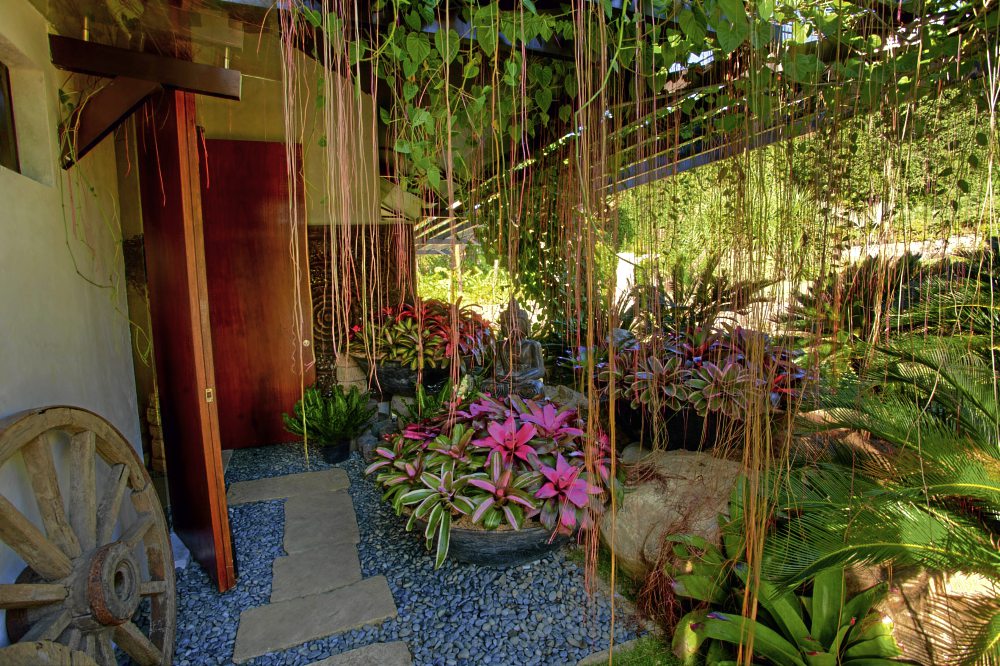
MULTI TEXTURES Stones on the pavement, rich wood, colorful bromeliads, lush ferns and hanging leaves all combine to create a variety of textures. PHOTOS BY JOEY AND LOUIE ENARIO OF NEEDS SOLUTIONS AND STANLEY ONG

Plant nurseries are curious places. They deal with the transience and mutability of nature: decay and rebirth, a lack of permanence, and the fact that everything is dependent on something else. Imagine then a garden within a nursery, set on two hectares of fertile land, and you get an idea that this garden, which is an extension of the nursery, changes with two seasons of wet and dry.

It’s a lot of work and dedication, but luckily there is someone happy to do it.

Plants are a consuming passion for Cebuano architect, landscape artist and gardener Jaime Chua, whose penchant for organizing things and creating settings helped get him started in gardening.

VRIESEA imperialis

“I love plants and I always wanted to organize things, make nice environments. My background in architecture was motivation for me to create a total setting to situate a structure in.

Architecture is also dependent on planning; even if a garden may not seem like it’s been planned, there’s always some form of order that goes into its creation,” says Chua.

From the driveway, a separate path leads to the gardener’s weekend house which fronts a serene lotus pond. Clearly meant to be a perch from which you can look at the rolling terrain, the house is a glass box with a view deck. Perfect for admiring the scenery with friends or quiet reflection at sunrise or sunset.

Stunning and exotic species

SUNNY CORNER Vignettes with potted plants and flowers like these are effortlessly composed throughout the house.

The nursery begins where the garden naturally seems to end. There, huge Japanese majestic Vriesea imperialis are carefully planted for their immediate effect on the surroundings. The most stunning and exotic species of flowering tropical plants and shrubs like giant bromeliads and palms make up parts of the huge lawn. Neat rows and hangings of Tillandsia, Neoregelia, Medinilla, strapleaf Vandas, Phalaenopsis doritis and Heliconias fill up several sheds built over a slope.

NATURAL STYLE Background and foreground blend seamlessly in the open and airy dining area for guests.

Tall hedges of different varieties of bamboo surround the property; some are bagged and balled ready for transporting to a new landscaping project, others set firmly on the ground.

For Chua, gardening has to be an active pursuit. It can’t be a hobby you can start and put down like a crossword puzzle. He goes to the nursery at least twice a week for some handwork and digging. Even with workers around to do the daily nurturing, he still believes that working the soil yourself makes you a better gardener. It is the only way to learn, and a great part of learning is making mistakes. There will always be a chance to plant something new, if something doesn’t work.

“Watch, observe, be patient, nothing grows overnight, but most of all enjoy your plants. See what the weather gives you and learn that there are things you cannot control, and you will just have to adapt to.”  Words of wisdom from someone who loves making gardens happen.

Reprinted from Vol. 5 No. 1 of Cocoon Magazine, with Wynn Wynn Ong on the cover, and available at selected magazine outlets nationwide.

Lawns face a rocky future in the suburban landscape

PHIL KADNER
pkadner@southtownstar.com | (708) 633-6787

July 10, 2012 6:54PM


Updated: July 11, 2012 2:14AM

Driving through south suburban neighborhoods observing all the brown lawns, I began wondering how long it would be before people started planting rock gardens.

I decided to bounce the idea off Mark Sipes, owner of Prairie House Garden Center in Orland Park, to get his opinion.

Mark’s mother, Geri, opened the garden and landscaping center at 151st Street and Harlem Avenue when that street still was a dirt road south of the store.

“I don’t know about rock gardens, but people might want to consider zero scaping,” Sipes said.

I had no idea what that was, but if it meant not having to plant things, grow things or water things, I was all for it.

Not that I don’t love greenery. I just have no luck with the stuff and it takes a lot of work.

A zero scape is apparently a landscape that doesn’t require any maintenance whatsoever
and includes rocks and desert plants such as juniper, yucca and cacti.

“They’re very popular out in Colorado right now,” Sipes said.

I vaguely recall a suburban homeowner spending a lot of money on a rock garden a few years back, in Burbank, and village officials went bonkers.

They threatened fines, wanted the woman to dig the whole thing up and replace it with grass, and she was ostracized by her neighbors.

Suburban folks used to get really touchy about their neighbors’ grass, and in many villages in the Southland they’ll fine you a hefty sum if you let the stuff grow a foot or higher.

I told Sipes I was thinking about replacing my front lawn with a natural garden.

“Those fields of wild violet I see growing in vacant lots and along the roadsides look real pretty and no one has to care for them,” I said. “Of course they’re weeds, but I could never tell the difference between weeds and natural gardens anyhow.”

Sipes said that anyone living in Orland Park could probably get away with such a thing “because if they tried to give you any grief you could tell them your place still looks a heckuva lot better than the police station.”

Orland Park a few years back spent thousands of dollars on a natural garden in front of its new multimillion-dollar police station.

“It looks like a big patch of weeds,” people would say.

And village officials would say that it was just natural growth and it would take some time to become all pretty.

After a few years, it still didn’t look pretty.

“It was hideous,” said Sipes, using technical landscaping terminology. “Ugliest thing I’ve ever seen.”

So the village ripped the whole thing up, spent thousands of dollars more for new natural plantings, and hired a guy to do some weeding.

“And it still looks hideous,” Sipes said. “I don’t know what they planned to do, but it just looks awful.”

I could do that.

Weeds are my specialty. I can grow them two, three, four feet high without even trying.

Sipes said that although this year’s drought has been tough on lawns, he estimates most of them will rebound nicely.

But I had a different theory.

I think the price of water in the suburbs, along with the economic downturn, has many of my neighbors wondering if a pretty lawn is worth the price.

I mean, would anyone in their right mind sprinkle hundreds of dollar bills on their lawns each month just because all that green looked nice?

That’s what watering a lawn amounts to, what with Chicago raising its water rates to the suburbs 15 percent a year and Oak Lawn about to spend a boatload of money on a new pumping station and water lines to the southwest suburbs.

“It might make sense to go minimalist,” Sipes said. “But I
don’t think rock gardens would
be attractive without some plantings.”

I did a little research and found out that in addition to zero scaping there’s also something called xeriscaping that involves drip irrigation, drought-tolerant plants and mulching that allows an area to remain more green than zero scaping.

In addition to the cost of water, there’s another factor that may be at work in the brown fields of the Southland.

It seems to me the drought has gotten people to thinking: Was maintaining my lawn really worth all the work?

There’s the fertilizing, the edging, the weed whacking and a lot of stuff that really comes down to pride of ownership vs. the loss of free time.

I mean, who really cares if you have a brown lawn? Don’t dandelions look like flowers to a child who doesn’t know any better?

And if we’re concerned at all about the future of the planet and the future of our children, shouldn’t we be conserving every drop of water we can?

And saving money on the lawn might even provide enough extra cash to pay the property tax bill.

Going Native: Green Landscaping with Native Plants

Native Plants

Native plants are, simply put, plants that naturally grow and have evolved in the area you live. People who are concerned about sustainability, personal health, water quality, natural habitats and creating an attractive, easy to care for option for their lawns and gardens often turn to landscaping with native plants, which is sometimes called “naturescaping.” Some people try to replicate conventional landscaping practices with their naturescaping endeavors, and others try to create a completely natural environment. Whichever way you choose to begin with native plants, this article will give you some insight on the basics and benefits of naturescaping.

Naturescaping vs. Landscaping

Landscaping is generally the practice of removing many native plants and replacing them with nursery plants. These nursery plants are the mass market flowers and shrubs that you see in typical gardens across the country. Landscapers typically like to work with these plants since the results are the same every time and the plants themselves are popular due to popular gardening magazines, radio programs and television shows. Most landscaping practices come from a strong tradition of contractors, homeowners, nurseries and landscapers that have learned one way to do things and decided to cling to it. These landscapes often require intense watering and chemicals to survive since they are not natural or native to the area they’re planted in. Naturescaping is the practice of throwing all of that out the window and going back to biodiversity and native plants.

Low Maintenance

The first thing that might attract your attention about native plants is how low maintenance they are compared to plants used in traditional landscaping. Native plants generally only require water while they’re getting established. They grow to predictable sizes because natural predators keep them in check. They are resistant to diseases so they do not need any synthetic chemicals, and they also exist happily without any fertilizer beyond what is already there. The natural process of life and death affects native plants, but they sustain their own lifecycles and basically look out for themselves. Some gardeners may wish to remove dead plant matter, but it can work as excellent fertilizer for surviving plants and also act as food for animals. Essentially, native plants take care of themselves and save you plenty of time while looking beautiful.

Sustainability

Perhaps the most notable feature of naturescaping’s green nature is that it requires no synthetic chemicals—you know, the kind that cause cancer and creep into the water supply. Water usage is typically very low on native lawns and gardens, which preserves a precious resource for more essential human and ecological needs. Naturescaping also saves money on edging, trimming and mowing and reduces the noise and air pollution from all of them.

Natural Habitat

A naturescape is also a functional habitat, which helps to sustain itself and give back to nature. Birds, butterflies and other wildlife will become a part of your naturescape. They have evolved along with these native plants, and they help one another to thrive. Replacing a lost habitat with these plants provides food and shelter for animals, many of whom people actively seek out with feeders and other store bought objects. Song birds, which are having a particularly tough time in our modern urban environments, will reap extreme benefits from native plants. Harmful insects and diseases will mostly leave your naturescape untouched since these plants have already evolved to resist them. Planting native plants helps to reform a balanced, natural habitat around your home.

When we look to native plants for our lawn and garden needs the workload is minimal but the rewards are vast. If native plants sound like something you’re interested in, you can visit PlantNative for planting tips as well as lists of plants that are native to your area.

Photo by Luke McGuff

Related posts:

S.F. ‘nanoclimates’ create gardening challenges

We talk about San Francisco’s local microclimates, but really they’re more like nanoclimates. Every neighborhood has been dealt a different hand of temperature, moisture, soil, lot sizes, drainage, slope, weeds and pests. Home gardeners come to know, sometimes the hard way, what their yards’ felicities and limitations are; smart nurseryfolks can advise customers about plant choices.

How does a professional garden designer cope with all these variations? We asked Janet Moyer and Michael Huffman, who combine 23 years of local experience with cutting-edge technology that gives a garden just the amount of water it needs – and not a drop more.

With clients all over the city and almost 500 gardens they’ve designed and built, Moyer and Huffman know the terrain well. “The Mission has the warmest climate, the nicest soil and the least wind,” Moyer says. “There’s more organic matter in the soil there. On the western edge the soil is very sandy. You have to choose your plants carefully. The most challenging areas? I’d say west of Twin Peaks. Mount Davidson is the most challenging because of the fog and wind.” Low valley spots get colder in winter and are less suited for succulents and other frost-tender plants. Noe Valley, where the weather and soil are good and the lots are a bit larger than average, is one of her favorite locales.

Edible plants are also vulnerable to local conditions. Citrus and figs thrive in the Mission. “Meyer lemon does best with a little more warmth, but can grow in all areas of the city,” Moyer said. “Not all vegetables do well in San Francisco, but cherry tomatoes are pretty productive.”

Even weeds can be local: for Moyer, pellitory of the wall is “Potrero Hills stickyweed.” Obnoxious as it is, pellitory has one redeeming quality: it’s the larval host plant for the red admiral butterfly. “Areas protected from the wind are more likely to have insect pests,” she said. Gophers are abundant in the Avenues, less so in the Mission.

Huffman handles the tech end of the business. Many of the couple’s clients have adopted “smart” irrigation controllers with local weather stations to activate them. “Local control is best in places like Forest Hills, where the topography makes it difficult to receive a satellite signal,” Huffman explained. “The satellite version has a one-day lag. But with the local system, if it rains enough today it won’t water tomorrow. You just set it and forget it.”

The systems not only reduce water use, they benefit the plants. “What we’re trying to advocate is having the plants be healthy but not grow too fast,” said Huffman. “We provide only the water the plants need. That means the owner isn’t taking a lot of greenwaste to the dump.” Each plant has its own emitter: “The most effective irrigation is individual. We can determine how much each plant gets, the same way it’s done in vineyards.”

Moyer and Huffman showed us two representative projects. One, in the Mission, had been a small, deep slope dominated by a huge New Zealand flax plant. “Originally there was no way to get access to the garden,” Moyer recalled. “We came up with a plan to bridge the space.” They planted miniature roses to suit the scale of the site; Meyer lemon and Bearss lime trees, native sage and alum-root, hellebore and impatiens; all in terraced beds, walkable yet narrow enough to seem a mural of color and scent for the patio at the back door.

The other garden, near the Ingleside, combines ornamentals and edibles in a more expansive backyard. “The owners had planter boxes but didn’t want to fill them until we had designed the rest,” said Moyer. “We placed them for the best sun and to least visual impact.” They’re now full of mustard, chard, onions, strawberries and mint, and surround a beehive. “We designed around a Meyer lemon tree and a Japanese maple.” The trees now have an understory of perennials, and anchor an inviting path.

The Meyer lemon trees in both gardens seem content, in very different spaces. Knowing precisely where to push the nanoclimate envelope seems to pay off.

Joe Eaton and Ron Sullivan are naturalists and writers in Berkeley. E-mail: home@sfchronicle.com

Then and Now: Herndon’s Gardening Pride

In 1935, some of the women of Herndon formed The Home Interest Garden Club of Herndon. Their club objectives included promoting interest in gardens, protecting windflowers and shrubs, encouraging civic planting and landscaping, and encouraging the culture of flowers among young people. 

Charter members of the club were Mrs. George Bready, Mrs. Harry Bready, Mrs. Arthur Buell, Mrs. Harvey Hanes, Mrs. Cassius Lawrence, Mrs. Russell Lynn, Mrs. William Myer, and Mrs. Floyd Thompson. Mrs. Lawrence served as its first president from 1935 to 1937, and the first meeting was held in her home. They approved the rose as the club flower and limited club membership to 25 people; they later increased their numbers to about 45 members.

Some of their early projects included:

  • Erecting a stone entrance and an iron gate at the Chestnut Grove Cemetery.
  • Furnishing a water pipe line to run Town water into the cemetery.
  • Joining the Virginia Federation of Garden Clubs and conducting flower shows.
  • Holding flower arrangement lectures and demonstrations.
  • Arranging for a shelf on gardening and related subjects to be set aside in the Fortnightly Library.

During World War II, the Club members engaged in many activities to help service members and the wounded, such as making surgical bandages and knitting afghans. They sent the proceeds from one of their flowers shows to the Fort Belvoir Hospital and to the Red Cross to help decorate veteran’s rooms with potted plants.

Post-war projects included helping to beautify the Herndon Town Green. They planted azaleas and a silver birch on the lawn and made Christmas wreaths for the Town Hall building. Additionally, they planted bulbs along the banks of Folly Lick Creek.

In 1956, a memorial garden was established in Chestnut Grove Cemetery to honor the club members who had passed way. The garden featured two marble benches, a birdbath, and various plants including boxwoods, azaleas, and bulbs.

By 1969, the Club had resigned from the Virginia Federation of Garden Clubs because it was too difficult for their aging membership to drive to district and state meetings. However, they continued their beautification efforts around town.  They planted 23 dogwood trees along Van Buren Street and made numerous efforts to remove debris from the streets and public areas of Town.

In 1975, members of the Club took on projects in preparation for the Town’s Centennial celebration. They cleared the old John Coleman cemetery of honeysuckle and trimmed the trees. (Coleman was a Revolutionary War veteran who built the first house in Herndon.) They also donated 100 tulip bulbs and money for benches in the area of Town Hall and the Depot.

The Herndon Home Interest Garden Club had about 185 members during the years from when it was established in 1939 until it ceased operating in the late 1980s. The last club president, as listed in a 50th anniversary document, was Mrs. Ruth Updike.

Today, the gardening spirit continues to live on today among Herndon residents. In 2004, the Town established the Cultivating Community Initiative (CCI). Robin Runser, who at that time was the Town Public Information Officer, served as the first chair. The CCI members are citizen volunteers who work in collaboration with Town staff.

One of the missions of the committee is to encourage neighborhood beautification. Herndon’s annual Garden Tour and the Yard of the Month recognition program are sponsored by the CCI. Early CCI literature explains, “As the beauty of the garden reflects the work of the gardener, the appearance and health of a community reflects the collective effort of its residents to maintain it. By taking pride in your home and neighborhood, you can set an example for everyone in the community and influence your neighbors to engage in similar efforts.”
 

Remembering Herndon’s History is written by members of the Herndon Historical Society. Barbara Glakas is a member. The Society operates a small museum that focuses on local history. It is housed in the Depot and is open every Sunday from noon until 3:00. Visit the Society’s website at www.herndonhistoricalsociety.org for more information.

Note: The Historical Society is seeking volunteers to help keep the museum open each Sunday. If you have an interest in local history and would like to help, contact Carol Bruce at 703-437-7289 or carolbrcom@aol.com.

Green thumbs mean dollars for church

COLUMBUS — A stroll through local gardens will help support St. Bonaventure Catholic Church.

The annual “Come Walk … In the Garden” will be held 4:30-8 p.m. Tuesday.

Those who purchase a ticket can view the gardens and landscaping at homes of five local residences.

Tickets cost $6 and are available at Tooley’s Drug, Wilke Landscape, Barbara Jeans, Earl May, Hy-Vee and the church rectory, 1565 18th Ave.

Past garden tours have helped pay for renovations to the rectory. This year, the funds raised will go toward purchasing and installing cupboards in the entryway of the church.

Addresses and maps to all the homes are available when the tickets are purchased. People may visit the sites at their own leisure and in any order they choose. All of the homes are located in the northwest part of town.

Because of water hazards, children are not allowed on the tour.

Mike Pilakowski, an organizer of the event, said the houses will feature a variety of landscaping including flowers, gazebos and water features.

The garden tour has been a popular event and is in its sixth year.

“It was our very first fundraiser we ever had, and it was successful,” Pilakowski said. “People enjoy walking through the gardens, seeing the flowers and getting ideas for their own yards.”

Typically, about 300 people attend the event, said Jody Bargen, another organizer.

“We’ve been pretty fortunate every year to find people who are willing to be a part of it,” she said.

Over the past five years, tickets sold have raised enough money to completely renovate the rectory. Bargen said hopes are to get enough funding from this tour to fully pay for the cupboards, and then settle on another project next year.

Along with viewing the landscaping, people also can win a variety of raffle prizes. The prizes include a gift certificate from Wilke’s, a terrarium and a basket of gardening products from Marc Chemicals.

Also available will be purses for sale, glass art and gardening aprons.

Master Gardeners: Rerouting the rain to reduce runoff can enhance landscape – Marin Independent

BEFORE MAN BEGAN constructing buildings and paving roads and parking lots, when rain fell on the earth it percolated down through layers of sand and soil and eventually entered the water table below the surface. When rain falls on solid buildings and paved surfaces, it runs around them often causing serious erosion. In modern cities, this runoff water is collected in storm drains which route the runoff to the nearest body of water.

In the Bay Area, storm drains typically flow into streams, eventually flow into the bay. Storm drains, which are expensive to build, collect water often containing petrochemicals, pesticides and herbicides. The runoff is often warmer in temperature than the water in the rivers, streams, lakes or ocean into which the runoff flows. Adding polluted or warmer water to natural water bodies causes changes in their ecology, sometimes killing native species or causing destructive plant or algae growth.

In 1990, while designing a subdivision in Prince George’s County in Maryland, David Brinker developed a plan to collect rainwater in gardens, rather than allowing it to run off into storm drains or be collected in a storage pond. One immediate benefit of these “rain gardens” was economic: the cost to build storm drains for the subdivision would have been $400,000. The complete cost of the rain gardens was $100,000.

The gardens were aesthetically pleasing, and the water was retained

in the local soil. The rain gardens reduced storm water runoff from 75 to 80 percent, according to flow monitoring done in later years. These prototype rain gardens spawned a whole landscaping movement now known as Low Impact Development.

The concept of rain gardens is simple:

• Identify where water will run off a building or parking lot.

• Plant gardens that will contain the water long enough for it to sink into the ground. Homeowners may check the drain spouts from the gutters that run along the edge of their roof. A pipe may be used to carry the water away from the foundation of the house to a garden area.

Make sure the plants in this area can tolerate damp roots during the rainy season of the year. Robust native plants that grow at the edge of wetlands, such as sedges, rushes, ferns, select shrubs and small trees, will do well in these conditions. If a low-lying area will contain water much of the time, it is called a wetlands rather than a rain garden. Rain gardens allow water to infiltrate — sink into — the ground in about 48 hours.

Commercial buildings and parking lots are more complex, but the principle is the same. Raised berms or depressed swales may be used to contain and collect water. In order to obtain a commercial building permit, the applicant must demonstrate how runoff will be dealt with.

In one case I am familiar with, the original plan called for the use of permeable paving stones in the parking lot rather than impermeable asphalt. A thoughtful landscaping plan using a series of planted berms to keep the water inside the property and out of the storm drains provided a much more economic solution.

For more ideas on rain capture and plant selection, visit the Sonoma County Master Gardener website http://tinyurl.com/bwzvfb8or or read the UC Cooperative Extension and SeaGrant joint publication at http://tinyurl.com/d8475dc.

One doesn’t have to be a subdivision developer or a commercial contractor, however, to take a step toward keeping rainfall from running into storm drains. The first step is conscious awareness: each householder should examine his or her own property to determine where runoff goes. The second step is to find a way to create a rain garden to capture the runoff and, using the appropriate plants, keep the water in the soil.

If we, as individuals, take responsibility for minimizing runoff from our own homes and properties, we can help minimize the negative effects of runoff on our streams, lakes and incomparable San Francisco Bay.

The University of California Marin Master Gardeners are sponsored by UC Cooperative Extension. For questions about gardening, plant pests or diseases, call 473-4204 from 9 a.m. to noon, and 1 to 4 p.m. weekdays, or bring in samples or pictures to 1682 Novato Blvd., Suite 150B, Novato.

Home-grown veggies take cake

FINANCIAL pressures and a greater demand for organic products have inspired a trend of kitchen gardens.

Anne Gibson (left) and Cath Manuel at the kitchen garden display at the Queensland Garden Expo.

FINANCIAL pressures and a greater demand for organic products have inspired a trend of kitchen gardens.

Gourmet lettuces, spinach, tomatoes, cucumber, chillies and strawberries are increasingly being grown in residential backyards and picked fresh for the dinner plate.

And it is not just home owners discovering their green thumbs. Renters are learning the smallest of spaces can be turned into an edible oasis.

The 2012 Queensland Garden Expo is expected to attract more than 30,000 visitors this weekend at Nambour Showgrounds.

The event, which opens today, has the biggest collection of sub-tropical plants in Australia and offers a fun day out for the whole family.

Event organiser Marion Beazley said the Giant Kitchen Garden would be popular

“Nurseries have noticed an increasing trend in people investing in fruit trees and growing vegetables, but there are a lot of questions out there,” she said.


Garden Expo

Info: www.qldgardenexpo.com.au.

Where: Nambour Showgrounds, Coronation Ave.

When: Today until Sunday.

Gates: Open 8am daily. Close 5pm Friday and Saturday, 4pm Sunday.

Calgary Custom Landscaping Company Completes Project at Calgary Zoo

Calgary, Canada, July 06, 2012 –(PR.com)– Ron Jones, President, Ananda Landscapes, has announced that the two custom landscape projects that the Calgary landscaping company was working on for the Calgary Zoo have officially been completed.

Corinne Hannah, Head Horticulturist for the Calgary Zoo, commented, “We couldn’t be happier with the way these projects turned out. The workmanship of Ananda Landscapes is exceptional and both projects look fantastic. We can’t wait for the weather to improve so everyone can come down and see them!”

Ananda Landscapes completed custom landscaping work for the Zoo’s Dorothy Gardens surrounding the new armillary sundial art piece and their garden gazebo. The armillary sundial was built in 2008 and placed at the Calgary Zoo as a 100th anniversary project for the Calgary Horticultural Society, and the Zoo’s gazebo is one of Calgary’s top locations for garden weddings.

“We would not hesitate to hire Ananda Landscapes for a third project at the Zoo,” concluded Hannah. “They were great at communicating with our staff, they were reliable, and they were safe in their business practices; something that is very important to us here at the Zoo.”

About Ananda Landscapes
Since 1978, Ananda Landscapes has been providing individuals and families, primarily within the Calgary and surrounding area, professional landscaping services and products including an array of heat sources, night lighting and water features. At Ananda Landscapes we know that landscape design is more than simply plants and patios; it’s about creating lifestyle opportunities. It is our passion to help you envision, design and build the biggest and most exciting room on your property: your yard—and without restrictions. Wherever it is that you live, Ananda creates outdoor living spaces for every person and answers to every type of lifestyle.

Ananda Landscapes | 403.851.0161 | Calgary, Alberta | www.anandalandscapes.com

Ornamental kale not great for eating

ONE of the best things about working in a garden centre is that I'm constantly learning about new plants.

Edible kale should be planted in the cooler months.

ONE of the best things about working in a garden centre is that I’m constantly learning about new plants.

These plants may not be new release or even new to you, but there are so many plants out there that each day it feels like I’m being told or shown something new.

Vegetables are especially hard for me to keep up on.

There are just so many different varieties out there, it would be impossible to know them all.

One which has recently come to my attention is kale.

Now if someone last year asked for kale, I would have told them that my lovely ornamental kale is only available as the weather gets cooler.

Even though it is closely related to broccoli, cabbage and cauliflower, it is not recommended that you eat ornamental kale.

Ornamental kale looks very much like brightly coloured cabbages, with white or purple-pink centres and green outer leaves. The heads are made up of closely packed leaves with frilly or serrated edges.

Ornamental kale is a popular garden plant that enjoys the cold weather and is commonly seen in southern or European gardens as a boarder plant. I personally love them in a pot surrounded by white asslyum.

I have recently found out that there is also edible Kale and this edible kale is one of the best nutrient-rich vegetables around.

During the Second World War , the cultivation of edible kale was encouraged by the Dig for Victory campaign. It was easy to grow and provided important nutrients to supplement those missing from a normal diet because of rationing.

Even though edible kale has been around for years I didn’t realise I was enjoying it on a regular basis. I have only known edible kale as boerenkool. Boerenkool is a Dutch word which means farmer’s cabbage.

Edible kale is still part of the cabbage or Brassica oleracea Acephala group.

It can be green or purple, but the central leaves do not form a head.

Edible kale is very high in beta carotene, vitamin K, vitamin C, lutein, zeaxanthin, and reasonably rich in calcium. It is also a good source of carotenoids.

Edible kale contains sulforaphane, a chemical with potent anti-cancer properties. It is also a source of indole-3-carbinol, a chemical which boosts DNA repair in cells and appears to block the growth of cancer cells.

Growing edible kale is very easy and can be done in pots or the garden. As with any plantings, make sure you use a good-quality garden soil or potting mix, a complete slow-release organic fertiliser when planting and liquid fertilise fortnightly with a complete organic liquid fertiliser.

Plant edible kale during the colder months as it tastes sweeter after being exposed to a frost.

To read more lifestyle stories.