Rss Feed
Tweeter button
Facebook button

New life floods into the Olympic Park: how £6bn legacy is transforming east …

But the factor most to blame for London going cold turkey was, perhaps,  that the Olympic Park — the focal point of the event — was off limits to the public within hours of the end of the Paralympic closing ceremony.

Many felt that Boris Johnson, by allowing the gates to be padlocked, surrendered to the demands of engineers and project managers to have the whole site back for conversion work. The feelgood factor had been unnecessarily snuffed out, it was claimed.

This week, the Evening Standard took a tour to check on progress of the £6 billion makeover of the Lower Lea Valley, and learn of the Mayor’s plans to connect the Games site to the residents who have been promised so much.

Media trips past the security fence have been strictly limited in the six months since the Olympics — and first impressions confirm why. Much of the park has the feel of a building-site-cum-ghost-town.  Nature plays its part in this bleak picture, as our Land Rover is buffeted by Siberian winds and snow flurries. The park had sported gardens, blooming meadows and lawns, but now the only dash of colour is a few primroses on the riverbank by the media centre.

Some of the venues where dreams were made or broken, and spectators thronged, now have a haunted feel. The basketball arena and water polo complex are being dismantled, the hockey arena has long since disappeared. But undoubtedly the biggest hole is the absence of spectators. At peak times during the Games it felt like Oxford Circus at rush hour as up to a quarter of a million ticketholders criss-crossed the park. Where there was once a sea of flag-waving humanity, the packed thoroughfare that had been overlooked by the BBC studio is now being turfed over.

Mr Johnson, a Games evangelist, has insisted the Olympo-sceptics who had been confounded by the success of London 2012 will be proved just as wrong about the legacy of the park.

The Mayor made himself head of the London Legacy Development Corporation weeks after the Games — ruthlessly sidelining the incumbent — in a considerable boost for the prospects of the project. The corporation has hired much of the expertise from the London 2012 construction agency, the Olympic Delivery Authority, and has a £292 million budget for converting sports venues, removing temporary arenas, building a new road network and landscaping (the amount of parkland will double).

On our tour, we enter at the southern gate of the site, where construction of a new Docklands Light Railway station at Pudding Mill Lane is in full swing. It is being rebuilt as the current one is located at the site where Crossrail — which will serve Stratford — comes to the surface.

Ahead is the most difficult piece of the legacy jigsaw, the Olympic stadium. The absence of building work is a reminder that its fate is still unconfirmed, although West Ham expect to be granted long-term tenancy this month for the 2015/16 season. Work to build a corporate tier and add seats over the running track can then begin, although it probably will not be finished in time to host the 2015 Rugby World Cup, as organisers have hoped.

Next to the stadium, the tarmac is slowly receding and will be replaced by a “South Plaza”, with tree-lined boulevards leading to outdoor “rooms” for theatre and play spaces. It has been designed by James Corner, creator of New York’s acclaimed High Line, a park created out of an old elevated railway. The eastern fringe of the Olympic Park is separated from Hackney Wick by a canal, and a new bridge will provide an entrance from the east.

It will halve east-to-west walking and cycling times from Hackney to Leyton, and is an example of how the ultra-secure island site is being connected to the boroughs surrounding it. Just further north, the copper-clad handball arena requires only minimal alterations — a new gym and a café — before it is ready to host a variety of events, from basketball matches to large Asian weddings.

Nicknamed the Copper Box during the Games, it and the Aquatics Centre will be run by venues operator GLL. GLL hopes to turn the Copper Box into a “mini O2 arena” to subsidise the cost of the aquatics centre, set to open next spring. Its neighbour is the Olympic broadcast centre, into which BT Vision moved recently in order to build studios for their Premier League football coverage, starting next season. The future of the vast Olympic media centre remains uncertain until the iCITY consortium, proposing a “digital cluster”, can convince the Mayor it has enough tenants to create the 4,500 skilled jobs pledged to the taxpayer in return for meeting the £330 million cost of building the facility.

In the far north of the park, across the A12, Eton Manor — host of Paralympic tennis — is being converted into a tennis and hockey centre. The corner of Hackney Marshes, lost to an Olympic coach park, is being reclaimed for footballers in time for the new season.

The basketball arena will soon vanish — its fabric skin is being peeled back by abseilers — to clear the site for Chobham Manor, the first of five new neighbourhoods, with 850 homes. In contrast to the adjacent high-rise Olympic Village, which will have its first tenants in late summer, Chobham Manor will comprise low-rise terrace  homes, one in five of them for families. Children will attend Chobham Academy, and use an adventure playground by the designers of the Diana Memorial Playground in Kensington Gardens.

The park is already well connected by Tube and rail, but the opening of Waterden Road in May will improve links for motorists. This north-south route through the middle of the site will allow traffic to turn off the A12 and drive through to Westfield shopping centre, and beyond to Stratford High Street. The tree-lined road could also be a case study for the Mayor’s bike revolution, as there will be segregated lanes for cyclists, pedestrian-friendly low kerbs, and a 20mph speed limit.

The north section of Queen Elizabeth Olympic Park is set to open in July. Londoners will get to judge progress when it hosts a series of anniversary events this summer, with Bruce Springsteen and Jay Z playing. Usain Bolt, Jessica Ennis and Mo Farah will be in action in the stadium on July 27, a year since the Games opening ceremony.

The south section of the park is timetabled to open in spring next year.

But experts agree that the true verdict on the Games legacy — as measured in thousands of new skilled jobs and homes — will, depending on the economy, probably not be delivered for another quarter of a century.

The five new suburbs, named by Londoners

Chobham Manor Newham
The first neighbourhood due to open, in 2015. There will be 800 homes over 9.3 hectares, 70 per cent of which will be for families. Built on the site of a 14th-century manor house of the same name.

Marshgate Wharf Newham
Surrounding the Aquatics Centre, Olympic Stadium and ArcelorMittal Orbit tower, there will be houses and flats as well as a “cultural promenade” along the canal with shops, restaurants, bars, galleries and open air performance space.

Sweetwater Tower Hamlets
Home to a mix of artists’ studios, flats and family homes along the Lea Navigation Canal. New bridges to connect pedestrians and cyclists with the adjacent Fish Island are planned. The name comes from the sweet factory which stood here in the mid-20th century.

Pudding Mill Newham
Adjacent to Stratford High Street, this will be a mix of industrial and business sites alongside houses next to the Bow Back River. Pudding Mill refers to the medieval flour mills that used to stand on the River Lee.

East Wick Hackney
Family housing around the parklands, with a strong cycling network to the Lea Valley. On the site where Eton Manor was during the Games. Includes what is now Hackney Wick.

Habersham Co.’s Heritage Gardens Apartments sold

MINNEAPOLIS – Dominium, an apartment development and management company, Wednesday announced the acquisition of Heritage Gardens in Baldwin, Ga.

Built in 2006, Heritage Gardens is an 80-unit complex located at 1667 Willingham Avenue. In addition to acquiring the property, Dominium will take over as property manager and plans immediate updates to the property’s clubhouse.

In addition to the clubhouse renovations, Dominium says it will address some of the deferred maintenance issues both inside and outside the units. The roof, siding, parking lot, landscaping and irrigation systems will be renovated.

“Heritage Gardens is a terrific property,” said Mark Moorhouse, senior vice president and partner for Dominium. “We are excited to add it to our growing portfolio in Georgia that offers affordable apartment living in picturesque communities.”

About Dominium
Founded in 1972, Dominium is a Minneapolis-based owner, developer, and manager of apartment communities nationwide. With more than 23,000 owned and/or managed units at 226 sites in 22 states,

Link: Dominium Apartments
Link: Heritage Gardens Apartments

Mutalya’s Home – a Geography Class of Its Own Status

A DRIVE on Katende Road, heading to Busoga Kingdom offices in Bugembe, offers a serene experience of fresh air from several trees dotting its sides.

The greenery dripping from the trees is not an accidental reality, but partly a product of Johnson Mutalya, a teacher at St. John Wakitaka Senior Secondary School in Jinja. It is from his irrefutable passion for environmental promotion.

The drive-way to his home is another environmental grandeur to behold, manifested through a nursery bed garden comprising a train of different tree species-a demonstration of his landscaping skills.

Rolling out skills

Jolted by a restless desire to environmentally transform society, Mutalya is training young people; equipping them with nursery gardening, compound cleaning and maintenance and landscaping skills.

In seemingly satisfaction-loaded tone, he says some of the boys he trained have attained graduate and post graduate degrees in environmental studies, with others using his nursery gardens as research and internship sites.

Mutalya has presented several talks on the challenges of environment impact assessment and the best approach for integrating environmental education in the secondary schools of Uganda.

“There is need to emphasise continued environmental education because most of the students leave and we get others, meaning there is a continued need. We need, therefore, to look at education for sustainable development,” he argues.

This conviction is best illuminated in the activities he has carried out at St. John SSS Wakitaka, where he is the head of the school’s environmental club.

“We found the school compound in bad shape. But, it has improved – we have an active and vibrant environmental club headed by Mutalya,” the headteacher, Faith Nakabago says.

“His input has environmentally transformed the school. Sometimes the students discourage him, when they start jumping over planted hedges and walking over grass,” she adds.

Similarly, driven by the passion to leave an indelible footprint, Mutalya is the brain behind the lush leafy compound at Parvatiben Madhvani (PMM) Girls’ School in Jinja town, where he taught for years before moving to St. John. PMM Girls is one of the few schools in Uganda with well-planned landscaped compounds.

Environmental education, Mutalya notes, should be trained in three phases – hands-on encounter, integrating it in the curriculum, and or handling it as a discipline of its own.

The grandeur exuded, according to Mutalya, by the PMM Girls compound is a product of a whole-school approach anchored in a hands-on encounter he undertook as the school environment coordinator.

Success

He established nursery gardens at school and took students to see the River Nile. It involved creating a students’ environment committee headed by a student and a teachers’ student committee; inclusive of the non-teaching staff.

“The teachers’ committee reported to the staff and the administration. Every class had a representative to the students’ committee. The representative monitored the other students and the environmental health of her class,” explains the father of four children.

Upon becoming the chairperson of the Jinja District Wild life Association, Mutalya, who is married to Sarah Etyang, a teacher at PMM Girls, donated trees to other schools such as Holy Cross Lake View SSS and Wanyange Girls.To create an environment awareness synergy between schools and the communities, Mutalya initiated community nursery beds.

“I started the Buyala-Butagaya Women group in Jinja – the women targeted fruits and vegetables to supplement the diet needs of their homes and some income. At the start they were about 60, but about 20 have continued with environmental awareness manifested through the shed and fruit trees in their homes,” he notes.

He started others in Kitengesa in Kagoma County in Jinja and in Magamaga, Mayuge district.

On the other hand, JADWA in conjunction with Source of the Nile Rotary Club spearheaded the afforestation of Bugembe Christ’s Cathedral hill – pine, greveria, plus shed and ornamental trees for the church compound we planted.

In the same breath, he planted about 200 trees for St. Andrews’ church in Jinja town in addition to planting a five-hectare woodlot at the Mwiri Hill Forest reserve overlooking the Napoleon Gulf.

Environmental education, although urgent, has obstructing challenges that can only be surmounted by the power of self-drive.

“Most students look at engaging in nursery gardening and related activities as an inferior experience, thus no enthusiasm,” Mutalya says.

He adds that sometimes there is no funding from school administrations for nursery gardening activities. So, success of most of these activities is fuelled by self-drive.

Notably, Mutalya’s self-drive is attested to by Beatrice Adimola, the director of the department for district support co-ordination and public education at the National Environment Management Authority.

“Mutalya has commitment and passion about what he does. For instance, we train people and when you contact them about progress of implementation of projects, all they say is they failed because they lacked funds,” she notes, observing: “Mutalya thinks of solutions and gets things done. I call him for ideas because he is knowledgeable despite being a historian – he understands ecology better than some scientists.”

Additionally, Mutalya’s self-drive and passion for promotion of the environment, Adimola observes, is conspicuous in his visionary plans.

“He has often talked about training and equipping boda boda operators, who are largely youthful, with self-sustenance skills relevant at a time when they no longer have the energy to ride the motorcycles,” she recalls, adding: “He has also talked about researching and documenting the wild fruits of Uganda.”

David Musingo, the acting manager of education and information at the Uganda Wildlife Education Centre and the chairman of the governing council of the wildlife clubs of Uganda, says consistence is the most important attribute to learn from Mutalya.

“What people should learn from Mutalya is passion and consistence. When you start something small, build on it into something bigger – this is what has been guiding him and people should learn it,” he counsels, observing: “Jumping from one activity to another may not give you a foundation – building and focusing on environmental education and promotion has given him a foundation and that is why his work is perfect.”

Master Gardener — Adding structure to your garden

This is a good time of year to take a look at your garden to assess its structure (sometimes referred to as the bones of the garden).  The bones are what give the garden its shape year round, help to anchor the garden in the landscape and give a strong framework for everything else to build off of.  Garden bones are elements that provide shape, form and structure.  Without the bones a garden is just a collection of plants.


You can add structure to the garden in several ways.  Items such as arbors, trellises, pergolas, fencing or a water feature can add structure to your garden.  Once the structural bones are in place, planting should start with the “botanical” bones.  Plants with architectural qualities such as large ornamental grasses, trees, shrubs and vines help anchor plantings and provide additional structure.  Once these major features are in place, then you can begin adding other plants.

Essentially a garden is a blend of plants and structures.  This combination is what makes the garden functional and aesthetically pleasing.  When the proportions are right and when there is structure and form, your eye moves naturally over the landscape.  Sometimes it is easier to recognize when this does not work in a garden.  Individual components should be sized according to their surroundings.  If a plant or item is out of proportion, then it is too large or too small for its surroundings.  For example a large lawn can accommodate a large flower bed, but a small flower bed looks lost and out of place.

Structural plants can be used to frame or block out views and to lead your eye around the design.  Using matching containers or identical pieces of art on either side of a door or path is an effective way to frame a view.  To give the garden a sense of organization and cohesiveness establish a background.  Gardens without backgrounds will seem incomplete.  A wall or fence can be the background, but a green, living background may be more practical and fit with the surroundings.  Fences are also a good way to add vertical structure and add depth to the garden.

A hedge is ideal for marking the boundaries of a large or medium sized garden.  Hedges also provide shelter and privacy.  Try to strike a balance between evergreen and deciduous plants as both have different qualities.  Evergreens are the backbone of every garden.  Their appearance does not change through the seasons.  Evergreens are effective year-round screens, but they can cast dense shade in winter, while deciduous hedges allow some light through most of the year.  Deciduous trees and shrubs change their look through the year; new foliage in spring, flowers and berries in summer, leaf color in fall and many have a beautiful winter silhouette.

Hardscapes can greatly enhance your garden.  (Hardscape refers to the inanimate elements of landscaping, especially any masonry work or woodwork.)  Walks and paths are used to avoid walking on planted areas or to define individual spaces.  How walks and paths are designed will determine the type of movement in your garden.  Curves slow down movement; straight lines are fast and efficient while intersecting paths cause hesitation.

A path that works makes the garden more inviting.  Curved paths reveal the garden gradually, allowing for surprises along the way such as sculptures, an arbor, or a fountain.  A straight, narrow path can make a garden appear longer especially if the end is not visible.  A winding path draws the eye and the visitor through the garden.  In a yard with a large lawn, a stepping stone path can break up and add interest to all that green plus protect the grass from wear and tear.

Focal points draw your eye and give your eye a place to rest.  Too many focal points make the garden look disorganized.  Strong focal points result where visual lines intersect; for example, where a fence meets the horizon, or where a path meets the front door.  Focal points can draw attention to select areas and divert attention from others.  In the garden, a focal point can be a special plant or an object.  Plants used as a focal point should look good year round.  Using pieces of art in the garden usually slows a visitor’s movement through the garden.  Placed in the center of the bed, a piece of art anchors the garden.  Putting a bench or statue at the end of a long path encourages visitors to travel toward it.

Do not forget to design the ends of the garden.  The ends of a garden should be anchored with a plant, or group of plants, with good structural quality.  They should have great foliage and if they are deciduous they should provide winter interest.

A garden can be full of interesting treasures, plants or other accessories.  Gardens can be complex, but everything must work together as a whole.  One of the things that separate a good garden from a great one is the structure.  There should be something beautiful or interesting to look at every day of the year.

Resources for this article include:  Texas AM University and Kansas State Research and Extension.

For more information contact the Cornell Cooperative Extension Genesee County Master Gardeners.  They may be reached by calling 585-343-3040, ext. 127, Monday through Friday from 10 am until Noon; or stop in at our office at 420 East Main Street, Batavia.  They may also be contacted via e-mail at: geneseemg@hotmail.com.  Visit our CCE web site at http://genesee.shutterfly.com/.  “Cornell Cooperative Extension of Genesee County provides equal program and employment opportunities.”

On Wednesday, April 10 from 6 to 8 p.m. the Genesee County Master Gardeners will host a free program on the New York State Purple Martin Project.  Learn how to become a Purple Martin landlord and other ways to help conserve this fascinating bird.  Free program but space is limited so please pre-register by April 5.  Call Brandie at 585-343-3040 x 101.  This program will be held at the Cornell Cooperative Extension of Genesee County, 420 East Main Street, Batavia.

Orleans County Master Gardeners will hold their “Spring into Gardening Education Day” on April 6.  This year’s theme is “Sustainable Gardening” with eight seminars to choose from plus a delicious lunch.  Fee $25, walk-ins $30.  To register contact Kim Hazel at 585-798-4265, ext. 26.

Want a garden on your wall? – U

If you’re over the potted-plant look and have some tax money to spend on your home or business, one thing to consider is a wall garden or green roof.

This special niche in the landscaping world remains relatively unknown but has in recent years attracted big-time clients like celeb chef Mario Batali, SDGE and Fashion Valley Mall in Mission Valley, a major regional mall in Southern California.

The firm that served those clients and many more is Good Earth Plants, which evolved from a downtown San Diego plant kiosk to a warehouse space in Kearny Mesa. It also birthed sister company Greenscaped Buildings.

Most of Good Earth Plants’ work is plant landscaping, but its green roof-living wall portion of business is nearing 50 percent, said president and founder Jim Mumford. Two years ago, it was non-existent.

“I’m not going to get rich on it,” said Mumford, referring to his specialty installations. “It gives us steady work. It’s a very niche part of the landscaping world.”

The U-T San Diego talked to Mumford about the growth of his business and why someone would want to install one of his alternative gardens.

Q: You gradually entered this niche market over the course of many years. How did that go?

A: It was 1994. I sold off all my flower shops. I had three retail locations. I wanted to focus on just plant service. An architectural convention came to town in 2003. I saw a sheet of a green-roof module tray. I didn’t understand it. But I was intrigued. Also, it was 2003, and the Cedar Fire came. It burned down my house. I lived by Barona. I had two little kids and I was rebuilding my house. I started looking for what was different. I talked to a colleague who heard about the green-roof thing.

Q: Then what happened?

A: I said ‘Gee, no one is doing green roofs here. What do I do?’ I had buildings. I said, ‘Let’s do one of them.’ … In March 2007, I did engineering and put a new roof down with three inches of soil in the current office building in Kearny Mesa. It was the first green roof on an occupied commercial building in San Diego.

Q: Why do people do green roofs and living walls?

A: Sometime for the environmental benefit. Many times, the view. The main one is how they cool your house down. Also, the codes have changed. When rain hits your house and it goes down, it’s bad because of runoff. So a green roof can mitigate that. They hold onto 60 percent to 80 percent of rainfall when it rains on buildings. Other benefits for both include biodiversity. It’s a habitat for birds, bees and critters.

Q: What’s the demand been like?

A: It didn’t even exist a few years ago. There’s been a tremendous amount of inquiries. But when you get into costs, reality starts to set in and the percentage of clients going forward diminishes greatly.

Q: What kind of costs are we looking at?

Hardscapes in your yard: The basics plus hundreds of ideas to inspire


culvert.swing.JPG

View full size

The display garden by Red Bird Restorative Gardens and Living Color Landscape at the Yard, Garden Patio show included several clever ideas, including a swing made out of section of culvert.


Looking for ideas for your home landscaping? Most folks start with hardscapes, the bones of any garden plan.  Paths, patios, walkways, decks, seating areas, water features — there are a multitude of structures to consider. Some tips for using them most effectively include thinking of how you use your garden, the types of materials already on your home and good traffic patterns.

The recent home and garden shows offered lots of inspiration; here are some more to inspire plans for your yard:

Houzz (one of our favorite sites) has great ideas, including for patio landscaping and gorgeous back yards. They also have a great one on hedges (not a hardscape but hard not to get sidetracked).

Pinterest has many pages of hardscape ideas, including 70 titled Hardscapes. One on Hardscapes and Paths has some fabulous options. On Houses Hardcapes be sure and check out the gorgeous Backyard river. (It looks like it’s a resort, condo or apartment backyard.) This Hardscapes page has a clever planter made out of recycled bottles and a lovely natural swimming pool.
 
North Coast Gardening, in a post about trends predicted for 2013, says water features will be replacing lawns. Neither cheap nor low-maintenance but definitely upping the wow factor over grass.
 
— Homes Gardens of the Northwest staff

If you want to automatically receive a free daily homes and gardens tip, sign up at OregonLive.com’s newsletter subscription site.

Baguio flower fest’s vertical gardens draw business interest


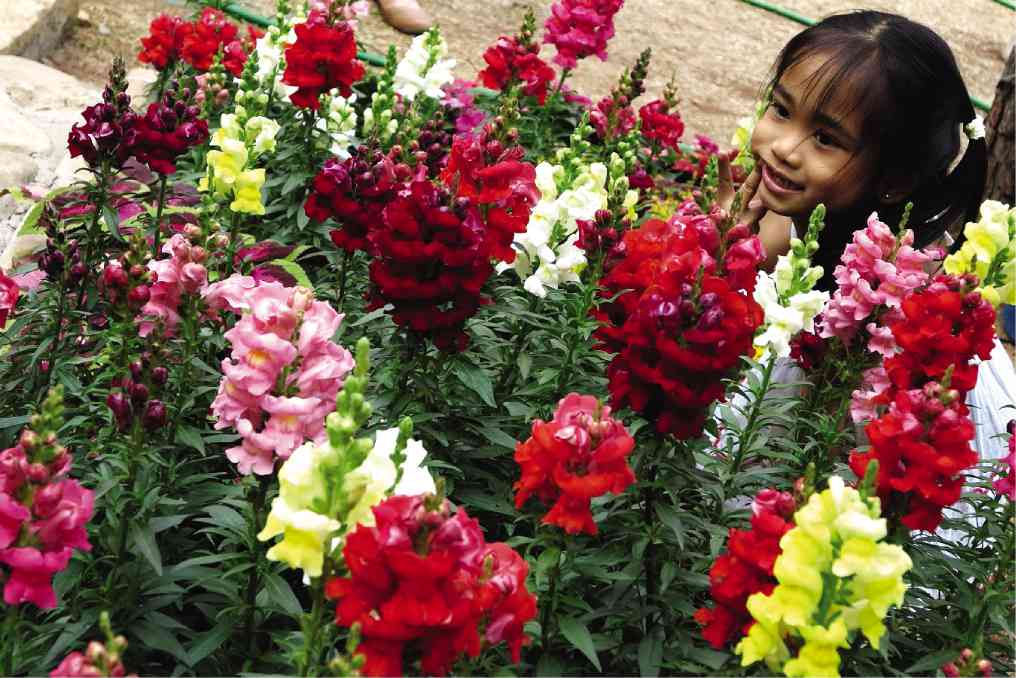
Colorful ornamental flowers enhance the design of vertical gardens in this year’s Flower Festival Market Encounter.

BAGUIO CITY, Philippines—Vertical gardens mounted on simulated building walls have been part of the landscape of Burnham Park, the second year this flower carpet technique has been promoted by organizers of the Baguio Flower Festival.

But local landscape artists say real estate developers have noticed the festival’s latest advocacy and some building owners have started to incorporate vertical gardens in their projects.

Lawyer Damaso Bangaoet, Baguio Flower Festival founder, pushed for vertical garden landscapes in the annual Flower Festival Market Encounter (renamed Blooming Odyssey), hoping to popularize a green building philosophy in Baguio and in areas from where the festival’s annual visitors come.

Cordelia Lacsamana, city environment officer, says the summer capital promotes green architecture and has been encouraging buildings to develop open air rooftop gardens to help reduce carbon in the atmosphere.

She says vertical gardens are innovations of the traditional landscape garden, which are mounted on interior building walls.

Lacsaman says vertical gardens can also be installed on the outdoor wall space available in high-rise buildings.

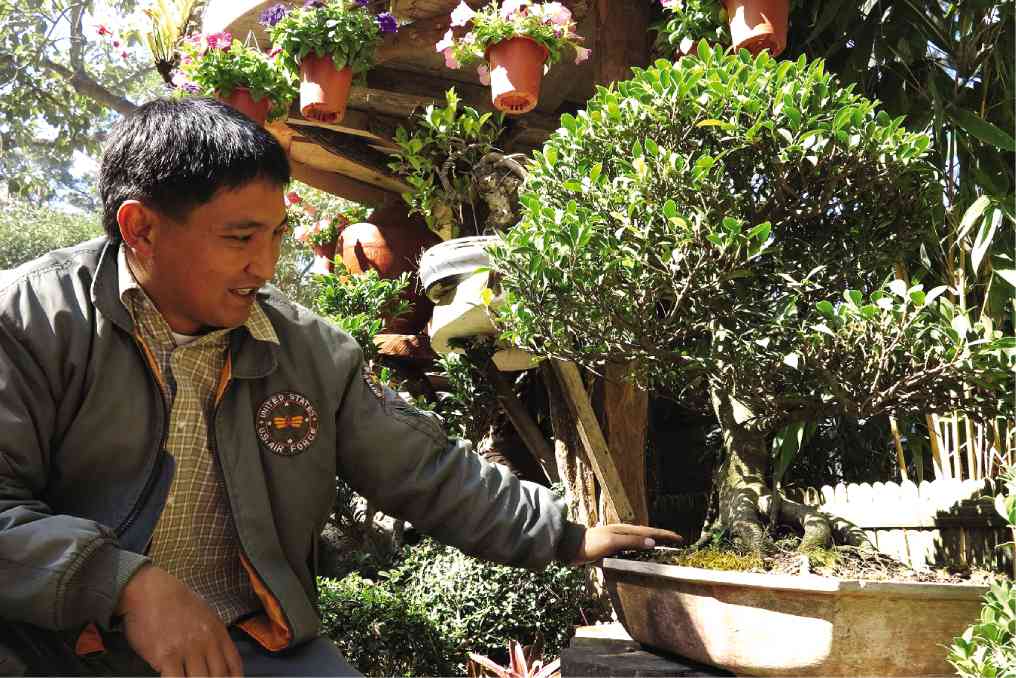
John Kimo and his bonsai worth P70,000

Agriculturists and scientists believe this technique can be harnessed in the future so vertical gardens can be mounted on the walls of buildings, to augment the food supply of big cities, she adds.

Vertical farming is still a theory, but vertical gardens are feasible options for building owners, who are willing to spend up to P2 million to grow seedlings of flowering plants or small fruit-bearing trees that thrive on rooftops and on building walls, according to Alexander Bangsoy, president of real estate developer, Goshen Land Capital Inc.

Bangsoy says developers are taking advantage of the skills available in Baguio.

Twelve members of the Panagbenga Landscapers Association take traditional and vertical landscaping assignments in Guam, Canada and Ireland, says Jonalyn Viloria, the association secretary.

“We have members, who earned as much as P5 million in net revenues last year … and their only training came from their work as gardeners and from landscape competitions like Panagbenga,” she says.

Viloria adds she learned about vertical landscaping from an American friend in 2007, but was only able to apply its principles when Bangaoet introduced it for the competition.

Local tourists enjoy the Flower Festival

The very first vertical landscape competition was won by John Kimo, 34, the group’s president. Kimo is a Kalanguya from Tinoc, Ifugao, who has an agriculture degree and who earned his stripes producing landscape gardens for the Baguio Country Club.

Unlike other countries, the Philippines is rich with natural landscaping resources, such as sea stones in the Ilocos coastline, which make homegrown gardens unique, he says.

He says landscapers charge P100,000 for a 10-square meter garden, but the price can sometimes shoot up to P1 million.—Reports from EV Espiritu and Vincent Cabreza, Inquirer Northern Luzon

Follow Us


Follow us on Facebook
Follow on Twitter
Follow on Twitter


Recent Stories:

Short URL: http://business.inquirer.net/?p=111617

Tags:

Baguio city
,

Business
,

Design
,

Flower Festival
,

flowers
,

landscaping
,

Philippines
,

vertical gardens

Want a garden on your wall? What it costs – U

If you’re over the potted-plant look and have some tax money to spend on your home or business, one thing to consider is a wall garden or green roof.

This special niche in the landscaping world remains relatively unknown but has in recent years attracted big-time clients like celeb chef Mario Batali, SDGE and Fashion Valley Mall in Mission Valley, a major regional mall in Southern California.

The firm that served those clients and many more is Good Earth Plants, which evolved from a downtown San Diego plant kiosk to a warehouse space in Kearny Mesa. It also birthed sister company Greenscaped Buildings.

Most of Good Earth Plants’ work is plant landscaping, but its green roof-living wall portion of business is nearing 50 percent, said president and founder Jim Mumford. Two years ago, it was non-existent.

“I’m not going to get rich on it,” said Mumford, referring to his specialty installations. “It gives us steady work. It’s a very niche part of the landscaping world.”

The U-T San Diego talked to Mumford about the growth of his business and why someone would want to install one of his alternative gardens.

Q: You gradually entered this niche market over the course of many years. How did that go?

A: It was 1994. I sold off all my flower shops. I had three retail locations. I wanted to focus on just plant service. An architectural convention came to town in 2003. I saw a sheet of a green-roof module tray. I didn’t understand it. But I was intrigued. Also, it was 2003, and the Cedar Fire came. It burned down my house. I lived by Barona. I had two little kids and I was rebuilding my house. I started looking for what was different. I talked to a colleague who heard about the green-roof thing.

Q: Then what happened?

A: I said ‘Gee, no one is doing green roofs here. What do I do?’ I had buildings. I said, ‘Let’s do one of them.’ … In March 2007, I did engineering and put a new roof down with three inches of soil in the current office building in Kearny Mesa. It was the first green roof on an occupied commercial building in San Diego.

Q: Why do people do green roofs and living walls?

A: Sometime for the environmental benefit. Many times, the view. The main one is how they cool your house down. Also, the codes have changed. When rain hits your house and it goes down, it’s bad because of runoff. So a green roof can mitigate that. They hold onto 60 percent to 80 percent of rainfall when it rains on buildings. Other benefits for both include biodiversity. It’s a habitat for birds, bees and critters.

Q: What’s the demand been like?

A: It didn’t even exist a few years ago. There’s been a tremendous amount of inquiries. But when you get into costs, reality starts to set in and the percentage of clients going forward diminishes greatly.

Q: What kind of costs are we looking at?

Edible mulch: Extreme edible landscaping gains popularity

The revival of edible landscaping has brought new life to urban gardens as plants are grown for both ornamental and practical purpose, but Ari LeVaux, syndicated food columnist, has taken it a step further and added edible mulch to his garden. That’s right, according to a Slate report dated March 8, Ari grows delicious greens as living mulch under his veggies.

Although Levaux admits that it may seem a bit lazy and unorganized, he has found a practical use for leftover seeds that actually improves the garden. He mixes them all in a bag and scatters them over prepared soil and lets them grow where they land.

His mixture, of course, consists of greens such as beets, spinach, chard and a variety of lettuce. He even throws carrots into the mix. These seeds sprout and grow in the area around his main crops. Because they have small root systems and are planted with larger vegetables, such as corn, tomatoes and broccoli the edible mulch doesn’t interfere with the main crop.

Ari adds that edible mulch can be started before planting other vegetables. He explains that he simply clears an area when he wants to plant larger veggies and pops them into the soil.

Flower seeds can be added to the mix as well and would work well with dwarf zinnias, marigold and bright pansies – but what you add it up to you.

_______________________________________________________________________

Thanks for visiting. For more garden topics, please subscribe to my gardening page and ‘like’ me on Facebook.

Stage a Garden Revival

Gardeners, for the most part, are optimistic people, according to Melinda Myers, gardening expert and author.

“There’s just something about digging around in the dirt that puts life in perspective a little bit,” Myers said.

Even such positive thinkers, however, were frustrated by the effects of last year’s drought on their gardens and yards, said Myers, who meets with thousands of gardeners as she travels throughout Wisconsin and around the country for speaking engagements.

“I’ve run into a lot of frustrated gardeners, but they are not giving up,” she said.

Instead, they are looking for solutions and are eager to find out what they can do to revitalize their landscapes, Myers said. And, on Friday, she will share such information with those in Racine County and the surrounding area at her presentation on “Garden Revival” at the 2013 Home Expo.

“My goal is to help people fix what they can, replace what they can’t, and keep them gardening,” Myers said. “Gardening is so good for the mind, body and spirit.”

No one wants to see plants die, she said. But, instead of lamenting those that were lost to the drought, gardeners can view this year as a chance to start over. “It gives us the opportunity to fix any problems we might have had in the past, and to make better choices down the road.”

Soil preparation and patience are some of the keys to creating a good foundation for growth in the coming season, Myers said. Her seminar will include tips for improving garden soil, as well as what to consider when choosing plants for your garden. While some people love spending hours in the garden, deadheading and watering, many others just don’t have that kind of time and need plants that will tolerate their “benign neglect” style of gardening, she said.

“You want to not only select plants that are tough enough for our growing conditions, but ones that fit your maintenance style.”

Myers’ Friday evening presentation will also include tips for repairing damaged lawns and aiding struggling trees and shrubs.

It is one of eight special seminars offered throughout the Home Expo, which will run March 15 through 17 at Festival Hall, 5 Fifth St. Others topics offered include basics of trimming shrubs and bushes; trends in window coverings; historic preservation and landmark designation; and “Before Perennials Ruled the Earth.”

The 29th annual Home Expo will also feature exhibits and demonstrations about topics ranging from home improvement and energy-saving products/services to ideas for interior design, landscaping, sunrooms and patios, flooring, bathrooms, kitchens, windows, doors and more.

Prizes will also be given away throughout the weekend, including Home Depot gift cards and family packs of Racine Raiders tickets, both of which will be distributed randomly each hour. Food, provided by Danny’s Meats, will be available for sale.

Sunday will be Kids’ Day at the Expo and will include a Kids’ Workshop from noon to 1 p.m. Visitors that day will also have access to the SafeAssured-ID program from 11 a.m. to 3 p.m. Presented in partnership with the Volunteer Center of Racine County, SafeAssured is an identification program used to aid in the search for missing individuals.

This service will be offered for free to Racine County residents ages 17 and younger, as well as those 55 and older, during the Expo. For more on this, go to www.volunteercenterofracine.org.

Other kids’ activities will include free face painting and balloon creations with Loli Pop the Clown.


 About Melinda Myers

Melinda Myers’ career in the horticulture industry spans more than 30 years and includes work in both hands-on and instructional settings, as well as media work designed to inspire and educate. A certified arborist, she holds a master’s degree in horticulture and taught for many years at the Milwaukee Area Technical College, and with the University of Wisconsin-Extension.

Myers began Milwaukee County’s Master Gardener Program and served as Milwaukee’s assistant city forester. She has also written more than 20 gardening books; served as “The Plant Doctor” on Newsradio 620 WTMJ for more than 20 years; and hosted seven seasons of “Great Lakes Gardener” on PBS television. Her nationally syndicated “Melinda’s Garden Moment” segments air on more than 115 television and radio stations throughout the country.

Most recently, Myers became the first woman to be inducted into the Wisconsin Green Industry Federation Hall of Fame in October, 2012. For more on this, go to www.wgif.net.


 If You Go

WHAT: “Garden Revival,” a seminar by gardening expert Melinda Myers

WHEN: 6 to 7 p.m. Friday. A question-and-answer session with Myers will follow her program.

WHERE: Racine Home Expo at Festival Hall, 5 Fifth St.

COST: This seminar is included with admission to the Home Expo (see separate box for details).

INFO: Go to www.melindamyers.com.


 Home Expo Details

WHAT: 2013 Home Expo

WHERE: Festival Hall, 5 Fifth St.

WHEN: 2 to 8 p.m. Friday; 9 a.m. to 5 p.m. Saturday; and 10 a.m. to 4 p.m. March 17.

COST: Admission is $3 for adults and free for kids ages 17 and younger.

INFO: Go to www.journaltimes.com/app/homeexpo/#1