Category Archives: garden design

A Wild and Playful Portland Garden


As Cynthia Woodyard likes to tell the story, she “married” her garden. 

The affair began in 1972, when she moved with her then-husband into a ’20s-era Arts Crafts bricker in Sylvan Heights, built with a picturesque flair by an English contractor and his Scottish wife. Woodyard liked the lot: it had five sides, none of them parallel. 

Early flirtations included an herb garden, and then some vegetables. The relationship evolved. Woodyard put up a fence and, with her father and brothers, rebuilt a tattered greenhouse once occupied by a giant lilac. She tried her hand at perennials and, one day, put some out in a garage sale. Buyers snapped them up. Within a couple of years, Woodyard had lines down the block from her garage for an annual sale of hostas, astors, irises, and campanulas. 

She and her husband divorced in 1988. Her horticultural soul mate became a passport.

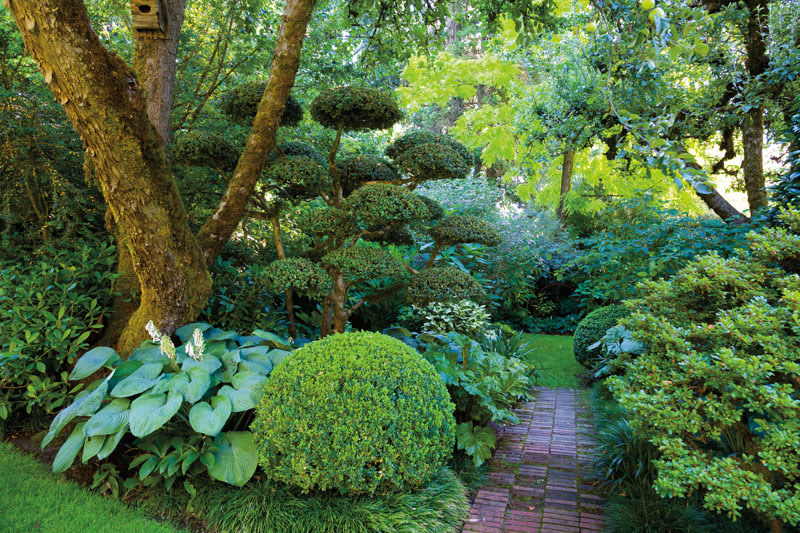
“[The garden] was my freedom,” Woodyard says, recalling how she once made $11,000 from one three-day sale. Her talent with perennials earned her landscape design jobs with Portland’s elite families and funded travel abroad to learn more. The lessons, in turn, took root at home in her own three-quarter-acre phantasmagoria. 
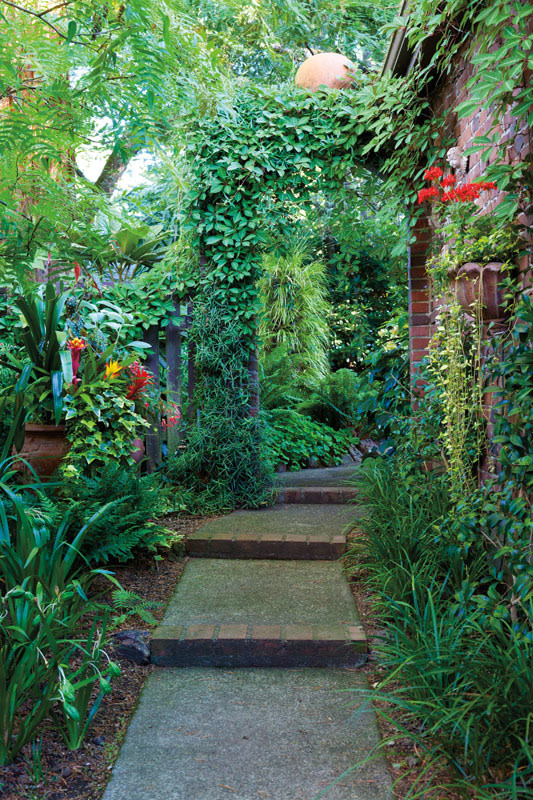

No xeriscaping here. Think English Victorian meets early Walt Disney; Edward Scissorhands snipping a topiary bubble bath to a French pop beat. Woodyard is fearless, freely mingling the sturdiest hardy plants with delicate exotics. (Many spend winter in a heated garage.) The density of her contrasts—spiky and soft, espaliered, climbing, and upright, green upon green upon green—attests to plenty of long mornings and evenings with the soaker hose. “Any real gardener only hand-waters,” she says. “You get to know the plant, what it needs, what’s eating it.” 

“The textures, the shapes, the juxtaposition of formal and informal plants—not everyone can do that, but she sure can,” says esteemed local landscape architect and garden historian Wallace K. Huntington. “Cynthia can grow hostas like no one in the slug belt. There’s not a chewed leaf. And she handles boxwood better than anyone I’ve ever seen. She uses it so imaginatively that there isn’t any longer a memory of ancient pictorial gardens.”

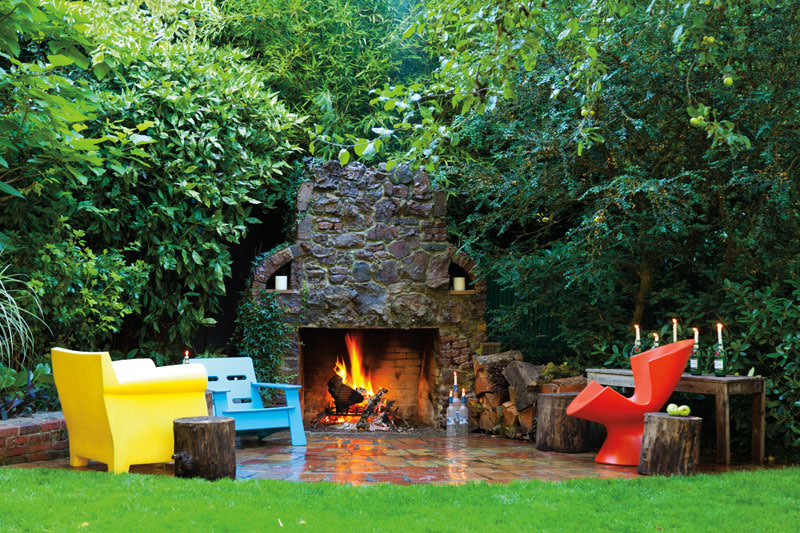
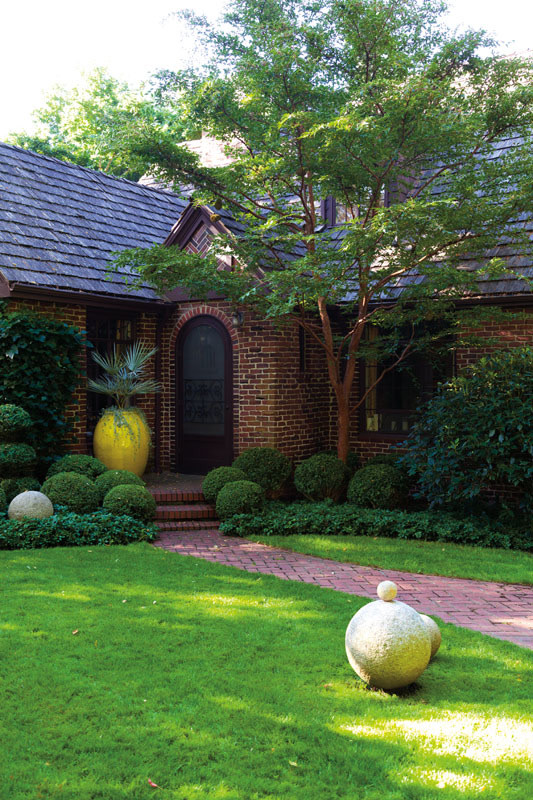
And then there is her humor. Woodyard likes balls: boxwood orbs rising against the blooms like pom-poms, drifting through the green like glass floats, or clustering around a granite globe like it was the cue ball on a crowded pool table. Against the bending mortar lines of her brick outdoor fireplace, Woodyard prefers brightly colored Philippe Starck chairs and, on her porch, a classic Marilyn lip-shaped love seat. The curving paths through the garden’s pentagonal shape make the three-quarter acre feel infinite—getting lost in Woodyard’s garden fantasy is easy. There is nothing quite like it in Portland.

Small wonder. Woodyard’s early self-taught mastery soon took her around the world, forging connections with some of its greatest gardeners and allowing her to broaden her repertoire far beyond the Pacific Northwest’s usual palette of rhodies and roses. A 1980s Sunset magazine article on her garden earned an invitation from the editor to do a “process story” on dividing perennials. So she picked up a camera for the first time and quickly learned that her natural flair with plants translated to pictures, and in turn, photography assignments from Horticulture, Better Homes Gardens, and Organic Gardening, among others. She’s contributed to a shelf of books: The Complete Kitchen Garden, The Garden in Autumn, Gardening with Ground Cover and Vines, Annuals, The Inviting Garden, and Secret Gardens: Revealed by Their Owners (the last two featuring Woodyard’s own garden) written by or featuring gardens by a generation of master gardeners now past, from Princess Greta Sturdza to prolific English garden designer Rosemary Verey. Woodyard gleaned lessons about both horticulture and life. (Verey, she says, “taught me how to drink.”) She also brought back plants from her travels: “Back then,” she recalls, “you could still smuggle.”

Now 71, Woodyard’s most recent influence evolved out of her 13-year mentorship of Francisco Puentes, whom she first met on the crew of one of her contractors. Now 32 and a sculpture major at Portland State University, Puentes recalls how his first encounters with Woodyard and her garden opened up a world. “I could just tell that I could progress in the realm of plants,” he says. “I felt a strong desire.” He quickly became her right hand in tending the garden—today, the two gardeners finish each other’s sentences. “I can prune, but not like him,” Woodyard says. “He has good ideas. The design is going more and more his way. It is simplifying.” 

Puentes has also expanded the garden’s giddy freedom. Using welded-wire cages, mesh, soil, and ornamental grasses, he invented what he simply calls “columns” that stand like a family of odd sentries at the gate. His tiny lighted “nests,” spun out of sisal, hang like glowing cocoons in the trees. 

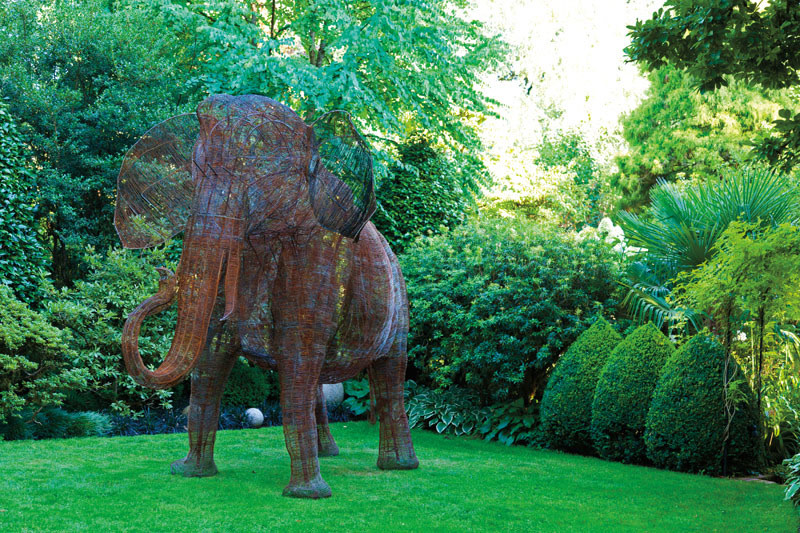
Working every evening for nearly a year, Puentes wrapped a woven steel armature with wire to create a life-size elephant. Knees seemingly cocked to launch into a dance—or maybe a charge—the rusted-red giant has the visual strength of a basket but the dynamism of a fast line-drawing. The inspiration? He recalls his first trip to the Oregon Zoo and the instant affinity he, as a fellow immigrant, felt toward the elephants. Puentes is now at work on “a baby,” he says. “Maybe one day a whole family.”

Woodyard’s mentor Verey, who edited the 1994 book Secret Gardens: Revealed by Their Owners, titled the chapter on Woodyard’s garden “A Paradise From Many Lands.” Yet, in it, Woodyard muses less on her global reach than her love of boundaries and the garden’s daily drama of plants, insects, and weather. “Here was a little piece of land,” she says. “Season after season. Nature. Working is what happens. It’s been a long experiment, you have to admit, in one place.”

woodyard’s plant picks


1. Mood Indigo, Agapanthus inapertus: “Hardy, sexy, dangling.”

2. Veitch’s Blue, Echinops ritro: “It’s dependable, blue, and bees love it. Stands on its own and is fairly drought tolerant.”

3. Fire Lily, Clivia miniata: “Not hardy, but easy to keep over the winter—very sturdy green leaves, good bloomer, floriferous and orange, red seed pods.”

4. Francisco Puentes tiny lighted “nests,” spun out of sisal, hang like glowing cocoons in the trees. 

5. Nymansay, Eucryphia x nymansensis: “A small, woody tree with a dogwood-like flower.”

6. Kangaroo Paw, Anigozanthos: “Totally tropical. Reminds me of Australia.”

7. The Swan, Hydrangea paniculata: “Very unusual, big pure-white flowers, yet loose white flower heads. Very sturdy. Nothing eats it.”


Obelisks are classic and classy garden ornaments

Obelisks make a good point. They’re an ancient garden ornament with plenty of modern style.

Obelisks give a garden a lift; they’re monumental exclamation points that capture your eye and attention and help organize a space. Although the world’s most famous obelisks — Cleopatra’s needles and the Washington Monument, among them — are not exactly on the scale of garden ornaments, the dramatic form adapts very gracefully to gardens of every size.

Technically, an obelisk is simply a pointed stone pillar, but this basic definition has been broadly interpreted. Garden obelisks can be constructed of almost any material. Unlike a garden tepee for beans or peas, which is usually put together with just three tall stakes held together at the top, an obelisk is a sturdier construction, with a strong architectural presence in the garden. It is the perfect finishing touch.

A pair of obelisks at a garden gate have the stately bearing of sentries, but you don’t need two: a single tall obelisk, standing proudly in a flower bed or at the bottom of a path, strikes a resounding and unifying note in a garden. Obelisks at the outer corners of a patio provide a subtle sense of enclosure, and they need not be tall to have this effect. By their very presence and uniformity, they lend a certain momentum, like chess pieces on a board, to even a simple setting.

Garden obelisks were perhaps at the height of their popularity in the 17th century, when Andre Le Notre, the great landscape architect of the palace of Versailles, set a pair of them at the gates to the French king’s extravagant country estate. Within the gates, topiary obelisks held strategic echoing positions in the artful parterres.

In the 17th and 18th centuries, trellis-work obelisks were used extensively in clipped and controlled Dutch gardens. Garden historians describe obelisks as “practically ubiquitous” in 18th-century English and Irish gardens, where stone obelisks framed the views. They were often engraved with commemorative inscriptions.

From European gardens, obelisks moved to America, where they took up residence, especially in cemeteries. One theory about their popularity is that obelisks had a much smaller footprint and were less expensive than more magnificent monuments. Another is that obelisks evoked the great civilizations of classical antiquity to which the young nation was very eager to compare itself. They also had space for engraving on four sides, and were thus sensible choices for family plots.

In a graveyard, obelisks appear solemn and perhaps a little mournful; in a garden, they are certainly dignified, but not always quite so serious. In a tiny backyard in Virginia, a designer erected a rustic fieldstone obelisk at the back of his garden and topped it with a shimmering golden ball, like something out of a fairytale. Another gardener set tradition aside and topped her 10-foot obelisk with a charming birdhouse.

Topiary obelisks of clipped boxwood, yews or other naturally slender evergreens, grown in ranks or as solitary punctuation points in a garden design, are living obelisks that need little attention. They become more and more commanding as they grow to their full height.

Wrought iron or wood obelisks are often put to work as three-dimensional trellises for clematis, annual vines, beans or tomatoes. They’re great for clambering roses and evergreen honeysuckles because lanky growth can be confined within their tidy framework while the blooms shine through the structure. Small obelisks, designed to fit in big flowerpots, let you bring vining plants such as mandevillas up onto a porch, where you can appreciate their flowers up close.

Even if you’re not very handy with tools, making your own obelisk is an easy project, well worth a few weekend hours. My husband and I downloaded plans from the Internet — many styles and designs with pointed or square tops are available for free — and made two obelisks last summer, a small one for a cucumber vine in a big terra-cotta pot, and an 8-foot-tall obelisk for a place of prominence in the middle of the garden.

Once we had our materials together, it took us most of an afternoon to complete the job, but we took plenty of breaks to appreciate our progress. Both obelisks were an instant success, standing tall in the summer garden.

Wong condemns dated design approach

By Sarah Cosgrove
Friday, 02 May 2014

‘UK horticulture lies bathing in the golden light of nostalgia, even down to the clothing garden presenters wear,’ says Wong.

Wong: panned dominant model

Wong: panned dominant model

The “heritage pathology” approach to garden design and horticulture has been attacked by ethnobotanist, television presenter and author James Wong, who said UK horticulture is like a “museum diorama” stuck around 1900.

Speaking at the Society of Garden Designers spring conference “Exotic” in London, he said despite leading the world in many other aspects of design, the British are stuck in the past and view gardens as “outside soft furnishings”. He also took a swipe at other television presenters for their archaic-looking clothes.

“UK horticulture lies bathing in the golden light of nostalgia, even down to the clothing that gardening presenters wear. Where do they buy this stuff? It’s like the 19th century,” said Wong. “The ideal time is about 1900 – it’s the zeitgeist. It’s such a dominant model that it’s so difficult for us to even conceive of horticulture outside of that.”

In contrast, Wong said garden designer Gertrude Jekyll, now venerated, was considered “a crazy old lady” by Victorians. But if we “showed her how much we have preserved her garden in aspic, I think she would be polite but also horrified”.

Wong said the “polar opposite to this” is Singapore, where he grew up. It was transformed from a malarial slum to a 21st century garden city thanks to the direction of former leader Lee Kuan Yew, who decided that if he made the country “clean and green” – modelled on Letchworth Garden City – rich white investors would come.

Lee established four tenets – education, health, enterprise and horticulture, deliberately aiming at creating a “white man’s Disneyland” that was nicer than “other hell-hole” countries nearby.

Now Singapore has the highest density of millionaires of any country in the world, green roofs, green walls and municipal window boxes, while sky parks are mandatory on new buildings, roads are lined with trees and bridges have hanging baskets on both sides.

Singapore’s airport has a director of horticulture who “treats palm trees as the British treat bedding plants”, said Wong, and has several gardens inside it despite the building being air-conditioned to 18 degsC.

Wong added that behind this modern city are principles “cut and pasted from the Victorians”, who were also quite happy to demolish and rebuild if there was money to be made.

Singapore’s Parkroyal Hotel can charge twice as much as others that have similar rooms because it has been in every design magazine. Wong said he advocates neither approach but did call for a plurality of design.

Sarah Eberle, Dan Hinkley and Made Wijaya also spoke at the conference.

Exotic styles – Broader range highlighted

James Wong who has presented two RHS Chelsea Flower Show gardens in exotic styles, said British people see many different types of western gardening but there is only one type of “exotic”, and that is largely based on British colonial sub-tropical style, itself just a small section of exotic garden design.

He said lumping all styles into one is “like me talking about herbaceous borders and topiary in the same sentence”.

Louis Benech’s Gardens of Earthly Delights


cat

Louis Benech
Eric Sander

THE GRITTY STREETS of Belleville, in northeast Paris, have acquired a hipster aura in recent years, but it’s the last place you might expect to find the landscape architect

Louis Benech.

Based in a secluded house off boulevard de la Villette, Mr. Benech, 57 years old, is the garden designer of first resort for members of the French establishment, who tend to make their homes at the opposite end town.

The life partner of shoe designer Christian Louboutin, Mr. Benech, is a celebrity in his own right in France, thanks to his work in the 1990s on the Jardin des Tuileries. He is currently finishing up a commission to redo a section of the gardens at Versailles. But over the past few decades, much of his work has been creating unique gardens for clients with names like Rothschild, Guinness and Pinault.

Born near Paris, Mr. Benech grew up on the Île de Ré, a windswept island off France’s Atlantic coast. Sojourns back on the mainland, in the gardens of relatives and family friends, left a deep impression. “I was raised on an island without trees,” he says, “but I developed a strange habit of kissing trees.”

Compared with the crafted wildness of English gardens, French gardens can seem strict and geometric, but Mr. Benech—who trained as a lawyer before rediscovering his true calling—sees the tradition differently. In France, the great gardens are about “the relationship between illusion and reality,” he says, a tension he often employs. The rationalism of French gardening, he argues, may be the means, but it is rarely an end. “Sometimes you don’t need to make sense,” he says, “just give pleasure.”

Here, a look at four of his best-known private gardens.

ROOFTOP GARDEN // Paris

Mr. Benech created this two-story landscaped terrace for the former chairman of Hermès
Agence de Louis Benech

The Esplanade des Invalides, on Paris’s Left Bank, is one of the capital’s most impressive public spaces—and one of its windiest. In 2004-05, Mr. Benech created a two-story, 125-square-meter landscaped terrace for

Jean-Louis Dumas,

the former chairman of Hermès, and his Greek-born wife, architect

Rena Gregoriadès.

“It’s not a garden,” insists Mr. Benech, “it’s a decoration.”

The challenge was to accommodate the opposing horticultural tastes of the pair. Mr. Dumas “was keen on Japan,” says Mr. Benech, while his wife preferred the Mediterranean flora of her native country. Plants include Japanese mint, magnolia and hydrangea on the north part of the terrace.

By using different levels of planters, Mr. Benech managed to disguise the terrace’s unattractive railings, which he calls “architectural details of poor quality.” And he used sturdy but relatively transparent grasses, instead of dense foliage. The grasses do well in the windy conditions, and don’t obscure the spectacular views.

If you have an urban rooftop garden: Don’t “use bamboo of any kind,” advises Mr. Benech. The roots can wreak havoc with waterproofing.

SUMMER GARDEN // St. Tropez

Knowing that client François Pinault would primarily enjoy this St. Tropez garden in the summer months, Mr. Benech emphasized plants that bloom in summer
Eric Sander

Mr. Benech created this hectare-size garden in 1994-95 for a villa belonging to French businessman

François Pinault.

The house is near the Chapelle de Ste-Anne, a simple but remarkable Provençal-style church. The steeple, though not a part of the property, was used as a visual element in the final garden design.

St. Tropez lies on the northern side of an eastward-jutting peninsula. The property, which overlooks the Gulf of St. Tropez, faces north. This meant careful planning. Northern light may be beautiful but, even in a southern climate, “it is not good for many plants,” says Mr. Benech. “That’s why I only planted the bougainvillea on the south side of the house,” he says—a spot, he laments, “without the view.”

Knowing that his clients would primarily enjoy the garden in the summer months, he emphasized plants that bloom in summer, like yellowhorn, a large shrub that produces a white flower. He also included “plants for fun,” like cordyline, a woody ornamental plant, and banana trees.

If you have a garden at your summer house: Don’t forget to plant for pleasure, says Mr. Benech.

SEMIARID GARDEN // Marrakesh

Mr. Benech created shade for Bernard-Henri Lévy’s classic Marrakesh riad using plants like glory-bower, a fragrant shrub, and mousethorn, an evergreen shrub
Eric Sander

In 2002-03, Mr. Benech designed a series of gardens, totaling nearly 2,000 square meters, for the grounds of a classic riad in Marrakesh. The palace itself dates back to the early 19th century and has had a “cascade of glamorous owners,” says Mr. Benech, including French actor

Alain Delon.

The current owners, the French philosopher Bernard-Henri Lévy and his wife, had planned to use the house throughout the year, except for the hot summer months.

A main challenge on the project was the clients’ wish not to see actual soil, compounded by a wish for areas of lawn, which aren’t suited to the extreme conditions of Marrakesh, where winter can combine hot days with freezing nights. Mr. Benech created heavy shade with plants like glory-bower, a fragrant shrub, and mousethorn, an evergreen shrub. For the sunny areas, Mr. Benech planted roses for the particular pleasure of the “maitresse de maison.” Roses also happen to be “very Moroccan,” he adds.

If you have a garden in a semiarid climate: That doesn’t mean you won’t have access to water, says Mr. Benech. So don’t plant for drought-like conditions if you don’t have to.

SMALL CITY GARDEN // Paris

Mr. Benech integrated the distinctive trompe l’oeil trellis in Claude Bébéar’s Paris garden into his project.
Georges Lévêque

In 1995-97, Mr. Benech created a formal garden for a private mansion in Paris’s 8th Arrondissement near the Élysée Palace, an area now dominated by offices. The clients, French entrepreneur

Claude Bébéar

and his family, were living in a building from around 1800, a neoclassical period of French architecture marked by simplicity rather than pomp. The garden area was dominated by the back wall’s distinctive trompe l’oeil trellis, created in the early 20th century. The house itself “is ravishing,” says Mr. Benech, but the existing trellis “was the central thing” in the project.

Without the trellis, says Mr. Benech, the 500-square-meter garden could have had an “informal” quality; instead, Mr. Benech played off the formal illusion of the trellis by creating an array of geometric hedges. He used “classical plants,” he says, like yew and boxwood.

If you have a small garden: Make it look bigger by using optical illusions, says Mr. Benech. The geometric array of hedges leading to the trellis appears to enlarge the space.

Explore More

Landscape designers compete in RTɒs Super Garden

Landscape designers compete in RTÉ’s Super GardenLandscape designers compete in RTÉ’s Super Garden

Jenny McGovern

Super Garden returned to RTÉ 1 last Thursday for a brand new series in which five up-and-coming designers compete to showcase their garden at this year’s 2014 Bloom Festival and this year there’s a Cavan contestant on board.
The show will follow each designer from the initial concept and design stage, to pitching their idea to the Super Garden judges, through the reality of the construction process and then the completion of their Super Garden. With just weeks to design and build a show garden, and a budget of just €5,000, the challenges that will face these promising designers will unfold throughout the series.

Homeowners’ specifications

Each garden designer works on a garden and to a brief given to them by the residents. Mindful of their budget, the designer must design a garden to the homeowners’ specifications. All five have been given similar size gardens to work with, but each has a very different brief, and certainly very different design approaches. This Thursday will see Ballymachugh native Padraig Kelly (26) grace our screens as he creates a garden, which showcases purely native Irish plants – his mission is to show the best of Irish horticulture by using guaranteed Irish plants in a woodland paradise. A landscape gardener by trade Padraig said he “thoroughly enjoyed” the experience.

Stunning location
The winner of Super Garden will be revealed in the sixth and final episode of the series, when all the designers and judges gather at the stunning location of Powerscourt House in Wicklow. The prize will be awarded to the designer voted Super Garden designer 2014, and with it the life-changing opportunity to re-create their design at the prestigious Bloom 2014 and the possibility of pursuing a career in professional garden design.

Battersea Power Station roof garden designs revealed

By Sarah Cosgrove
Monday, 28 April 2014

Top designer Andy Sturgeon has revealed his ‘Garden of the Elements” design plans for the three roof gardens at Battersea Power Station.

The Boiler House Square garden references the element of air

The Boiler House Square garden references the element of air

The gardens, a hectare in total, reference the iconic London power station’s original use and the elements of fire water and air.

Sturgeon, of Andy Sturgeon Landscape and Garden Design, is working as a consultant to LDA Design, the lead landscape architect on the first and second phases of the development.

The newly named Switch House East garden will boast strong architectural qualities where huge corten steel fins will represent fire, wide lawns and mounded planting respond to the building’s architecture and terraced belvederes at either end of the garden will allow residents and office staff from inside the Power Station to enjoy views over London.

Switch House West will house a slender garden stretching 120 metres along a fluid, path to create a meandering green ‘riverine route’, to represent the water element above the original 1930’s Battersea Power Station building and connecting it to its riverside setting.

In addition, an ethereal ‘garden in the sky’ with the largest glass atrium in London will be created in the new Boiler House Square crowning the building between the four chimneys.

Cloud-like planting evoking the element of air will be set among large dishes of shallow, reflective water aiming at an otherworldly quality. Only owners of the nearby luxury apartments will be able to access this garden.

Where the gardens are open to both residents and office workers the spaces will feature adaptable pavilions, intimate seating areas, a petanque court and open pergolas for differing activities.

The gardens will incorporate recycled brick and steel elements from the power station building and differing planting styles will give each garden a distinct atmosphere. Sturgeon has chosen mounded planting throughout to make the spaces seem more architectural and more open while in other places raised planters and tall grasses immerse the visitor amongst the planting.

The planting palette is designed to offer year round interest and will include a mix of evergreens, Mediterranean and more exotic species, made possible by London’s unique microclimate.

The roof gardens are part of the second development phase of the 15.7ha site. LDA is also designing a public park between the building and the River Thames and a new public piazza at the southern entrance to Battersea Power Station.

More than 250 apartments and townhouses within the power station itself are due to go on sale on May 1 to Londoners only. The guide prices start at £800,000 for a studio flat.

Garden Pond Expo designed for novice, master gardeners

This weekend, the Industrial Arts Building at the Lake County Fairgrounds will be transformed into a lush garden landscape, with dozens of vendors offering products, advice and inspiration to gardeners from around the area.

About 3,000 people are expected to attend the 13th Annual Waterscape Weekend Garden Pond Expo, sponsored by the Illiana Garden Pond Society.

The event is designed to help gardeners take their landscaping and backyards to the next level, said Kathy Bartley, the Expo chair.

“Every part of the building will be landscaped,” she said. “You will feel like you are walking through a park. Some of the designs you will see are phenomenal.”

There will be vendors selling everything from fish to equipment for water gardeners, as well as plants, gourd and glass yard decorations, lighting options and irrigation options.

There also will be local not-for-profit organizations who will be exhibiting information on their upcoming garden walks as well as Lake County Master Gardeners offering helpful tips and answering questions. There also will be educational seminars and workshops.

“This year, we have 58 vendors. We have our usual ones coming back, as well as eight new ones,” she said. “They are offering everything from koi fish for your garden’s pond to ironwork that is beautiful.”

Recent trends include container gardening and vertical gardening, and there will be lots of supplies available to support gardeners who are interested in these trends. The trend focuses on gardening in a smaller scale, with vertical gardening focusing on growing plants at different elevations, as in up the side of a wall.

“We can show them what kinds of products to look for, either on a smaller scale or a larger scale,” she said. “It’s a really unique, self-contained, self-watering kind of garden.”

Master gardeners will also be available to answer questions, she said.

“The purpose of our organization, the Illiana Garden Pond Society, is about educating the public on gardening and incorporating water into their gardens,” she said. “The money we generate from this event goes back into the community, either through community beautification projects or through scholarships.”

For experienced gardeners, the event is a chance to get specialized products, or products that are new to the market, or to get inspiration for your own garden at home.

“We really do have everything, so many beautiful options,” she said. “There is definitely something for everyone here.”

In Abu Dhabi, A Desert Park With A Secret Garden

In Abu Dhabi, a grassy European-style park requires constant irrigation to counteract the sun’s intensity. With that in mind, the London-based architect Thomas Heatherwick plans to redesign the 30-acre Al Fayah Park to embrace the desert setting while providing a comfortable place for people to gather.

Heatherwick Studio reconceives the Abu Dhabi public park in a way that ensures that the park is attuned to its climate. The park, which is scheduled for completion in 2017, includes 65-foot-high canopies that mimic the fractured look of a cracked desert landscape. Those same canopies shield a garden oasis from the heat and sun, reducing the amount of water lost to evaporation and improving the park’s energy efficiency.

Underneath these canopies, in the shade, visitors will find pools and streams, vegetable gardens, spaces for performances and festivals, a cafe, a library, and a mosque. In the cooler evening hours, people can gather on top of the canopies, to wander.

The design was envisioned “as a way of celebrating the beauty of the desert and its distinct surrounding landscape,” the architects write. “Instead of denying the presence of the desert that the city is built on, we set ourselves the task of making a park out of the desert itself.”

[H/T: ArchDaily]

Turning gardens into healing sanctuaries: Walnut Creek to host landscape …

WALNUT CREEK — Sarah Sutton’s no stranger to the relationship between healing and nature. Growing up on the Peninsula, Sutton and her sisters appreciated the wonders of nature — forests, landscapes, beaches and gardens. Then and now, Sutton had always regarded the earth’s treasures as a natural art form that helped to calm the mind, body and spirit.

“Our Dad would take us out to be immersed in nature, whether it was hiking in the forest, walking in Huddart Park, the beaches along Half Moon Bay,” said Sutton. “We were three little girls tidepooling.”

From her father, Sutton learned the art of de-stressing in nature — something she’s cultivated as a landscape architect, ecologist and artist.

The author of “The New American Front Yard: Kiss Your Grass Goodbye” will be presenting “Healing Places, Restorative Spaces: Creating Landscapes and Gardens that Sustain Ourselves and the Planet.” The book received a Silver Nautilus Award for Green Living/Sustainability and an Honorable Mention Award at the 2013 SF Green Book Festival).

At the April 30 event at The Gardens at Heather Farm, Sutton will show people how to regard home gardens and landscapes as much more than window dressing — they can be sustainable, restorative healing places.

Sutton admits that while she grew up reading Sunset Magazine, which first instilled in her a love for gardens, she initially wasn’t an avid gardener at the time. She thought about becoming a commercial artist but a college counselor pointed her toward pursuing a degree in landscape architecture. Suddenly, it all made sense–this career integrated her childhood love for nature with her love of art.

Sutton, who is also a Certified Natural Health professional, will discuss how garden designs and what you plant in your garden can help you create a healing sanctuary in suburbia. Topics will include how to holistically manage your garden, front yard foraging, regenerative landscape design and using Feng Shui principles in your garden.

While Sutton has painted oil and watercolor pieces, she considers the healing design projects she’s helped create to be a different kind of art medium. She’s applied holistic garden design principles to park plazas and gardens for family and friends.

Suzanne R. Schrift, a longtime colleague and a friend, said Sutton has a broad understanding of ecologically sound landscape principles and cutting edge practices, and is committed to teaching people how to think and act sustainably in the landscape.

“Her new book is an easy to read yet extensive guide that will change the way people see the landscape around them,” Schrift said.

Gail Donaldson, who’s known Sutton for nearly 20 years as a colleague and friend, said Sutton’s work has always combined her passion for the natural environment with her love of art and design. Sutton’s book, Donaldson said, is a guide “to restoring the planet one yard at a time.”

“The book contains a wealth of information on sustainable design, clearly presented in a lively and engaging way,” Donaldson said. It is chock full of ideas, images, references and information, valuable to novices and experts alike. Presenting a step-by-step approach to transforming a front yard, I find that I can open this book to just about any page and find an inspiring idea or image.”

At first, trying to apply her knowledge to her own home garden was a challenge, said Sutton, who lives in Berkeley.

Eventually, she learned to design a healing garden tailored to her own needs. She’s also learned how to make tinctures and healing salves made from herbs from her own garden.

When she experienced some health issues, Sutton gravitated toward natural remedies that included using herbs and plants from the garden.

“The realization was that I learned about propagating, harvesting and growing my own plants to use for healing,” said Sutton, who obtained a certificate in Therapeutic Healing Garden Design from the Chicago Botanical Garden. “I could dig up dandelion and make my own tea. It was a real epiphany.”