Author Archives:

Tips for a Pollinator-friendly Garden – Twin Falls Times

When you swat at a bee in the garden, remember that it’s not just a stinger but a pollinator — an insect, bird or mammal that enables a plant to set seed.

With 75 percent of all flowering plants requiring pollinators — a third of which are human food sources — it is imperative that we address the threats they face: habitat degradation and loss, the spread of pests and diseases, extensive pesticide use and climate change.

The honeybee is probably the most familiar pollinator, and its plight is well documented. According to a survey by Treasure Valley Beekeepers Club, 312 honeybee colonies were being managed in the Valley in fall 2012. By spring of 2013, that number was down by half. Club President Chad Dickinson, attributed much of this loss to an unusually cold winter and mismanagement by beekeepers. These issues combined with numerous others resulted in a tough year for local honeybees.

And it isn’t just honeybees, not native to the Western Hemisphere, that are in danger. North America is home to thousands of pollinating insects, including numerous species of bees, butterflies, moths, wasps, flies and beetles — all with varying habitat and forage needs. Many of these native insects, including the blue orchard bee and the Eastern bumblebee, are just as important for agricultural pollination as the non-native honeybee.

The good news is that all pollinators (native or non-native) can benefit from similar conservation strategies. Creating pollinator-friendly habitats that are free from pesticides and include diverse food sources and nesting sites will help ensure the health and survival of these beneficial organisms.

Consider dedicating a portion of your yard to pollinator habitat. Here’s how to get started:

Sunny location:

Full sun helps keep pollinators active.

Season-long blooms:

Select at least three plants that flower in each of the three blooming periods (spring, summer and fall).

Early-spring bloomers and fall bloomers are especially important.

Cluster Plantings:

On each foraging trip, bees visit flowers of a single species, so planting in small clumps will help them out.

Diversity:

Plants in your garden should have varying heights and growth habits. Not only should they bloom at different times, but they should also have flowers of various colors, shapes and sizes. This will help attract a wide range of pollinators.

Nesting sites:

A warm-season bunch grass, such as little bluestem, will provide habitat for bumblebees. A small section of bare ground is important for ground nesting bees. Bundles of hollow stems, such as bamboo or elderberry, provide nesting sites for mason bees.

Water:

Pollinators need water, too. Include a birdbath or something with a ledge for pollinators to perch and drink.

What to plant:

Native plants are typically the best for native pollinators, especially those that require specific plants for food and habitat. When selecting non-native plants, choose old varieties when possible, since some modern varieties and hybrids can be poor sources of nectar.

Casey O’Leary of Earthly Delights Farm, an urban farm and seed company in Boise, suggests purple and blue flowers, such as larkspur, borage and bee’s friend, for bumblebees, and small white flowers, such as yarrow and plants in the carrot family, for solitary bees.

She has also found that native buckwheats (Eriogonum spp.) are excellent at attracting pollinators. On her farm, O’Leary allows vegetable crops not typically grown for their seed or fruit (such as lettuce, arugula and radishes) to flower, attracting beneficial insects and providing additional nectar sources for foraging pollinators.

To find more ideas for designing and planting your pollinator garden, visit the Pollinator Pathway in the Children’s Adventure Garden at Idaho Botanical Garden (visitor details at idahobotanicalgarden.org), and ask the horticulture staff for more specific plant recommendations. For more information on inviting native pollinators into your yard, visit www.xerces.org.

Daniel Murphy is a horticulture technician at the Idaho Botanical Garden.

Garden art at Toledo Museum of Art, tax tips and gardening workshop: AM Links …

H23AMLINKARTMARCH.JPGView full sizeSondra Freckleton’s Begonia with Quilt is part of an exhibit on garden-inspired art, now on view now at the Toledo Museum of Art.
GARDEN-THEMED EXHIBIT:  A new exhibition that focuses on how people interact with nature, landscape and garden design is now on view at the Toledo Museum of Art, and is sure to delight art and garden lovers.

Assembled entirely from the Museum’s own collection, “Paper Roses: Garden-Inspired Works on Paper” presents 100 prints, drawings and photographs by some of the most acclaimed European and American artists. The works date from the 17th to the 20th centuries.

The free exhibition continues through Sunday, May 18. “Paper Roses” is an exhibit that complements the Toledo Museum of Art’s major international exhibition “The Art of the Louvre’s Tuileries Garden.”

The Tuileries Garden, which stretches from the Louvre to the Place de la Concorde in central Paris, was created in 1564 for French royalty. Today it attracts 10 million visitors annually and is a key venue for art. “The Art of the Louvre’s Tuileries Garden” is now on view.

If you can’t see the exhibition in person, you can view the online catalog for “Paper Roses” at toledomuseum.org.

TAX TIPS: If you’re preparing your taxes and wondering if you can get a tax break for home improvement expenses, the answer is maybe. First, you must have kept track of all home improvement expenses. Some improvements, such as installing central air conditioning, may help reduce taxes when you sell your house, according to TurboTax.

Click on the IRS website for more information. Some home appliances that are Energy Star Rated may qualify you for a tax deduction. See a list of qualifying appliances here, suggests the Huffington Post.

GARDENING WORKSHOP: The Master Gardeners of Cuyahoga County, a part of Ohio State
University Extension, will present the “From Garden to Table” seminar  9 a.m. to 3 p.m. Saturday, April 26 at the Cuyahoga Valley National Park Happy Days Lodge,
500 W Streetsboro Road, Peninsula. The program fee is $36 ($42 after Wednesday, April 16)
and includes breakfast, lunch and handdouts. 

Presentation topics include pest management, growing strawberries, making wine, favorite tomato varieties and dmore.

A registration form is available
at the Master Gardeners of Cuyahoga County website.

Rebuilding the Natural World: A Shift in Ecological Restoration

17 Mar 2014: Analysis

From forests in Queens to wetlands in China, planners and scientists are promoting a new approach that incorporates experiments into landscape restoration projects to determine what works to the long-term benefit of nature and what does not.

by richard conniff

Restoring degraded ecosystems — or creating new ones — has become a huge global business. China, for instance, is planting 90 million acres of forest in a swath across its northern provinces. And in North America, just in the past two decades, restoration projects costing $70 billion have

Tianjin Qiaoyuan Wetland Park

attempted to restore or re-create 7.4 million acres of marsh, peatland, floodplain, mangrove, and other wetlands.

This patchwork movement to rebuild the natural world ought to be good news. Such projects are, moreover, likely to become far more common as the world rapidly urbanizes and as cities, new and old, turn to green infrastructure to address problems like climate change, flood control, and pollution of nearby waterways. But hardly anyone does a proper job of measuring the results, and when they do, it generally turns out that ecological restorations seldom function as intended.

A 2012 study in PLOS Biology, for instance, looked at 621 wetland projects and found most had failed to deliver promised results, or match the performance of natural systems, even decades after completion. Likewise,

A new study finds more than 75 percent of river restorations failed to meet minimal performance targets.

an upcoming study by Margaret A. Palmer at the University of Maryland reports that more than 75 percent of river and stream restorations failed to meet their own minimal performance targets. “They may be pretty projects,” says Palmer, “but they don’t provide ecological benefits.”

Hence the increasing interest in what Alexander Felson, an urban ecologist and landscape architect at the Yale School of Forestry and Environmental Studies, calls “designed experiments” — that is, experiments designed by ecologists and incorporated into development and landscape restoration projects to test which alternative approaches work best — or whether a particular approach works at all. The idea is both to improve the project at hand, says Felson, and also to provide a scientific basis for making subsequent projects more successful.

At first glance, the designed experiment idea might seem to echo practices that already exist. Environmental consultants have been a part of most development projects for decades. But they almost never do long-term research on a project, says Felson. “Adaptive management,” the idea of continually monitoring environmental projects and making steady improvements over time — or “learning by doing” — has also been around in ecological circles since the 1970s. But a recent survey in Biological Conservation found “surprisingly few practical, on-ground examples of adaptive management.” In part, that’s because “long-term investigations are notoriously difficult to establish and maintain.”

To deal with that challenge, Felson proposes incorporating ecologists into the design team, so that designers and ecologists build a relationship and complement each other’s strengths from the start. As part of its Million Tree Initiative, for instance, New York City was proposing in 2007 to plant almost 2000 acres of new and restored forest over a ten-year period. The project fit the city’s sustainability agenda to reduce air pollution, sequester

As part of New York’s Million Tree Initiative, a scientific team proposed experiments for the planned forests.

carbon dioxide, control stormwater run-off, and provide wildlife habitat.

But planners didn’t have much basis for determining which species were more likely to achieve those goals, or where to plant them. The usual feedback about whether an urban tree planting project is successful boils down to a single question: “Are they alive or are they dead?” Nor could science provide much guidance. A literature search turned up only a single long-term study of new urban forests planted with native tree species.

So Felson and a team of scientists and designers proposed designed experiments for New York’s planned forests — plantings with different species, in varying configurations, some with compost or other amendments, some without — to learn what worked best.

The proposal represented a compromise between two sensible but contradictory ideas. On the one hand, it is widely accepted that the best time to plant a tree is 50 years ago — or, failing that, right now. On the other hand, Felson writes, you “would not build a wastewater treatment plant if it did not achieve water-quality standards, so why plant an urban forest without knowing that it performs the intended function?”

Because experimental plots are not typically scenic, the ecologists worked with park managers to disguise the test plots within a more natural-looking forest. The first test forest went in at Kissena Corridor Park in Queens in 2010, and a second at Willow Lake in 2011, on the site of the 1964 World’s Fair.

The ambition is to study traits like carbon sequestration and how species patterns change over decades. But the study is already producing results that may be useful within the context of the Million Tree Initiative, according to Felson and Yale co-authors Mark Bradford and Emily

The Chinese park features a terraced system of 21 ponds, designed to filter urban runoff.

Oldfield: If the goal is to get trees to canopy height as quickly as possible, for instance, competition from shrubs will actually make them grow faster, not slower. Some trees, like basswood, do better in more diverse plantings; others, like oaks, prefer less diversity. Compost doesn’t seem to make much difference for the first two years but kicks in during year three.

The designed experiment idea has begun to turn up in restoration projects around the world, notably in China. The northeastern city of Tianjin, for instance, was struggling in 2003 to deal with a 54-acre former shooting range that had become an illegal dumping ground and was also heavily polluted by urban runoff. It hired Kongjian Yu, founder of the Beijing design firm Turenscape, who had trained at Harvard with Richard T.T. Forman, a leading thinker in urban landscape ecology.

The result, Qiaoyuan Wetland Park, opened in 2008, with none of the great lawns and formal plantings seen in conventional Chinese parks. Instead, Yu’s design features a naturalized landscape of ponds, grasses, and reeds, with walkways and viewing platforms for local residents.

Traditional landscape design in China is “based on art and form,” says Yu. “My practice is to find a scientific basis.” The park features a terraced system of 21 ponds, designed to filter urban runoff as it moves through the site. Yu calls it “peasant” landscaping, based on traditional rice farms. But the ponds are of different sizes and depths, with the aim of monitoring how

As urban crowding increases, cities may require new projects to deliver multiple ecosystem services.

each microhabitat affects water quality, PH values, and the character of the evolving plant community.

Ecologists on staff at Turenscape and Yu’s students at Beijing University do the monitoring. Among other results, they recently reported that three families of Siberian weasel now call the park home, a remarkable development in a city of 7.5 million people. Yu acknowledges that the experimental results don’t hold much interest for city officials, who have sometimes tried to replace “messy” reeds with playgrounds and formal plantings. But Yu has employed the results from Tianjin to improve his subsequent projects, which also incorporate designed experiments.

The pell mell pace of urban development in China, combined with the often catastrophic environmental after-effects, together create a demand for landscape designs that do more than look pretty, according to Yu. The usual engineering solutions — for instance, “larger pipes, more powerful pumps, or stronger dikes” to handle monsoon flooding — often just aggravate other problems, like the water shortages and falling groundwater levels that now afflict 400 Chinese cities. Yu sees naturalized landscapes as

MORE FROM YALE e360

Urban Nature: How to Foster Biodiversity in World’s Cities

Verrazano falcon
As the world becomes more urbanized, researchers and city managers from Baltimore to Britain are recognizing the importance of providing urban habitat that can support biodiversity. It just may be the start of an urban wildlife movement.
READ MORE

urban “green sponges” to retain and filter water, with designed experiments to show whether or not they deliver the promised services.

The goal of incorporating designed experiments more broadly in restoration and development projects is likely to meet resistance on both sides. Developers may regard ecologists as natural adversaries, and research as a costly nuisance. The idea of working within the agenda of developers and government agencies may also strike some ecologists as a fatal compromise.

But China is no means the only place with rapidly worsening environmental issues. As urban crowding increases worldwide and the effects of climate change become more evident, cities may require every new development or restoration project to deliver multiple ecosystem services. The stricter financial standards of the green marketplace will also oblige project managers to demonstrate that those services are real and quantifiable.

“There are certainly problems with what we’ve been doing in restoration projects, but it doesn’t mean we should stop,” says Franco Montalto, a Drexel University environmental engineer who has written about the designed experiment idea. “We should be trying to figure out what doesn’t work and stop doing that, and figure out what does work and do more of it. That’s what you learn from experiments.”

POSTED ON 17 Mar 2014 IN
Biodiversity Business Innovation Energy Forests Science Technology Asia Asia North America 

Print 
Email  
Recommend  
Tweet  
Stumble Upon  
Share

POST A COMMENT


Comments are moderated and will be reviewed before they are posted to ensure they are on topic, relevant, and not abusive. They may be edited for length and clarity. By filling out this form, you give Yale Environment 360 permission to publish this comment.

Name Email address Comment  

Please type the text shown in the graphic.

RRHBA Spring Home Show is March 28-30 at Salem Civic Center

The Roanoke Regional Home Builders Association, Inc.  is proud to present the 44th annual Spring Home Show at the Salem Civic Center on March 28-30.


Show hours are Friday (March 28): 2 to 7 p.m.; Saturday (March 29): 10 a.m. to 7 p.m.; and Sunday (March 30): noon to 5 p.m.

Admission is $8 for adults, which is good all weekend with SCC hand stamp, and free for ages 18 and younger.

To plan your visit, go to www.theSpringHomeShow.com.

The show is all about your home and offers a broad selection of 160 local home-related businesses displaying and selling the latest in products and services. You will find insulation, roofing, pest control, blinds/shutters, HVAC, household items, contractors, energy saving ideas, landscaping, and much more. For the consumer who is planning to build, remodel or enhance their home and/or outdoor living space, it is an opportunity to learn the most current design trends, talk with local professionals, save money by taking advantage of “show only” discounts, watch demonstrations, receive giveaways and win valuable prizes.

This year’s theme is “Bright Ideas,” and attendees are encouraged to ask each vendor/exhibitor the bright idea that he or she has to share.

Meet Rob Jessee, local credit expert and extreme couponer, who will be offering 30-minute sessions on how to cut your grocery bill in half, why everybody should use coupons, the differences in coupons, when you should or should not stockpile, time-saving ways to get organized, and much more. The sessions are located in Parlor A. Here is Rob’s schedule:

  • Friday, 3/28/14: 4 p.m. and 6 p.m.
  • Saturday, 3/29/14: noon; 3 p.m.; and 5 p.m.
  • Sunday, 3/30/14: 1 p.m. and 3 p.m.

See Window World’s custom-built Orange County Chopper, built by Paul Teutul, Sr., located in the rear of the arena. Bring the kids to build a free “Build and Grow” wooden project compliments of Lowe’s all weekend and located in the far left of the arena. A tree giveaway tradition will continue and on Saturday (10 a.m. and 2 p.m.), 1,000 white pine seedlings will be given away.

RRHBA is a nonprofit, professional trade association that enjoys a strong membership of more than 300 member firms. Since 1955, RRHBA has proudly served the counties of Botetourt, Craig, Floyd, Franklin Roanoke; and the cities of Roanoke Salem. Visit RRHBA at www.rrhba.com. The Spring Home Show’s media partners are WDBJ 7 Television, Star Country (radio), The Roanoke Times and Q99 (radio).

Submitted by Melody Williams, Roanoke Regional Home Builders Association

While Some Lawmakers Offer Outdated Ideas for Drought, California Proves …

A few weeks ago, I got to see Californians experience something they hadn’t in a long time: a downpour. It was a welcome gift, but it wasn’t enough. Even with the wet weather, roughly 90 percent of California is still in severe or exceptional drought.

California can withstand this drought — and the arid days ahead brought on by climate change — if it expands water-saving measures. These solutions are already benefiting the state. Los Angeles uses the same amount of water today as it did in 1970 despite adding 1 million people.

Water efficiency, recycling, and other local supplies will help California flourish in a drier future. But some lawmakers are stuck in the past.

On Wednesday Congressmen Doc Hastings, Devin Nunes, and other House Republicans will host a field hearing in Fresno. They will complain about NRDC’ court victory last week that put science and health of the water supply ahead of outdated water management ideas. And they will claim that if we strip away environmental protections for the Bay-Delta, build more reservoirs, and allow the agriculture sector to draw more water, then California can return to wetter days.

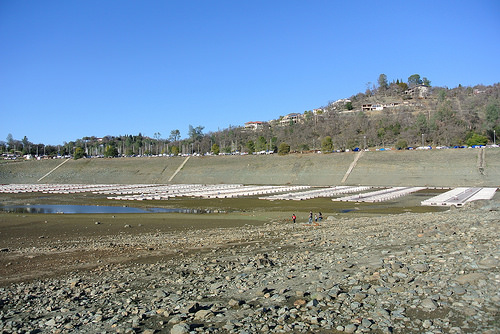
The truth is you can’t get more water from reservoirs that are empty. The problem in California isn’t environmental safeguards. It isn’t a dearth of storage capacity. It’s a lack of rain. Sacrificing the Bay-Delta ecosystem and building more canals and reservoirs won’t usher in the rain clouds or create more water.

2014-03-17-12577781915_e6d9c5a553.Marina.at.Folsom.Flickr.estro.jpg
The marina at Folsom Lake, February 16, 2014.

Concrete-heavy approaches were the preferred solutions in the 20th century when the West experienced the wettest time in the past millennium and California had access to plenty of rushing rivers. Those days have passed. California has damned all its major rivers, taken so much from the San Joaquin that it went dry in stretches, and overdrawn from a Colorado River that is running at record lows.

But California has another way forward. It can maximize the potential of its largest sources of new water: efficiency, stormwater capture, recycling, and groundwater cleanup. If the state fully tapped these resources, it could provide more water than California gets from the Bay-Delta. This is a 21st century approach to a changing climate, and it will make the state far more resilient than empty reservoirs.

Indeed, it already has. Homeowners across the state have seen how super-efficient toilets and showerheads, Energy Star washing machines, and drought tolerant landscaping can dramatically their lower water use. And San Diego, Long Beach, Los Angeles and other cities have seen the benefits of water recycling, groundwater banking, and rainwater harvesting. An NRDC report found that catching rainwater falling on rooftops alone could meet between 21 and 75 percent of the water supply needs of several major U.S. cities.

Cities have also realized that making efficient use of existing supplies is cheaper than building massive new infrastructure. It would cost $2.5 billion to deliver the same amount of water from the proposed Temperance Flat as California water agencies could get for $450 million from recycling programs.

Similar water and financial savings await farmers. Right now the agriculture sector accounts for 80 percent of all water use in California. While some farmers have invested in advanced systems to use their water more efficiently, more than half of the irrigated acreage in California still relies on less efficient flood and furrow techniques. That presents a huge opportunity for the agricultural community to improve crop yields, maintain farm income, and save water.

California’s drought affects everyone in the state, from farmers to fishermen, business owners to suburban residents, and everyone has a role to play in using precious water resources as wisely and efficiently as possible. We can’t make it rain, but we can take charge of investing in solutions that help the state thrive — even when reservoirs run dry.

Photo credit: Jen Estro

Furniture Library Debuts Plaxico Gardens

Article Summary:
Bienenstock Furniture Library Gardens to debut during High Pont show.


The Bienenstock Furniture Library will officially unveil The Pat Plaxico Gardens during the April 2014 High Point Market. Show visitors are encouraged to check out the Library, enjoy the gardens, its interior spaces and resources.

Named in honor of designer Pat Plaxico, whose distinguished service to the furnishings community has earned her a reputation for excellence, the gardens are a place where anyone with an interest in furniture and design, can find inspiration. “The sculptures, landscaping and additional parking, made possible by donations from friends of the Library,” explains current Library Board President, Russell Bienenstock, “unify its interior and exterior spaces, making the new campus ideally suited for hosting furniture industry groups and events.

The garden project is just the latest facilities update undertaken by the Library. It’s book collection was recently re-cataloged and the entire Interior re-designed. A new conference room available for meetings, seminars, lectures, and events was added, and the building expanded to improve access, and accessability.

For those who have not visited before, BBFL is one of the most interesting specialty libraries in America. It is located on North Main Street in High Point, just a mile North of the Market’s center. Open all year, it is used by furniture designers, interior designers, students, manufacturers, industry suppliers and retailers.

The collection of more than 5,000 books and periodicals include significant volumes on design, furniture, interiors, architecture, textiles, finishes, and construction published since 1640. Rare books such as original works by the 18th century furniture masters Chippendale, Sheraton and Hepplewhite, plus hundreds of others can be viewed in a temperature and humidity controlled rare book room.
“The garden includes several outdoor spaces which lend themselves to meeting areas, notes Pat Plaxico. “Paired with the spaces available inside the library, there are opportunities to have lectures, retreats and seminar space for groups up to 25. It is very heartwarming that so many folks have contributed to the gardens. It has literally been a ‘grass roots’ effort. I really love all the pieces of sculpture which add to the fun and playful nature of the gardens. The gardens are a little gem of solitude on a busy city street.”

Charles Sutton, past Board President adds, “The labels of icon, legend, Renaissance woman and creative genius all do apply to Pat for her contributions to our industry, the Furniture Library, her profession, the community and state. But what I have always admired about Pat is that she is a ‘get it done worker’. If she is on board with a project, she is always a 100% contributor; giving her thoughts and time pro bono to the effort”.

In the near future the Library intends to add a scholarship for Landscape Architecture and Garden Design to complement the existing design competition scholarships for Interior and Furniture Design. Also on the drawing board are the addition of a high tech space for collaboration, and the launch of the “Speaking Volumes” design seminar series.

About Pat Plaxico: Plaxico is a nationally recognized interior designer renowned for the reuse of historic buildings — adapting old structures for new purposes. Her portfolio includes Historic Market Square, the EJ Victor building, the Phillips Building (now High Point Convention and Visitors Bureau) and the Bernice Bienenstock Furniture Library. She’s been a member of the Furniture Library board for 38 years.

About the Library: The Bernice Bienenstock Furniture Library is a worldwide center for research, design and collaboration, which holds the world’s largest collection of rare and significant books on the history, and design of furniture. Founded in 1970 by Furniture World and the Bienenstock family, the Library is devoted to the advancement of knowledge about design, furniture, interiors, architecture, textiles, finishes, and construction.

For more information visit http:// www.furniturelibrary.com.


Furniture World is the oldest, continuously published trade publication in the United States. It is published for the benefit of furniture retail executives. Print circulation of 20,000 is directed primarily to furniture retailers in the US and Canada.  In 1970, the magazine established and endowed the Bernice Bienenstock Furniture Library (www.furniturelibrary.com) in High Point, NC, now a public foundation containing more than 5,000 books on furniture and design dating from 1620. For more information contact editor@furninfo.com.

Rachel ‘Bunny’ Mellon Dies at 103

Rachel “Bunny” Mellon, the heiress and paragon of understated luxury who late in life was linked to a presidential campaign scandal, died Monday at age 103.

For decades, Ms. Mellon was regarded for her elegant taste and sense of style, and for gardening and landscaping, all handled with minimum publicity.

She had homes in the Massachusetts enclaves of Cape Cod and Nantucket, and in Antigua, Paris and Manhattan. She…