Author Archives:

A Modular Garden That Floats Across The Sea

We may be able to deal with looming overpopulation by stacking people into ever taller high rises, but growing crops that way becomes a much tougher proposition. What happens to food production when we simply run out of land? We can go to the oceans.

Sealeaf is a floating garden, designed to grow crops off coastlines. Designed by Jason C. Cheah, Idrees Rasouli, Sebastian Wolzak, and Roshan Sirohia, it’s a modularly expandable system that’s essentially a floating dock with a greenhouse on top.

“Essentially, we believe that instead of trying to design against rising sea levels and urbanisation, why not use it as a source and view the situation as a positive?” Cheah writes.

Sealeaf modules, which cost $50 apiece, are linked together by a mortar of walkways. So farmers can tend to the crops as needed, but maintenance is relatively automatic, thanks to rain collection along with a 1W solar panel that drives root aeration. These financials are an important point. Because while most of us consider coastline to be premium property, the team has found that in dense urban areas like Singapore, leasing a dock is a fraction of the cost of leasing land. Meanwhile, in a case study using bok choi, each Sealeaf module could grow six plants at a time, with seven harvests per year. That equated to 44lbs of food, or $105 in crop revenue in the first year.

Then, when you consider all of the saved ancillary costs–all those trucks burning diesel that no longer need to ship in certain fresh goods–the idea certainly becomes exciting. But I can’t help but be a bit skeptical as to how the system would scale alongside the larger ecosystem. Our shallow coastlines feature some of our most diverse, solar-dependent life in the ocean. We have to be careful not to steal their sun.

As of today, Sealife is about 70% realized, 30% concept. A future iteration could incorporate a wave power system to further lower the price.

See more here.

Florist and clothes designer among new business units at Carnon Downs …

NEW businesses have opened at a garden centre near Truro.

Sarah Newton, MP for Truro and Falmouth, opened five new units at Carnon Downs Garden Centre.

  1. Pictured from left, Kelly Galsworthy, from Flynn's Flowers; Kate Pearson, from Cornishbirdinthesticks; Jacque Hassal, co-owner of Carnon Downs Garden Centre; Julian Power, from Garden Design; Sarah Newton, MP; Sue Young, from Sujati Design; Caroline Evans, from Vici Jewellery; and  James England, from In2Build Builders.

    Pictured from left, Kelly Galsworthy, from Flynn’s Flowers; Kate Pearson, from Cornishbirdinthesticks; Jacque Hassal, co-owner of Carnon Downs Garden Centre; Julian Power, from Garden Design; Sarah Newton, MP; Sue Young, from Sujati Design; Caroline Evans, from Vici Jewellery; and James England, from In2Build Builders.

The units now house a florist, Cornish craft work and paintings, a clothes designer using recycled products, a garden designer and a jewellery shop.

Mrs Newton said: “I was delighted to meet and talk to the traders and I wished them every success. It is really pleasing to see fledgling businesses have a new start in an excellent area with such wonderful units.”


Main image for myprint-247

Our heavyweight 350gsm business cards have FREE UV coating, FREE next day delivery VAT included. Choose from 100s of pre-designed templates or upload your own artwork. Orders dispatched within 24hr

Terms:
UK supplier of Business Card, Leaflets, Compliment Slips, Letterheads, Posters, Folded Leaflets. 24hr Turnaround

Contact: 01858 468192

Valid until: Sunday, March 31 2013

She toured the garden centre with the owners Jacque and Mark Hassall and said she was a long term customer.

Mrs Hassall said: “It is wonderful to be able to offer an opportunity to small local traders to get their businesses off the ground in the hope that they may be able to expand in years to come.”

Milford garden club members win honors for design

Members of the Greenleaf Garden Club, of Milford, won honors at the Boston Home and Garden Show.

Elaine McNanna won a blue ribbon for her miniature design reflecting the swan boat, a Boston landmark.

Beverly Huckins received an award for excellence in design for her linear design “Love of the Orient” using peonies, peach blossoms and pittosporum leaves to illustrate her vision of the Orient.

June Donnelly received two honorable mentions, a blue ribbon and the Novice Award. She used skating to illustrate “The Love of Sports and designed a hat to reflect “Love of Style.”

Carol Burke received an honorable mention in “Love of Holidays” category by using fall colors to illustrate Thanksgiving.

Anne Sarkisian won an honorable mention in “Coined in the USA” category for an angular design
 

Home News City of Toronto staff and residents talk ideas for…

12 hours ago  |   


Bookmark and Share

<!—->

12 hours ago 

‘));
jwplayer(“UIVDO”).setup({
stretching: “uniform”,
flashplayer: “/portals/_default/skins/zuza/resources/player.swf”, skin: “/portals/_default/skins/zuza/resources/blueratio.zip”,
image: ” + _$adActive.attr(‘vdoBG’) + ”, width: 542, height: 275, file: ” + _$adActive.attr(‘vdoURL’) + ”,
‘events’: { onReady: function () { jwplayer(‘UIVDO’).play(); } }
});
}
} else {
$(‘.ad-image-wrapper’).css({ ‘display’: ‘block’ });
$(‘div#UIVDO, div#UIVDOWRAP’).remove();
}
}
});

Beach Mirror

by DANIELA PITEO

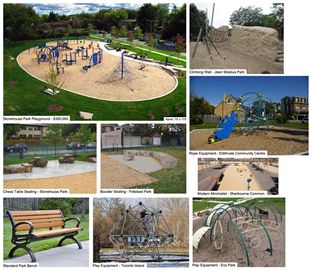
Toronto city staff and neighbourhood residents bandied about ideas March 20 at the Frankland Community Centre regarding the upcoming revitalization of Withrow Park’s south area grounds.

Alex Mut, a landscape architect with the City of Toronto, presented potential uses for the playground and invited ideas from residents and their children.

“The park has a nice canvas to do something exciting,” said Mut, but remarked the neglected grounds are due for a major facelift.

“It seems to be the lesser-known playground or, at best, the playground with the swings because that is all it has to offer,” Mut said.

The playground, on the west side of Logan Avenue in Riverdale, will receive new equipment and landscaping with funding from the city’s capital projects and an additional levy from Parks and Recreation. The project has a budget of $250,000.

A presentation of potential uses for the land was displayed for residents and children to examine followed by an interactive group workshop allowing small groups of people to share their ideas with the city.

According to Mut, it was important children were included in the process and he said he was pleased that several parents brought their kids out to the meeting.

“I think it is very important to get a full range of ideas, obviously we can’t accommodate everyone’s ideas, but to hear them all and learn about the park is very valuable,” Mut said.

The feedback will be gathered, refined and again presented to the community for further discussion.

The selection process will transpire over various stages of planning and presented to the community in subsequent meetings.

“We will review the information gathered tonight and determine where the priorities seem to be,” Mut said.

Longtime resident Sandra Lester said she was excited to be a part of the process and put forth an array of ideas.

“I’d like to see interactive, naturalized learning so kids can learn about science, nature, issues like producing your own power and pumping your own water. I’d like them to feel empowered to interact with their own landscape,” Lester said.

Her focus, which strongly appealed to all present at the meeting, centred around educational and environmentally responsible play with an emphasis on adventure and fun for children of various ages.

“I’ve been in the neighbourhood for a very long time, over 20 years. I remember being a nanny in this neighbourhood and a little girl, who is now in a master’s program, climbing on equipment that is still in the park. That means this equipment is over 20 years old and it hasn’t changed since then.

“It’s time to revitalize it. My son is getting to the upper age limit, he’s nine, and I think kids should still play a lot at nine, but he’s not finding it adventurous anymore. There’s a lot of opportunity to do something really different here,” Lester said.

Ward 30 Councillor Paula Fletcher was also on hand to take note of what her constituents had to say.

According to Fletcher, a common complaint is that city equipment has been dumbed-down, so the city is working toward finding equipment that is both fun and challenging.

“I think adults pick pieces of equipment that they think look interesting and then the kids have to say, ‘That’s the one I like,’” Fletcher said.

Mut and city staff will work toward compiling the information garnered from the meeting and present a conceptual design by late April.

Garden events: Learn the keys for rose success

AFRICAN VIOLET SALE: Three Dallas-area violet societies will host the annual judged show and sale. Members also will offer growing advice and instructions. 1 to 4 p.m. Friday and 10 a.m. to 4 p.m. Saturday. Growing African violets workshop,10 a.m. Saturday; growing gesneriads, 2 p.m. Saturday. North Haven Gardens, 7700 Northaven Road, Dallas. Free.

ROSES: The monthly meeting of the Dallas Rose Society will include a presentation on Fortuniana grafted roses by champion rose growers from Arkansas. 7 p.m. Friday. Farmers Branch Recreational Center, 14050 Heartside Place, Farmers Branch. Free. 972-727-3007.

OWL PROWL: The Indian Trail Chapter of the Texas Master Naturalists and Midlothian parks are co-hosting a night hike and owl prowl. 8:30 p.m. Friday. 1361 Onward Road, Midlothian. Free, but advance registration requested. 972-291-2868.

GARDEN ED: Free classes at North Haven Gardens, 7700 Northaven Road, Dallas. 214-363-5316. nhg.com. Lawn care, noon Saturday Peonies, 1 p.m. Saturday

ROSE FESTIVAL: The rose festival will include a variety of roses to buy, including antique, English, climbing, hybrid, Knock Outs and more. Rose experts will answer questions and share advice from 1 to 3 p.m. Saturday. Festival is 9 a.m. to 7 p.m. Saturday at Calloway’s locations in North Plano, 2460 State Highway 121; South Arlington, 4940 S. Cooper; and Hurst, 760 Grapevine Highway. A rose clinic describing best practices is 10:15 a.m. Saturday at all Calloway’s locations. Free. calloways.com.

URBAN CHICKENS: Learn about caring for chicks and nurturing them to adulthood. Class also will cover housing, feeding, watering and proper hygiene. Marshall Grain Co. 10:30 a.m. Saturday, 2224 E. Lancaster Ave., Fort Worth, and 1 p.m. Saturday, 3525 William D. Tate, Grapevine. Free. marshallgrain.com.

NATIVE PLANTS: Learn how to create a sustainable landscape with native plants from well-known North Texas practitioner Gailon Hardin. Redenta’s Garden. 10 a.m. Saturday, 111 W. Arkansas Lane, Arlington, and 2 p.m. Saturday, 2001 Skillman St., Dallas. Free. redentas.com.

ARBORETUM EDUCATION: Upcoming classes at the Dallas Arboretum, 8525 Garland Road, Dallas. Advance registration required. dallasarboretum.org. Bulb trial walking tour, 9 a.m. Saturday, $25 Container gardening, 9 a.m. Saturday, $48

DROUGHT-TOLERANT LANDSCAPE: Two free landscaping seminars will cover ideas for installing drought-tolerant yards. Water-wise landscape design will be 9 a.m. to 12:30 p.m. Saturday. Suitable plants for North Texas will be 1:30 to 5 p.m. Saturday.

The first 100 attendees at each session will receive a copy of landscape designer Bonnie Reese’s book, Common-Sense Landscaping. Texas AgriLife Research and Extension Center, 17360 Coit Road, Dallas. Reservations required. 214-670-3155. savedallaswater.com.

WETLANDS: Learn about the John Bunker Sands Wetland Center in Seagoville at a meeting of the Indian Trail Chapter of the Texas Master Naturalists. 7 p.m. Monday. Red Oak Library, 200 Lakeview Parkway, Red Oak. Free. 972-825-5175.

ROSE LIBRARY: The Dallas Area Historical Rose Society’s monthly meeting will include a presentation on the 25 books rose gardeners should own. 6:30 p.m. Tuesday. Farmers Branch Recreational Center, 14050 Heartside Place, Farmers Branch. Free. 972-620-1131.

POLLINATORS AND PROPAGATION: Learn about pollinators and propagation at the monthly meeting of the Grapevine Garden Club. 9:30 a.m. Tuesday. Stacy Furniture, Community Room, 1900 S. Main St., Grapevine. Free. grapevinegardenclub.org.

BUNCHGRASS PRAIRIE: The Trinity Forks Chapter of the Native Plant Society of Texas’ monthly meeting will include a presentation on the largest bunchgrass prairie in North America. 6:30 p.m. March 28. Texas Woman’s University, Ann Stewart New Science Building, Denton. Free. npsot.org/trinityforks.

HERBS: The Greater Dallas Organic Garden Club welcomes Texas magazine publisher Judy Barrett for a presentation on herbs and how they can be used in the garden, kitchen and around the home. 6:30 p.m. March 28. REI, 4515 LBJ Freeway, west of the Dallas North Tollway. Free.

IKEBANA DEMONSTRATION: A presentation on creative ikebana, featuring sogetsu trends and techniques, will be offered this month. 9:30 a.m. to 4 p.m. March 28. Bent Tree Country Club, 520 Westgrove Drive, Dallas. $45 or $65. Advance registration requested. 214-750-7236 or email sallyshockey@sbcglobal.net.

SQUARE-FOOT-GARDENING: Learn how to grow vegetables in a raised box. This class will offer tips for square-foot-gardening in Texas and working with a small space. 9:30 a.m. to noon March 30. 1106 Almond Drive, Mansfield. Advance registration required. 682-234-3873 essentialsforenduringhealth.com.

BECOME A MASTER GARDENER: The Dallas County Master Gardeners are accepting applications through May 28 for the 2013 Master Gardener Training School. Classes will meet 8:30 a.m. to 4 p.m. Mondays, July 29 through Oct. 28. In addition to the 78 hours of class time, participants must contribute a minimum of 72 hours of approved volunteer work through the DCMG over 12 months. Applications are available at dallascountymastergardeners.org or by calling 214-904-3053.

WATER-WISE LANDSCAPE: Enter the 19th annual Water-Wise Landscape tour. The event, which is sponsored by Dallas Water Utilities, is open to all landscapes within Dallas city limits and the city limits of Dallas’ wholesale customers or reciprocal cities. Judging criteria includes design (aesthetic appeal; composition; use of color and plant variety) , water conservation (water use; non-vegetative materials such as fences, walls, walks; use of native or adapted plants; reduced turf area; and use of mulches) and appropriate maintenance landscape (healthy, disease- and pest-free plants; no weeds; plants pruned as appropriate). Entry deadline is April 12. Visit savedallaswater.com to apply online. Entries will be judged in mid-April. The public tour of landscapes will be June 1.

AZALEA TRAIL: See 10 miles of azaleas, dogwoods and spring flowers in Tyler during its 54th annual event. Friday through April 7. 315 N. Broadway, Tyler. Complimentary visitor packets are available by calling 1-800-235-5712 or at visittyler.com.

ROAD TRIP: The Lady Bird Johnson Wildflower Center will host a public plant sale. 9 a.m. to 5 p.m. April 13 and 14. 4801 La Crosse Ave., Austin. For a list of plants that will be offered, visit wildflower.org.

Submit calendar information at least 14 days before the Thursday publication date to garden@dallasnews.com.


Home, Remodeling & Garden Show March 22-23 in Hudson

Talk about it

    Looking for fresh ideas in new home building, home remodeling and improvement, home decorating, design, and landscaping? With over 60 vendors at the upcoming St. Croix Valley Home Builders Association Home, Remodeling Garden show you’ll be able to gather a multitude of ideas to help you create your dream home—from the ground up or by re-inventing the home you’re in!

    Find everything you need under one roof at the Hudson Sports Civic Center on Hanley Road in Hudson. The show will be open to the public on Friday, March 22, from 4 p.m. to 8 p.m. and on Saturday, March 23, from 9 a.m. to 5 p.m.

    From top to bottom, inside and out — finding the right contractor and company for your project has never been so easy! At this event you will find home building and remodeling, landscaping, garden and lawn care, designs and trend ideas, windows, doors, floors and more! Come get new refreshing ideas for 2013 and first hand information from our builders, remodelers and subcontractors about your new home construction or your home projects…all under one roof!

    Get expert advice! Don’t miss this great opportunity to speak directly with the St. Croix Valley Master Gardeners about any planting issues we may experience this spring, ways to combat your worst weed nightmares and much, much more! Take advantage of our onsite demonstrations and seminars on Saturday including topics such as conquering the clutter, design and remodeling trends for 2013 and easy ways to keep your home in tip-top shape.

    Make it a family event! Bring the kids for a fun filled day complete with a visit from the Easter Bunny!

    Prizes, prizes, prizes! We are proud to have vendor-sponsored prize give-aways as well as multiple cash prizes this year. The drawing for the grand prize will take place on Saturday at 3:45 pm. Winner need not be present to win, however, must present winning ticket upon grand prize collection.

    The 2013 show is made possible by the St. Croix Valley Home Builders Association, its Home Show Committee and major sponsors, Erskine Interiors, County Materials, Xcel Energy and WESTconsin Credit Union, Admission is $4 at the door and children under 18 are free.

    For questions or additional information, please contact Bonnie McCormack at 715-796-5377

    Tags:
    area news, news, business, hudson, events

    More from around the web

    Straw bale gardening got its start on Worthington farm


    By Carol Stender
    cstender@agrinews.com

    Date Modified: 03/20/2013 9:23 AM

    E-mail article | Print version

    MINNEAPOLIS — Joel Karsten has the seeds, fertilizer, soaker hose and straw bales ready to go.

    Karsten uses the straw instead of soil.

    He considers growing with straw a breakthrough vegetable growing method. Karsten can grow vegetables earlier, anywhere and without weeding. It’s become a gardening craze and led Karsten to write “Straw Bale Gardens.”

    The concept started on his family’s Worthington farm.

    “As a young farm boy, one of the major steps to manhood is when you get to stack your first rack of straw bales by yourself,” said Karsten.

    The rack would almost make it back to the dairy and grain farm before one or two bales would fall and break, he said. The broken bales would be tossed to the side. Weed seeds, carried on the summer winds, would fall and rains saturated the straw. The seeds would germinate and grow “like Jack’s bean stalk,” he said.

    “Anyone could see that they were getting some kind of benefit from those rotting bales of straw,” he said. “I noted this even then and sort of filed it away in my head.”

    After high school, Karsten attended the University of Minnesota to major in horticulture science with an emphasis in nursery and landscape management. While he took classes on the “farm campus,” Karsten traveled to the east bank for football practice where he played for coach Lou Holtz. He was the only team member studying anything agriculture-related, he said.

    Karsten began landscaping for others after his sophomore year. Most of his clients were professors who lived near campus.

    “They loved having a farm kid who knew how to work hard, so I had work lined up constantly,” he said. “I hired other football players to help out.”

    He stayed in the Twin Cities following college and focused on his landscaping skills. But nothing created a bigger challenge for him than the first property he purchased. As he began working the soil for a garden, Karsten discovered the ground was more like a construction soil. It bore little resemblance to loose soils.

    Karsten wanted a lush garden like his Grandma Josephine’s . It was where he played with his trucks as a child while she weeded. As he grew, Karsten helped her and learned about vegetable production.

    He didn’t have money to purchase truckloads of compost, and he didn’t have the resources to build raised beds or make other garden modifications.

    That’s when he remembered the broken straw bales.

    If he were to purposely set out a bunch of straw bales and encouraged the bales to decompose quickly, it might provide enough nutrition. He mentioned the idea to some of his college professors, but they hadn’t heard of straw bale gardening. He yielded no results when researching the topic.

    Frustrated, he called his father who simply said, “Well, why don’t you just try it a bunch of different ways and see what works? What are you out if it doesn’t work?”

    He set bales up, treated different groups of bales with different rates and concentrations of nitrogen and kept them moist.

    By mid-summer, Karsten knew he had a winner.

    “Everything was growing fast and looked so much better than similar plants planted in soil at the same time,” he said. “The inside of the bales was decomposing very quickly and literally created brand new soil inside the bale.”

    He intended to use the gardening method to produce vegetables for him and his wife, Patty, but people started paying attention to his methods. Eventually a KARE 11 TV reporter from the Twin Cities’ station, Jeff Olson, interviewed Karsten about the straw bale garden.

    Almost overnight, Karsten’s schedule got busy. He was asked to speak at garden clubs, to teach a class on straw bale gardening and to write a pamphlet. When someone suggested he start a Facebook page, he did and, within a week or two, had 500 “likes.” So far the page has more than 20,000 followers on Facebook. He’s learned that straw bale gardening is spreading across the globe.

    A website, strawbalemarket.com, is devoted to farmers with bales to sell.

    Karsten sold his landscaping business 22 years ago and started a small manufacturing and distributing company. But he’s continued to use the straw bale garden method for his own produce. Gardening is his hobby, he said.

    Patty has great culinary skills and turns the vegetables into delightful dishes. Their dog, Aspen, also likes the straw bale garden and handles the garden security and hole digging, Karsten said.

    His book, “Straw Bale Gardens,” published by Cool Springs Press, is a complete guide. He uses easy to understand terminology combined with pictures that easily illustrate his methods.

    Library Lowdown: Books for garden inspiration – Exponent

    Sharon Saye

    Sharon Saye


    Posted: Wednesday, March 20, 2013 2:10 pm
    |


    Updated: 2:12 pm, Wed Mar 20, 2013.


    Library Lowdown: Books for garden inspiration

    by Sharon Saye, Library Director

    exponent-telegram.com

    |
    0 comments

    Spring is finally here, and although it has not been a bad winter, it has just seemed endless. So with the daffodils starting to sprout and lawns turning a darker green, many people begin to plan for their gardens.


    Inspiration is often the real first step and a brand new book may just provide that: “1001 Gardens You Must See before You Die.” Not exactly the niftiest title to remind one of one’s mortality, but the information in the book is certainly worth the look.


    This volume is a stunning guide to the most outstanding gardens flourishing in the Americas, Europe, Asia, Africa, and Australia. These gardens are startling, unusual, interesting and beautiful. From famous gardens like Granada’s Alhambra to private, hidden gems, this magnificently illustrated guide is packed with vivid photographs and detailed descriptions.


    For those looking for new ideas or those who just like to armchair travel, “1001 Gardens You Must See before You Die,” is a remarkable companion.

    “Patio Stone: A Sunset Design Guide” provides the latest ideas on materials and plans to create perfect outdoor living spaces. It includes expert advice from landscaping professionals as well as real-world solutions to practical problems. It contains clear, concise charts to choose materials that meet your needs regarding appearance, durability, ease of installation and price. And if you are concerned with the environment, there is the latest information on green materials and landscaping techniques.

    Another new book is definitely for the person who likes architecture and the unique. “1000 Details in Landscape Architecture” emphasizes forward design with real-life projects that demonstrate “the pinnacle of progressive design and eco-restraint from around the world.” With photographs, site plans, drawing and sketches, this is a book that looks at landscape architecture as a function of artistic design.

    The library has shelves of books on gardening from the needs of everyday to the large, coffee table size book of the most beautiful flowers. So if you need to plant shrubs, grow herbs, plant tomatoes, there is a book for you on our shelves.

    on

    Wednesday, March 20, 2013 2:10 pm.

    Updated: 2:12 pm.

    Green gardening tools and techniques that really work

    Americans have embraced recycling and are enthusiastic about cleaner energy sources. Yet when it comes to caring for their outdoor environment, many people still use less earth-friendly tools and techniques. So what’s standing in the way of Americans going green in their gardens and landscapes?

    One answer may be the common misconception that eco-friendly products and practices don’t work as well as less environmentally conscious ones – such as chemicals that repel common garden pests, but can also cause groundwater contamination.

    “Advances in environmentally responsible products have made it possible for homeowners to effectively care for their gardens and landscaping, while protecting the environment at the same time,” says Elizabeth Summa, president of Repellex, which makes eco-friendly lawn and garden products.

    Some greener gardening tools are time-honored, like rotary lawn mowers. Others are leading-edge, such as pest-control products that are eco-friendly. Here are a handful of environmentally safe, effective ways to keep your landscape and garden green this spring and summer:

    Responsible repellent – Deer, rabbits, squirrels and gophers – animals munch on landscaping and garden plants because they’re hungry and the vegetation tastes good to them. Eco-friendly repellents, like those made by Repellex, use taste aversion and natural ingredients like pepper, dried bloodmeal and egg to make non-edible plants less appealing to foragers. Repellex Systemic Tablets deliver a dose of pepper to the roots of plants – just place in soil, water and walk away. The flavor gets absorbed through the roots into non-edible plants, making them taste unappealing to garden pests. For edible plants, Repellex Fruit Vegetable uses a combination of putrescent eggs and plant extracts to keep animals and insects away from fruits and vegetables all season long. Log on to www.repellex.com to learn more.

    Friendlier mowing – Long before combustion engines made it possible to mow your lawn quickly and easily, people relied on rotary mowers – also known as reel mowers. Environmentally responsible gardeners have rediscovered these people-powered mowing machines. Reel mowers have many positive attributes: they are pollution-free, quiet and very economical to operate. Modern reel mowers are lighter, smaller and with fewer working parts that require maintenance and repair. They’re also a great way to exercise; walking behind a rotary mower burns more calories than pushing a self-propelled mower.

    Organic fertilizing – Chemical fertilizers are a well-known source of groundwater contamination, yet some form of additional nutrients is almost always necessary for successful gardens and lawns. The EPA says composting can eliminate the need for chemical fertilizers and results in higher crop yields. You can compost food waste from your own kitchen, as well as grass clippings and other yard waste. Composting your own organic waste at home not only reduces the amount of waste that ends up in landfills, it can provide you with an effective, eco-friendly and essentially free way to fertilize gardens and flower beds. For lawns, you can find a variety of organic fertilizers – based on natural ingredients rather than chemicals – at most hardware, big box stores and garden centers.

    Kinder weed control – Weed killers are also well-known contaminants, and can be hazardous when used around small children or household pets. Before you bring out the spray bottle, consider weed-elimination alternatives that are kinder to the environment. Some very effective options include using a mixture of vinegar and water, boiling water and even pulling weeds by hand. Removing weeds by hand also adds a health benefit for you – you’ll burn more calories pulling weeds than simply spraying them.

    Bug-free without bugging the environment – Chemical insecticides can be harsh on the environment – not to mention skin if you use a chemical repellent to ward off mosquitoes and other biting bugs. Instead of chemical insecticides, consider natural alternatives. Repellex’s Mosquito Tick product keeps mosquitoes, ticks and other insects off you by keeping them out of your lawn and garden. The all-natural repellent sprays on your lawn, garden, patio, deck and home exterior to ward off these disease-carrying insects.

    Choosing to go green with your lawn and garden care doesn’t mean you have to give up effectiveness. With the right tools, it’s possible to accomplish your lawn and gardening goals while protecting the environment at the same time.

    Spring Gardening Tips

    text size

    Updated: Wednesday, March 20 2013, 07:24 AM EDT

    The start of Spring brings the start of gardening excitement.  

    People are looking for ways to spruce up their lawns and turn gardens into their own private produce markets. 

    The team at B.B. Barnes showed us some secrets for success with gardening . 

    The tips include the fact that now is the time to get some cool weather vegetables in the ground, but you need to wait for more tender plants like tomatoes.  

    Click here for links to Spring Gardening tips and a list of special gardening workshops.

    By Victoria Dunkle
    Follow Victoria on Twitter @victoriadunkle

    Spring Gardening Tips