Author Archives:

Sit Pretty with High-Design Outdoor Furniture


Your backyard chair is much more than just a seat. It’s a crucial object that connects you to your outdoor world—one that should be beautiful, comfortable, and in sync with its surroundings (both architectural and organic). To prep you for summer lounging, Portland-area garden designer Vanessa Gardner Nagel, author of The Professional Designer’s Guide to Garden Furnishings, shares some tips and tricks for enhancing your outdoor domain.

You see a lot of garden furniture. What common mistakes do people make?  Mixing furniture styles that don’t agree. Mixing, say, a Japanese bench with a Victorian table usually results in a complete disconnect, not a charmingly “eclectic” look. Also, not paying attention to the scale and proportion of the furnishings in relation to the surroundings. A beefy house with lightweight, pixie furniture looks unbalanced. And then there’s the Adirondack chair problem.

What’s so bad about the Adirondack chair?  First off, it’s become trite from overuse. Granted, it’s fine if gazing across a sweeping lawn toward a distant lake. But its vast footprint makes for stumbling in small urban gardens, and it’s hard to lift, move, or position around a fire pit. Above all, it’s awkward for conversation: the angle of the back makes eye contact tough. 

So if Adirondacks are out, where should people start? There are four main factors to consider: Do the furnishings physically fit in the space? Do they properly fit the people using them? Do the materials work with the use they will receive? And do they suit the setting stylistically? 

How important is color? It’s huge! We usually think of color as “hue,” but it’s also intensity (bright or dull) and value (light or dark). Thinking about all three helps you pick the right color. And remember, not everything can be a statement—something always has to take backstage. Got a plain table? Make the chairs striking!  

Where do you like to shop locally?  I love Digs Inside Out and Garden Fever. And there are also great larger retailers specializing in outdoor furnishings, like Hive Modern, Design Within Reach, Fishels, and Ludeman’s.

Five space-changing chairs

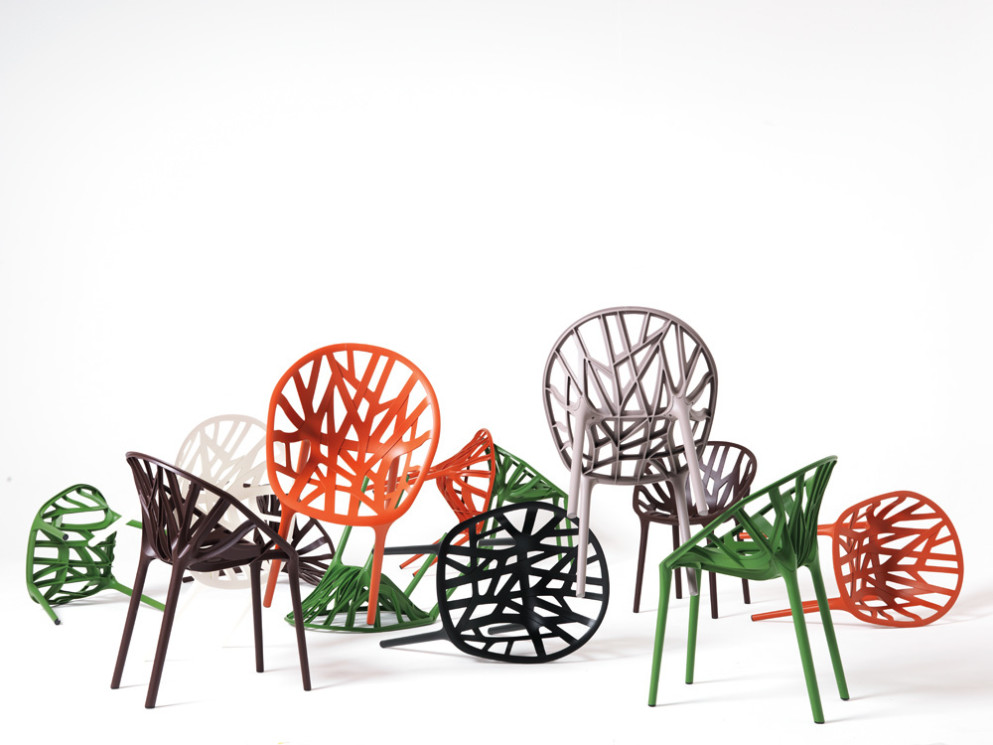
Vegetal by Vitra (above): This 100 percent recycled polyamide chair is weather-resistant, sustainable, and well-suited to a ranch, midcentury modern, or contemporary garden and home. $650 at Hive Modern, 820 NW Glisan St

Luxembourg Chair by Fermob: These bright, comfortable retro chairs dry quickly (great in the Northwest) and suit a broad range of midcentury and contemporary settings. $347 at Digs Inside Out, 1829 NE Alberta St 

Aman Dais by Westminster Teak: With a nod to historical style in the legs and back detail, this modern lounge would sit well with a traditional, contemporary, or even Asian-style house or garden. From $1,361 at westminsterteak.com 

Lago Chair by Loll Designs: Taking its cues from the midcentury aesthetic, the Lago chair is particularly well-suited to contemporary or Japanese-themed spaces. $496 at Garden Fever, 3433 NE 24th Ave

Louis Ghost by Philippe Starck: Inspired by Louis XVI, this chair’s scale and simplicity mix well with many styles: contemporary, traditional, colonial, classical, Victorian. $410 at Design Within Reach, 1200 NW Everett St

Reclamation plant first step in clean beach

Reclamation plant first step in clean beach


Share

Pin It

More Galleries

Mike Beanan walks on the berm that separates polluted urban runoff in Aliso Creek in foreground from the ocean. The Aliso Creek Water Reclamation facility will help reclaim runoff water from Aliso Creek and provide it to customers who use reclaimed water, predominantly for landscaping.


Aliso Creek Urban Runoff, Recovery and Reuse Water Conservation Project

Where: Laguna Beach

Cost: $2.8 million project between County of Orange, City of Laguna Beach and South Coast Water District

What: Plant will remove 800,000 gallons of runoff from Aliso Creek for filtration.

Additional benefits: Provides a water supply reserve in the event of disaster such as fire or earthquakes.

Contamination: Reduces contamination levels at nearby Aliso Beach.

Conservation: Helps restore habitat for the federally protected gobi fish.

Historic and current Aliso Creek flow

• Prior to the 1970s before the region became heavily urbanized, Aliso Creek was an intermittent stream. Creek flow data from 1930 to the 1970s show that during the summer months and dry periods, little to no flow is documented in lower Aliso Creek.

• Creek flow has significantly increased since 1970 with urbanization and residential development and the resulting urban runoff entering Aliso Creek.

• Over a 30-year period, flows in Aliso Creek from 1970 flows in the creek have increased 450 gallons per minute to approximately 4,500 gallons per minute.

• Aliso Creek flows year-round; creek flows have declined in recent years due to the drought and ongoing outdoor water conservation efforts.

• County data shows the average creek flow in 2012 at approximately 3,000 gallons per minute and in 2013 at approximately 2,900 gallons per minute. This represents an estimated decrease in creek flow by more than a third in less than 10 years – from about 4,500 gallons per minute in the 2004-2006 timeframe to approximately 2,900 gallons per minute in 2013.

Heal The Bay

Data: Three monitoring sites by the county provide weekly data. Heal The Bay calculates the data and puts it into an algorithm that calculates the grade.

Ratings: Since 2000, Aliso Beach has received an F nine times from Heal the Bay. 2008: B and 2013: B.

Grades: Given during the wet times of the year. Dry times of the year produce better results because the creek flow is lower and less bacteria flows onto the beach.

LAGUNA BEACH – Michael Beanan swims in the ocean off Thousand Steps beach at least three times a week – a habit he’s had for 30 years.

An avid ocean advocate, the former Navy SEAL has targeted ways to create a healthier ocean for years. Now for the first time he sees a solution to the brown and murky algae bloom often hugging the coastline of some of Laguna’s most picturesque beach coves. The bloom is caused by bacteria-filled water that flows along Aliso Creek and into the ocean at Aliso Beach from inland communities.

The murkiness stays concentrated in coves like Thousand Steps, where water has very little circulation. Recent data show that about 1.3 million gallons of runoff enter Aliso Creek daily from uphill communities. Recently, officials at the OC Health Care Agency closed the popular beach after 10,000 gallons of sewage dumped into the creek from a storm drain in Laguna Hills. Unlike Trestles Beach in San Clemente, where a berm filters runoff water that flows into the ocean, the berm at Aliso Beach is breached daily.

A new $2.8 million plant called the Aliso Creek Water Reclamation Facility is what Beanan calls the first step to taking a beach rated F for multiple years and turning it into an A or B beach in non-drought years.

Experts say the plant may remove as much as 300,000 gallons a day. Care will be taken to not remove too much water so as not to disturb wildlife habitat or to affect the lagoon at the creek’s mouth near the ocean.

Beanan, who two decades ago joined a city clean water task force and researched other facilities such as Santa Monica’s Urban Runoff Recycling Facility, is credited by project experts as being the catalyst that gave city, county and public agencies the needed push to look for solutions to help the beleaguered creek.

Beanan, who has a degree in biology from UCI, toured the Santa Monica facility and brought back some ideas that could work in South County to officials at the South Coast Water District and the city of Laguna Beach. He also helped write grant proposals that ultimately secured state funds.

The new facility was funded partly by $300,000 from a State Water Resources Proposition grant and $25,000 from the city of Laguna Beach. The rest comes from the water district’s operating fund. Officials at the water district say ratepayers won’t see an increase from the new facility – a collaboration of the County of Orange, South Coast Water District and the city of Laguna Beach.

It will remove runoff water coming from uphill communities in Trabuco Canyon and Saddleback Valley and turn it into reusable water. Although similar to SMURRF in its results, its technology is the first of its kind, said Andrew Brunhart, general manager of South Coast Water District.

It works by harvesting water through an extraction pipe – which protects against the removal of fish, plants and larvae – placed in Aliso Creek. The site is about half a mile from Aliso Beach near the South Coast Water District-owned Coastal Treatment Plant in Aliso and Woods Canyon Regional Park. That plant treats wastewater from homes in Laguna Beach, Emerald Bay and Dana Point.

The district’s water comes from the Colorado River through an open aqueduct traversing the desert. Due to evaporation along the route, the water arrives with a high salt content. Most homes filter out the salt with water softeners. About 10 percent to 30 percent of the brine water with high salt content is sent into the sewer system. Though the water is treated at the Coastal Treatment plant, it’s still too salty for use at golf courses or as landscape irrigation.

The new facility is dual-purpose. It captures urban runoff in the creek to be blended with present high-salt recycled water, diluting the salt content of the recycled water so it can be used for landscape irrigation.

And when the creek is too low for water recovery, the facility can be used to polish present recycled water supplies to a lower salt content.

The facility brings other benefits such as increasing the supply of potable water in the event of a disaster such as earthquake or fire.

Mike Dunbar managed South Coast Water District for 25 years. Recently he, representatives from the county, the city of Laguna Beach and the water district dedicated the new facility.


More from Politics and government

  • The three biggest reasons to vote Tuesday

    GOP gubernatorial pick could shape future of the state party, two Republicans might head to a runoff for Congress, and two county supervisor seats are open.

  • Ballots in primary will carry even more weight

    Lower turnout means that those who do vote have a louder voice.

6 Ways to Update An Outdoor Space This Season

As a landscape contractor, you know the advantages of updating your clients’ yards and gardens in accordance with their needs. A recent Houzz study revealed that 56% of homeowners are making updates to their yards and gardens for entertaining purposes. Likewise, another 55% are updating their outdoor space to solve problematic issues such as sun exposure, privacy and flooding.

Now is the ideal time to offer your landscaping expertise to clients who wish to have their outdoor space updated but don’t have time to do it themselves. Here are six ideas that will make their outdoor spaces pop and serve their functional and entertainment needs this summer.

Ideas for Outdoor Space Updates

Outdoor Bar and Grill. A deck or patio can become an extension of someone’s indoor living space with the addition of an outdoor bar and grill. Your professional knowledge of landscaping and design allows you to listen to what the client is envisioning and make suggestions. The addition of an outdoor bar and grill makes it easy for homeowners to entertain family members, friends and other guests.

Multi-Tasking Storage Space. Lack of storage space in a person’s yard results in the frustration of trying to figure out where to put garden supplies, kids’ toys and other frequently used items. Storage benches placed on a patio or deck can take care of removing clutter and also provide additional seating. Suggest storage and seating combinations that work well with clients’ existing patio decor or that will complement the overall design you’re working on.

Automated Watering. It’s a real treat for homeowners to be able to come home after a long day at work and relax outdoors. Automated watering is an effective addition for busy couples or families that have a large yard, a garden or landscaping that needs regular watering. Use your expertise to explain the benefits of automated watering and how it can add to the quality of your clients’ lives.

A Comfy Outdoor Living Space. Turn a “nice patio” into an outdoor living space that’s inviting, comfortable and functional. As you plan along with your clients, offer suggestions for seating areas that complement the rest of the area, as well as your clients’ lifestyles. Show them how particular seating arrangements or styles can add to the enjoyment derived from their outdoor space.

Landscaping and Gardening for Non-Green Thumbs. Not everyone has a green thumb. Suggest easy-to-care-for plants that are hardy during dry weather or will thrive with little care, while still adding to the beauty of the yard or garden. Your professional knowledge will be highly appreciated by people who want their yards to make it look like they’re master gardeners.

Light the Way. Lighting around patios, garden pathways and other areas allows homeowners to enjoy their outdoor space long after the sun has gone down. Suggest various types of lighting that fit in with the yard design.

Professional Landscaping for Beauty and Function

By working with your clients and really listening to their needs and dreams, you can help increase awareness of the benefits of professional landscaping. Many homeowners used to feel that they could or should do the landscaping themselves. But times have changed and homeowners are interested in enlisting the help of a professional to solve their outdoor problems or help them create the outdoor space of their dreams. The above ideas, along with the ideas and services you have to offer, can assist clients in obtaining the yard, garden or patio they can enjoy throughout the seasons.

About the author:  Jeff Caldwell is Brand Manager of Superior Shade in Carrollton, GA. Superior Shade provides protection that matters—umbrellas, shade sails, and shade hips—all that provide protection from the sun and harmful UV rays. We provide custom products for parks, schools, auto dealerships, and more, and our engineers can custom build shade for your unique space.

Facebook Garden Junkie

6/2/2014

Yes, I have to admit it; I am a Facebook junkie. Not a stalker. Let me be very clear on that part. I am an equal opportunity Liker/Sharer of fun, interesting and possibly never able to be accomplished, cool gardening and landscaping ideas. It is just so easy to “like” something and then post it to my own FB page with a “for later” or “cool idea” or more than likely “need this.” Heaven help me if I ever really get going on Pinterest.

However, I have come to the conclusion to get any of these cool ideas initiated, built or otherwise established in my yard, I am going to have to lay off Facebook and get going with the actual starting of the projects. To that end, here are my top three “too cool” projects I want to accomplish before fall.

Potato Box

The caption reads “How to grow 100 lbs of potatoes in four square feet.” Love it; sign me up. Oh wait. I have to build it from instructions? Oh boy. But I really want it. Colleague at work suggested using old pallets for this project as the dimensions would work. We also have leftover wood from the parents’ house project. The premise is to keep building the box around your potato plants and add soil as the plants get taller. With each addition of soil, the plants will grow more potatoes on that level. You harvest from the bottom.

Get your potato slips together and plot out where your 4-foot-square box will be in the garden. Potatoes like sun but can tolerate afternoon shade, so keep that in mind as you scout out your location. Once you decide where to put the box, assemble your supplies of untreated wood either from existing stock, old pallets or purchased wood for the project. The online instructions gives you all the details including size of wood needed, nails, screws and exactly how to construct the box.

Make Your Own Plant Fertilizer

When I clicked on this link, I was hoping it was all about compost tea (which I do pretty frequently) and I could say “Yay, I am already doing this!” Well, it was compost tea and many more fertilizer recipes including manure tea, Epsom salt fertilizer and even fish tank water as fertilizer. Great ideas; not too much work. Sounds like a plan.

Once again, I would like to mention the website www.gardeningknowhow.com as a great reference tool. They post gardening info on Facebook and send out a good newsletter not too frequently, so it doesn’t bog down your mailbox.

And last, but not least:

The Garden Journal

When I first started writing these articles, I did keep a journal. I recorded what worked where in the garden; if seeds germinated and when; when it rained and how much rain water I managed to use before the next rain, etc. This last year, I haven’t kept up a journal and sometimes I struggle for things to write about as the memory is not what it used to be. Keeping a garden journal will aid the gardener (including me) in plotting next year’s plantings and harvest; what grew best where; what did not grow anywhere and what was attacked and which attacks were successfully thwarted with what. (Yes, that last sentence may only make sense to a few of you, but I am sticking by it.)

Next time you are at Brace Books or office supply store, grab a cute notebook and attach a pen to it and start writing. Take a few minutes once or twice a week to jot some notes on your garden, be it flower or vegetable, and start recording your successes as well as your failures. You will find you learn more from the failures, but the successes make you willing to try something new next year. Like sowing wildflower seeds where the cannas were supposed to be because, sniff, they are not coming up this year. But the wildflowers and buckwheat are coming up all over the place and the bees are buzzing.

Here’s to trying something new and Happy Gardening.

—————

Online:

Potato box Instructions: http://bit.ly/1kgTpxq

Garden fertilizer recipes: http://bit.ly/1nW47cD

www.gardeningknowhow.com

Garden Club looks to beautify Ashe County

The Ashe County Garden Club is starting another year of helping improve the landscape throughout the area, but this year is different — they are making themselves known.

“This is really a new kind of chapter in the Garden Club,” said Cindy Escoto, president of the Ashe County Garden Club. “The things (the club) did in the past, they were a little incognito in doing it. It wasn’t quite as involved, but they didn’t have the publicity and interaction with the people.”

Part of the new-found publicity is a push to get more potential members to join and to figure out new ideas for the organization’s future.

The Garden Club has been around for approximately 10 years, with the goal of beautifying Ashe County. This is Escoto’s first year in the club, and first year serving as president.

“This is all done with member dues,” said John Jackson, a member of the Ashe County Garden Club. “We don’t ask for anything from anybody. It is all funded by our dues and pocket money.”

While the plants and landscaping is mostly provided by Garden Club funds, for some projects, local nurseries will donate flowers and other plants for the Garden Club to use.

As spring kicked off and now racing toward summer, the Ashe County Garden Club is working on many different events in the community.

“We only do things during the spring and summer seasons, because of the nice weather,” Escoto said. “We are doing plenty of new things that we previously did not do.”

On Mother’s Day Weekend, the club helped 65 area children at the Farmer’s Market provide potted plants for their mother and on Friday, May 30, the group was helping to beautify the front lawn of the Ashe Pregnancy Care Center in Jefferson.

“It just beautifies our area and makes it feel better and more homely for the girls and the guys that we serve,” said Roger Newton, director of the Ashe Pregnancy Care Center. “That’s the wonderful thing.”

For the Pregnancy Care Center, the Garden Club removed old weeds and dead plants from the front and then placed two flower beds and a tree to greet visitors to the center.

“They asked for help doing it, so part of our mission statement is to be involved in our civic community and beautifying it,” Escoto said. “This seemed like perfect outlet, because they wanted the help and we had the members who wanted to donate their help.”

In the past, the Garden Club has created gardens at the Jefferson Post Office, the Museum of Ashe County History and Mountain View Elementary School. In July, the club will have a booth at the Christmas in July Festival, where a raffle will be held to give away a botanical painting by local artist Jane Johnson.

While the organization has been around several years, it has been something that was not widely publicized. As the group does more for the community, more people in Ashe County are showing their support.

“We get thank you’s from everybody we have helped in the past, but we really haven’t publicized the club very much,” Jackson said. “We have good recognition from our Mother’s Day project. Up to this point until (Escoto) took over, we didn’t have a lot of publicity, we were undercover.”

The group meets monthly from April to November at Smokey Mountain Barbecue in West Jefferson.

People who are interested in joining the Ashe County Garden Club can join the nonprofit’s Facebook page at: www.facebook.com/www.ashecountygardenclub.org/

Wil Petty can be reached at (336) 846-7164 or on Twitter @WilPetty.

Senior citizens build garden for Perry Museum

Seniors residing at the Gardens at Friendswood Lakes apartment complex have decided to plant a garden behind the Perry Museum in Friendswood as a tribute to the Perry’s and for everyone to view.

The Gardens at Friendswood Lakes is an apartment complex for active seniors. These are men and women who love being involved in special activities and really enjoying their lives.

Vice President of the Friendswood Historical Society Board Mel Measeles discussed the significance of the garden.

“Nathan and Mary Perry, they came in and so they had a garden like this so when we restored the house and everything we wanted to make sure that we had a garden here also, but we’ve had a hard time getting people to help keep it going and these great folks came in and said we’ll do it! So that’s why they’re here,” he said.

Thanks to Councilmember Steve Rockey for discussing his interest about the garden to the Property manager at the complex, Susan Cavendar, the seniors have one more thing to keep them occupied and full of joy.

“I had talked to Steve Rockey prior to this…he expressed his interest with the Gardens, doing some things for the Heritage Society and then the residents have always wanted to have a gardens and things like that and we couldn’t figure out a place that we could do it on the property. He approached me with this idea and Pat Lodder, she drives the van. She helps me in the office,” Cavendar said. “She’s the assistant there, that’s what she wanted to do and I told her to go for it…so it gives them a little bonding time and you can say they’re just loving it. I just think it’s cute. They’re out here and it just helps provides stuff for our seniors and the heritage.”

Cavendar is thrilled about the garden and loves how the seniors are enjoying themselves and one another while gardening. She said the motive behind the garden was a blessing for them.

“Well, it’s funny, you know how they say faith? You know it does, it just kind of intermingles you, the residents were wanting a garden and we were talking about it and how we could set it up on the property and it just so happened that Steve Rockey showed up and said we have a place behind the Perry House and we would be interested in having a garden and I said thank you God! It was just coincidently; it was something they wanted, something he wanted and so I told Pat you know what just go ahead and put it together and so she is. She’s doing a wonderful job of keeping the ladies going and the ladies like it.”

Resident Jane Townsend, explained her love for the garden: “You’re closer to God when you dig in the garden and I think it’s just an excellent opportunity, the food is so much better tasting and we share it with everybody even the one’s that aren’t well enough to come out and play in the garden. So then for Mother’s Day we did the big salad from the fresh greens from the garden… and each time we come and harvest, we plant some more seeds so we’ll have continuing plants that are coming up and some of us are city folk and we don’t know what we’re doing, but it’s really a good experience, we’re having fun.”

They have planted cucumbers, different types of lettuce and tomatoes, onions, egg plants, bell peppers, basil and much more.

Townsend said they planted squash and fig trees as well. “We’ve been doing the garden since 2 months, 2 ½ months, something like that.”

Resident Mary Samford said that her ex-husband helped with the garden and is responsible for laying down the landscaping fabric in the garden. He “helped out here a lot; he put down this landscaping fabric…which helped specifically when it was so muddy, we can walk on it and he helped plant these tomatoes and all the lettuce and then really one of the most important things that he (did was) blessed our little field here. Our little plot that it would be bountiful and produce a lot of good vegetables for us this summer.”

Vicky Glaisyer, resident of the complex, loves the garden so much that she will find any means necessary to come to the garden and work, even with her disability.

“She cares enough about the garden, when she can’t even walk to it and she has to kind of scoot to get here and she cares enough to do that for us and with us and she of course as 100 percent accepted as she is; we all are and she digs hard and works hard while she’s here,” Townsend said.

She said that anyone who is feeling well enough to come to the garden will come, but the core group that maintains the garden consists of about seven residents.

The garden is directly behind the Perry Museum and anyone is welcome to view the garden and see all of the hard-work and dedication that the residents have put in daily. The Perry Museum is located at 109 W. Spreading Oaks, Friendswood, 77546.

Edible garden is sustainable, tasty

Now is the perfect time to consider edible landscaping. It’s a way to grow your food not in a traditional vegetable patch — sequestered in the back yard, lined in neat rows — but out front and proud.

Unlike foraging, which can be an occasional fun and productive venture into the woods, edible landscaping blends the aesthetically minded design of an ornamental garden with the sustainability of micro-scale farming. Strawberries and apple trees are a brilliant sight when fully grown, as are elderberries, juneberries and red kale.

MORE: Want to go healthy and local? Try foraging

With gardening season in full bloom, consider reclaiming the space around your home in a way that a vegetable patch or flower bed can’t. An option for urban and suburban homeowners alike, the practice also benefits the local food and water infrastructure, advocates say.

Edible landscaping “is beautiful and makes our community more sustainable,” said Rae Schnapp, a local landscaper and wildlife aficionado. On a recent summery afternoon, Schnapp leads a small team of volunteers to dig out old shrubs in front of the Unitarian Universalist Church in West Lafayette, replacing them with edible, brightly colored and beautifully patterned trees and shrubs.

With her right hand, Schnapp holds up an elderberry shrub, which has pointed purple leaves and bright pink clusters of flowers that shake in the wind like tiny bobbleheads. A golden-green variety bounces in her other hand. Placing the two colors together, she creates a deep-purple-on-chartreuse pattern that puts to shame most color designs found in a regular front yard garden.

But the elderberry, Schnapp explains, isn’t just a pretty plant. It’s food. With the help of her fellow volunteers, she bends down to cultivate what will eventually produce small, black, tart and antioxidant-filled berries, which she plans to make into jam, pie, or juice.

The Indiana-native shrub, sold at local nurseries like Bennett’s, is an attractive, resilient, healthy, tasty and less toxic alternative to front lawns. Compared to a grass lawn — which Americans spend an estimated $40 billion a year to maintain — a front yard with elderberry and other edible plants requires less water, eliminates the need for a gas-gobbling mower and provides a source of food that’s local and organic.

And while Unitarian Universalist Church Rev. Charlie Davis describes edible landscaping as a “lost art,” it’s a practice that can start as simply as replacing one unwanted shrub with an herb.

Plant colorful edibles like red Russian kale or tricolor variegated sage among flowers and other shrubs, interspersing different colors in patterns that make sense for the existing landscape. Asparagus grows surprisingly tall in the summer. After the spring harvest season, watch them shoot up to past waist level with elegant, wispy foliage.

“Just follow the same principals of plant placement for creating a flowered landscape,” said Ian Thompson, founder of Tippecanoe Urban Farmers, a collective that promotes and cultivates sustainable food yards in Greater Lafayette. “It’s a worthwhile endeavor because of the quality of food, the exercise and the fortification of the local food infrastructure.”

Thompson is partial to honeyberries, a honeysuckle relative. The elongated, dark blue fruit of honeyberries is an excellent ingredient in homemade bread and a mineral-rich topping on vanilla ice cream and yogurt. He also delights in gooseberries, a currant relative.

Seth Wannemuehler, a nursery worker at Bennett’s, recommends herbs like creeping thyme and oregano, easy ways to “help spice up your garden.”

Juneberry is easier to grow than the blueberry, and they’re just as tasty, albeit with an added almond flavor from the seed. You can pluck the berries right off the tree and eat as is or sprinkle in cereal. Take your most trusted blueberry pie recipe and use juneberry as a substitute, or crush them up and heat it in a saucepan with sugar and lemon juice to make jam.

Some more local native plants that look and taste good: Paw paw, or “Hoosier banana,” can be scooped out with a spoon and enjoyed raw, or incorporated into sorbets and muffins. Rhubarb is a no-brainer around these parts — crisp, tart or pies are a sure hit at potlucks.

Here’s an idea the kids can get behind: The Unitarian Universalist Church is growing a pizza garden, a collection of basil, tomatoes and peppers that allows the church to teach its youth groups about growing your own food.

The plan is to have a pizza party at the end of the summer — fun, tasty and everything grown locally.

“The idea is to learn to be connected to the Earth,” Davis said. “And we see it as part of being holy. For Thoreau, Whitman and Emerson, having that relationship with nature was a big part of spirituality.”

Schnapp and her church are two years into a “green sanctuary” initiative, which aims to reduce the church’s environmental footprint. Those efforts dovetailed nicely with an ethical eating initiative when Schnapp and other volunteers decided to convert the church’s outdoor landscape into an edible one.

Like any type of gardening, edible landscaping can get complicated. Elements to consider: shade, design, taste, resilience of the plants, soil, staking, pruning, weeding and protection from insects and animals. There are probably too many options to begin with, from planting a tree for the long term, to cultivating an herb garden or alternative methods like straw bale gardens, a popular way to create a weed-free, raised bed garden.

But possibility is a virtue. Novices and experienced gardeners looking for a greener garden can start with online resources or the local library. Tippecanoe County Public Library currently features several gardening books. Tippecanoe Urban Farmers, found online at www.facebook.com/TUFarmers, serves as consultants for local edible landscapers.

Planting annual flowers

Posted: Saturday, May 31, 2014 12:30 am

Planting annual flowers

By Bob Beyfuss
For Columbia-Greene Media

thedailymail.net

|
0 comments

The temperature reached 90 degrees this past Tuesday and I opened every window in the house for a breeze. By Wednesday night it had dropped to 40 and I had to close everything up once more. My anxiousness to get the vegetable garden planted in a hurry quickly subsided. It is still May and there is lots of time to begin a garden.

Few plants can add as much color to a landscape in such a short time as annual flowers. There are annual flowers suitable for just about every location around your home, from deep shade (try impatiens or coleus) to the hottest, driest spot imaginable (try portulaca or celosia). Visit your local garden center and ask them for advice as to specific plant selection. In general, the workers at these local businesses are very knowledgeable. I stopped at a local nursery today to buy some seed potatoes and spied a beautiful shrub in full bloom that I did not recognize. I asked a young woman who works there, who appeared to me to be about 15 years old, what type of shrub it was and she told me it was a variety of viburnum. Of course I would expect her to know what type of plant it was, but she then went on to explain that, unlike many viburnums, the flowers of this one did not have a bad smell. That extra bit of friendly information from this worker impressed me! Hopefully, the following guidelines will help you to have a successful annual flower garden this year.

Subscription Required


An online service is needed to view this article in its entirety.


You need an online service to view this article in its entirety.

Have an online subscription?


Login Now

Need an online subscription?


Subscribe

Login


Login Now

Need an online subscription?


Subscribe

Login

on

Saturday, May 31, 2014 12:30 am.

Green Living: Recycling tips for your garden

Stay green while using your green thumb this week. With all that earth-tending you may be doing, make sure you know the dos and don’ts of garden-related recycling, too.

Plastic flower pots: Recycle in your bin or cart at home, so long as they are smaller than two gallons. Though all plastic flower pots are not created equal, our buyers have a way of dealing with those that meet their recycling specifications and those that do not, and they are willing to sort them out. It’s best to keep recycling them.

Plastic plug trays: These are a different story. These thin, easily crumpled or torn black plastic containers are a no-no for all of our buyers, across the board. That makes them one of the few exceptions to the general “all containers two gallons and smaller” rule. They should be tossed in the trash if they can’t be reused.

Empty fertilizer bag: These plastic bags certainly stretch, but they are not clear or translucent — the other half of the plastic bag and film rule of thumb for products eligible for recycling at large groceries, pharmacies, and big-box stores in R.I. These heavy-colored opaque bags belong in your trash.

Leftover fertilizer: Use it up! If not, this material is household hazardous waste. Call our Eco-Depot program for a free appointment at (401) 942-1430 ext. 241 or make an appointment on our website: rirrc.org/ecodepot. Next year, try fertilizing nature’s way with our “Class A” compost (sold at RIRRC for $30 a yard) or your own.

Landscaping rocks: People will be looking for these to accent their own gardens. Post yours on Craigslist (providence.craigslist.org), FreeCycle (freecycle.org) or our Reuse Marketplace (reusemarketplace.org), and let a fellow Rhode Islander take them off your hands.

Krystal Noiseux is program manager at Rhode Island Resource Recovery.

Wanna Help Honeybees? 5 Gardening Tips

While Honeybee Colony Collapse  Disorder (CCD) is relatively uncommon in West Virginia, bees and pollinators are still threatened in the region and all across the country. About a third of all of our foods (and beverages) come from crops pollinated by these insects. There’s growing concern that pesticides and certain farming practices are at the heart of the crisis, so more and more gardeners are stepping up to support pollinators in their own yards and fields. Meet the Johnsons.

Emilie and Bill Johnson of Morgantown are Master Gardeners, meaning they’ve been trained and either volunteer or teach horticulture through a national Master Gardener program. They have become passionate, quite accidentally, about supporting pollinators. Here are five tips to help you do the same:

1. Pollinators come in many shapes and sizes.

What started as a desire to encourage more butterfly visits became an interest in encouraging visits from all sorts of pollinators including honey bees and native bees, dragonflies, mayflies, and even humming birds and bats.

“We love the beautiful garden, too,” Bill said, “so it’s not just about gardening for insects. It’s about gardening for people as well!”

Bill also points out that a butterfly is only an adult butterfly for a small portion of its total lifespan, and many early incarnations of butterflies require very specific plants.

The Johnsons grow milkweed for Monarch Butterfly larvae, for example. Monarchs are the big black, orange, and white migratory butterflies in grave danger of disappearing because of loss of habitat and other factors.

2. Keep it wild—or as wild as you can handle.

In fact, the Johnsons grow a variety of milkweeds as well as other native and wild plants because, apparently, bugs love the native stuff.

“Find a part of your garden that you can let go wild, or as wild as you can stand it and put native plants in or plants that people might think of as weeds,” Bill said. He cautions others about introducing plants that might be (or become) invasive.

3. Don’t keep a lawn, keep a “clipped meadow.”

While the Johnsons won’t claim coining the phrase, “clipped meadow,” it gets to the point. From about 20 feet away, you might be able to discern some clover or a dandy lion in the yard, maybe. Johnson shrugs when he says he’s given up a monoculture-grass lawn.

“Clover is a legume and legumes are the only plant family that I know of that actually fixes nitrogen out of the air and puts the nitrogen into the soil. So there’s a synergy between the clover and the grass. Why put chemical nitrogen on your lawn when you can have clover do the job,” Bill said.

The Johnsons admit that they aren’t organic gardeners. But they, like many, are worried about pesticide use. According to a recent study by Harvard’s School of Public Health, pesticides are at the heart of colony collapse disorder (CCD). And the Environmental Protection Agency indicates that there is data to implicate one of the most commonly used pesticides, called neonicotinoids. The agency reports that residues from the pesticide, “can accumulate in pollen and nectar of treated plants and may represent a potential exposure to pollinators.”

4. Pollinate your own food.

Thirty percent of our food effusively depends on honeybees alone. The value of their pollination services is often measured by farmers and economists in billions of dollars. And the Johnson’s have come to learn that they, too, can take advantage of this free service to grow their own apples, blueberries, raspberries, and lots of herbs, too.  The Johnsons report that pollinators love herbs like thyme, lavender and basil.

5. Anyone can do it.

Emilie said, as more and more information is being circulated on the subject of pollinators and gardening, Farmers Markets are a good place to get educated. And you don’t need a green thumb to grow some pollinator-friendly foods and plants.

“Anybody can help,” she said. “Anybody can plant a few things. Everyone can get in on this. It’s a fun thing, especially for kids! Kids love bugs!”

From a community garden, to a box of herbs on your deck or in a window box, Emilie said, the pollinators will find you.